


June in review: Tate & Lyle-Ingredion deal, IFF Food Ingredients sale, AI-driven brand visibility


Key takeaways
- June’s biggest ingredients stories were led by major M&A, including Tate & Lyle’s proposed sale to Ingredion and IFF’s Food Ingredients sale to CVC.
- Digital disruption and food innovation featured strongly, with Unilever focusing on AI-driven brand visibility and PepsiCo creating new culinary occasions for snack brands.
- Supply chain, regulation, and market volatility also dominated, from fertilizer and cocoa pressures to NGT rules, deforestation due diligence, and rising food inflation.
In June 2026, Tate & Lyle’s board recommended Ingredion’s £2.7 billion (US$3.6 billion) cash offer in a deal that would create a larger global ingredient solutions provider across texture, sweetening, sugar reduction, mouthfeel, and fortification.
Meanwhile, IFF’s US$4.3 billion sale of its Food Ingredients business to CVC highlighted rising private equity interest, supplier portfolio simplification, and possible ripple effects for competitors, customers, and future M&A.
Unilever Foods explained how AI-driven search is changing brand visibility, product discovery, and digital strategy. PepsiCo expanded its snack brands into broader culinary applications through chef collaborations and localized menus to create new meal occasions.
We look back at the biggest stories from this month.
How IFF’s Food Ingredients sale could impact the industry
What could IFF’s US$4.3 billion sale of its Food Ingredients business to CVC Capital Partners mean for the wider ingredients sector? We explored how the deal reflects growing private equity interest in food ingredients, ongoing portfolio simplification among major suppliers, and the potential implications for competitors, customers, and future M&A activity.
Coffee’s price volatility challenge: IFF identifies key trends redefining the category
According to a new IFF report, the next phase of coffee innovation will be shaped by how effectively brands can balance various competing forces. “The next five to ten years will be defined not by how high coffee prices go, but by how companies design portfolios that remain profitable under permanent volatility,” noted Eve Martinet, director of Global Innovation at IFF.
How Unilever is using AI to stay visible in a new era of food discovery
Olivia Kirby, director of integrated demand generation at Unilever Foods, explained how the rise of AI-driven searching is fundamentally changing how brands think about visibility. In this in-depth interview, Kirby explored how AI is reshaping product discovery and adapting digital strategies to improve visibility and relevance. The UK’s proposed deforestation due diligence rules could raise traceability expectations for ingredient suppliers.
Tate & Lyle board backs Ingredion’s £2.7B cash offer to create specialty ingredients powerhouse
Tate & Lyle’s board unanimously recommended Ingredion’s cash offer for the UK-headquartered specialty ingredients business, valuing its share capital at approximately £2.7 billion (US$3.6 billion). The proposed transaction would create a scaled global ingredient solutions provider spanning texture, sugar reduction, mouthfeel, sweetening, and fortification.
How PepsiCo is creating new consumption occasions beyond the snack aisle
PepsiCo is exploring how its snack brands can move beyond the packaged foods aisle and into full culinary applications, using chef collaborations, restaurant concepts, and localized menu development to create new meal occasions for consumers. Pol Codina, general manager and senior vice president of PepsiCo Food Ventures, told us more.
Strait of Hormuz crisis: UN FAO warns of “increasingly visible” fertilizer and production shocks
The greatest risk of the Strait of Hormuz closure for the agri-food industry is not an immediate food shortage, but a fertilizer and production shock. This was the opinion of the UN FAO’s director-general, Qu Dongyu, speaking at the 181st Session of the FAO Council this week. As the crisis hit its 100-day mark, he said the effects of the crisis on farmers globally are “increasingly visible.”
NGT update: European Parliament adopts deregulation rules and rejects seed patent amendments
The European Parliament adopted contested rules deregulating plants made with new genomic techniques (NGTs). It will inaugurate a two-tier framework that treats NGT-1 plants like conventional crops while NGT-2 stays under GMO-style rules. We looked at what the regulation means and the controversies surrounding it. Food innovators are exploring how manufacturers can support appetite regulation as consumers transition off GLP-1 therapies.
UK deforestation rules raise traceability stakes for food ingredient suppliers
The UK government revealed it is preparing mandatory due diligence rules to prevent food and consumer goods sold in the UK from being linked to illegal deforestation. The move could reshape sourcing expectations for ingredient suppliers handling cocoa, coffee, soy, palm oil, and rubber-derived inputs.
When appetite returns: Designing foods for the post-GLP-1 consumer
The next frontier in food innovation may be in helping consumers manage the return of appetite. Greg Holgate, business development manager at ACI Group, told us how manufacturers should look beyond nutrient density to support appetite regulation and long-term habits, as millions eventually stop using GLP-1 therapies.
Behind the scenes at Cargill’s Dutch cocoa operations as manufacturers face supply volatility
Cargill is positioning the Netherlands as a critical cocoa processing hub within its global supply chain. Food Ingredients First visited the agribusiness giant’s Dutch cocoa operations to examine how it is responding to sector-wide production challenges after several years of price swings and supply disruption.
RaboResearch warns energy crisis will reignite European food inflation
European food prices are set to rise again, with inflation expected to reemerge in late 2026 and intensify throughout 2027, driven by high energy costs linked to prolonged disruption in the Strait of Hormuz, according to RaboResearch. Maria Castroviejo, senior analyst — Consumer Foods at RaboResearch, told us more.



Upcoming webinars
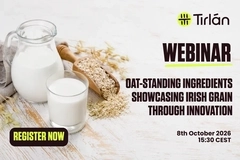
Oat-Standing Ingredients - Showcasing Irish Grain Through Innovation
Tirlán Ingredients

2027 Food Safety Risks for Quality & Compliance Leaders
FoodChain ID

Formulating for function: Developing benefit-led beverages with natural colours, botanicals, and flavours
Givaudan Sense Colour