



Barry Callebaut’s strategic reset: Driving growth in a volatile cocoa market

Key takeaways
- Barry Callebaut resets its strategy with a “Focus for Growth” plan, as it looks to stabilize operations after a volatile period in the cocoa market.
- H1 2025/26 shows lower sales volumes, but improved cash flow, gross profit, and reduced net debt.
- Cocoa price swings, overcapacity, and supply disruptions continue to pressure profitability despite regional growth pockets.

Barry Callebaut CEO Hein Schumacher says there is still significant work to do to strengthen the company following a prolonged period of industry disruption and transformation. Schumacher made the comments as the chocolate and cocoa giant published its half-year results for 2025/26, which show volumes improving in the second quarter, but still down in the first half, alongside strong cash generation and an improved financial position.
Schumacher, the former Unilever boss appointed CEO in January, points to the company’s strong market position and deep expertise, but says action is needed to drive sustained profitable growth and strengthen the organization. The business is navigating a volatile cocoa price environment and pressure on profitability.

“We have significant work to do to strengthen the company after a turbulent period of industry disruption and transformation. We need to restore fundamentals, step up service levels, and empower our regional businesses,” he says.
“In the first half of our fiscal year, cocoa bean prices decreased, which is encouraging for future chocolate market momentum and supported strong free cash flow generation.”
“Yet, the rapid pace of the market decline combined with a competitive overcapacity market, volume declines, and supply disruption impacted EBIT performance, and led us to adjust our profitability outlook, as we prioritize restoring volume and leading the market back to growth.”
Barry Callebaut’s sales performance
Net profit increased 66.1%, driven by lower finance costs and income tax expenses, while strong free cash flow generation reached CHF 801.8 million (~US$0.9 billion).
Barry Callebaut’s sales volumes fell 6.9% to 1,010,247 metric tons in the first half of 2025/26. However, the decline eased in the second quarter to 3.6%, supported by growth in Asia, the Middle East and Africa, and Latin America.
The company reduced its net debt to CHF 3,604.3 million (US$4.61 billion), down from CHF 6,111.6 million (US$7.8 billion) in the prior year, helped by strong cash generation and lower working capital as cocoa prices fell. Gross profit increased to CHF 668.9 million (US$854 million), despite lower volumes, supported by improved conditions in the cocoa market and pricing.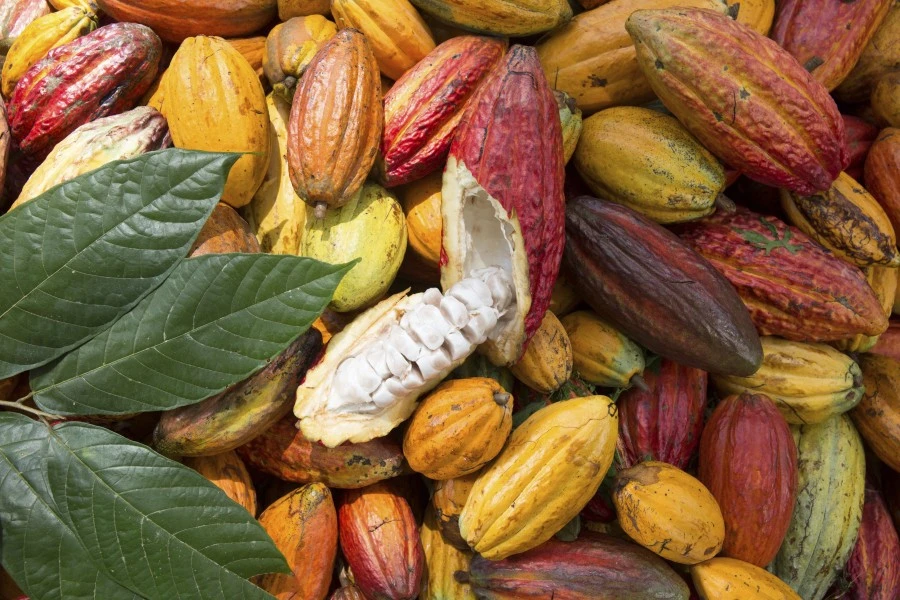 Barry Callebaut welcomes the decline in cocoa bean prices this year, which has supported stronger margins.
Global chocolate volumes fell 5.1%, while Food Manufacturers volumes dropped 5.4% due to weaker demand, changing customer behavior, and supply disruptions in North America. In the Gourmet segment, sales fell by 3.4% due to temporary pricing disadvantages, while cocoa prices were falling, along with some supply disruptions.
Sales revenue amounted to CHF 6,752.2 million, down 3.7% in local currencies (7.3% in CHF), reflecting lower volumes. In the second quarter, cocoa-related pricing turned negative due to the group’s cost-plus pricing model.
Cocoa market disruption
Barry Callebaut’s results come amid ongoing disruption in the cocoa market, with sharp price swings and shifting supply conditions continuing to reshape the industry and weigh on performance.
The sector has been hit in recent years by record cocoa bean prices, weak harvests in key growing regions in West Africa, pests and disease, and extreme weather conditions, such as drought. Cocoa prices peaked at record highs in late 2024 and early 2025 before easing sharply, prompting a wave of interest in alternative cocoa solutions and reformulation strategies.
Cocoa is now trading at roughly US$3,000–3,500 per metric ton, down around 60–75% from the peak of about US$12,000.
In H1 2025/26, cocoa bean prices fell around 61%, which Barry Callebaut says is a positive signal for market stabilization and future recovery through lower input costs and improved industry conditions.
Alternative cocoa innovation
While conventional chocolate still dominates the market, cocoa alternatives and extenders are emerging, as companies look to reduce dependence on volatile raw materials.
In November 2025, Barry Callebaut partnered with Planet A Foods to scale cocoa-free chocolate made using sunflower seeds and fermentation technology, aimed at improving supply chain resilience and expanding sustainable product options. Hein Schumacher, Barry Callebaut CEO.
The company also entered a collaboration with Zurich University of Applied Sciences in July 2025 to research cocoa cell culture technology.
Elsewhere in the industry, Cargill has partnered with Voyage Foods to scale cocoa alternatives, while UK-based Fermtech is developing “Koji Cocoa,” a cocoa extender made from cocoa shells using fermentation.
Mars is also investing in cocoa R&D under its “Cocoa for Generations” strategy, focusing on gene-editing tools, such as CRISPR, to strengthen long-term supply resilience.
Barry Callebaut’s outlook for 2026
Barry Callebaut expects a return to growth in the second half of 2026, but has revised its full-year outlook, forecasting volumes to fall between 1–3%.
The company expects continued volatility, with the outlook subject to potential disruption in the Middle East, and a full update due in June.
“Our immediate priority is to focus commercially, operationally, and organizationally. By focusing our people on impactful initiatives and reinvesting in a customer-centric winning culture, we will stabilize fundamentals, deliver on distinct growth opportunities, and ultimately unlock strong financial performance,” says Schumacher.