Ingredion Q2 results show texture and health solutions outpacing core ingredients


Key takeaways
- Texture & Healthful Solutions volumes rose 7%, marking a ninth consecutive quarter of growth.
- US and Canadian Food & Industrial Ingredients volumes fell 4%, with operational issues at Ingredion’s Argo facility adding pressure.
- The results reinforce Ingredion’s shift toward clean label and formulation-led solutions, including its proposed Tate & Lyle acquisition.
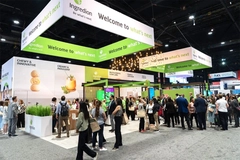
Ingredion’s Texture & Healthful Solutions business recorded its ninth consecutive quarter of sales volume growth, even as softer food and beverage demand and operational disruption weighed on its traditional North American ingredients portfolio.
The company’s Q2 2026 results, released today, suggest that manufacturers are still investing in clean label, texture, and health-oriented formulation, while demand for more traditional, high-volume ingredients remains subdued.
Ingredion’s Texture & Healthful Solutions segment recorded a 7% rise in sales volumes. Net sales increased 5% year over year to US$627 million, while operating income also rose 5% to US$117 million.
The results contrasted with Ingredion’s Food & Industrial Ingredients business in the US and Canada. Volumes fell 4%, net sales declined 7% to US$488 million, and operating income dropped 33% to US$58 million. The segment primarily supplies high-volume starches, sweeteners, and other corn-based products.
Ingredion attributed the weaker performance to lower production at its Argo manufacturing facility in Illinois, US, softer F&B demand, and an unfavorable price mix.
Clean label formulations sustain momentum
Jim Zallie, Ingredion’s chairman, president, and CEO, says the Texture & Healthful Solutions business “delivered its ninth consecutive quarter of broad-based net sales volume growth, driven by continued strong customer demand for our solutions offerings.”
The company highlighted particularly strong growth for its clean label and solutions-based offerings across Europe, the Middle East, Africa, and Asia-Pacific.
The momentum shows that F&B producers continue to prioritize projects addressing label simplification, texture, nutrition, and product performance, even as they remain cautious about broader purchasing volumes.
Ingredion’s specialty business was not immune to pressure. Unfavorable price mix subtracted three percentage points from the segment’s net sales growth, while higher tapioca costs weighed on operating income. Tapioca supply constraints also affected volumes in Asia-Pacific. Ingredion’s Q2 results reveal growth in texture and health solutions, but weaker core ingredient demand.
Tapioca is a starch extracted from cassava root. In clean label formulations, tapioca-based starches can provide texture, stability, and functional performance, while supporting more recognizable ingredient declarations.
Despite those headwinds, the segment’s operating margin edged up to 18.7%, compared with 18.5% a year earlier.
North American volumes remain under pressure
Production rates and yields at Ingredion’s Argo facility improved sequentially, and operations had normalized by the end of the quarter.
However, Ingredion expects full-year operating income for its US and Canadian segment to decline between 20% and 25%, largely because of Argo’s first-half operational difficulties.
By comparison, Texture & Healthful Solutions’ operating income is expected to increase by a mid-to-high single-digit percentage, supported by volume growth, but partly offset by higher input costs.
Latin America delivered mixed results. Net sales rose 3% to US$611 million, supported by foreign exchange movements, but volumes declined 1%, and operating income fell 7% to US$118 million. Ingredion cited weaker demand in Mexico while reporting growth in Brazil’s brewing and industrial markets.
Specialty shift supports Tate & Lyle rationale
The contrast between Ingredion’s segments provides fresh context for its proposed acquisition of Tate & Lyle.
Tate & Lyle shareholders approved Ingredion’s 595-pence-per-share cash offer on July 28. The acquisition implies an enterprise value of about US$5 billion and remains subject to regulatory clearances and court sanctions, with completion expected in the second half of 2027.
The combination would expand Ingredion’s position in texture, sugar reduction, fortification, and other formulation-led categories. Ingredion expects about US$130 million in annual run-rate net cost synergies, fully realized by the end of 2030.
For Ingredion, the deal would increase its exposure to areas of the market showing greater resilience. For customers, it could create a broader ingredient and technical platform for addressing increasingly complex formulation briefs.
Zallie says the combination would “strengthen our ability to help customers solve complex formulation challenges with an expanded innovation engine to accelerate product development.”
The transaction reflects a wider shift toward suppliers that combine ingredient portfolios with application expertise, formulation support, and regional technical capabilities.
Growth comes with margin pressure
At the group level, Ingredion’s net sales rose 1% to US$1.85 billion. Gross profit declined 11% to US$426 million, while gross margin narrowed to 23% from 26%.
Adjusted operating income fell 5% to US$258 million, and adjusted diluted earnings per share decreased to US$2.82 from US$2.87 a year earlier.
Ingredion reaffirmed full-year adjusted earnings guidance of US$10.30 to US$10.90 per share. It expects annual sales to range from flat to low-single-digit growth, with volume gains and favorable currency movements partly offset by weaker price mix and the sale of its majority interest in Pakistan.
The results point to a clear divide, with Ingredion’s US and Canadian Food & Industrial Ingredients segment facing softer volumes and price mix, while Texture & Healthful Solutions continues to grow. They could help explain Ingredion’s push toward more formulation-led capabilities and the strategic importance of its proposed Tate & Lyle acquisition.