




Cleaner labels put ingredient performance to the test at Fi Europe 2026
Key takeaways
- Clean label briefs increasingly combine ingredient removal with added nutritional benefits.
- Preservation, leavening, and fat structure still need to perform when formulations change.
- Application-specific development helps manufacturers manage taste, texture, and shelf life together.

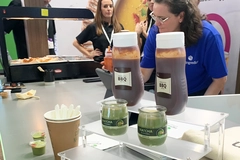 Ingredion’s matcha pudding concept on display at Fi Europe 2026.
A carrageenan-free pudding, a fermented sausage without added nitrates, and bakery ingredients that controlled when dough rose demonstrated different sides of reformulation at Fi Europe 2026. Each addressed the consequences of changing a recipe while asking the finished food to deliver more.
Suppliers at the event in Frankfurt, Germany, last week described customer briefs combining simpler labels, nutritional improvements, and dependable eating quality. Meeting those demands requires understanding the functions of individual ingredients and their interactions during production and storage.
Reformulation demands can extend across the recipe, from sweetness and savory flavor to preservation, gas release, and the structure of a fat.
A broader clean label brief
Scrutiny of ultra-processed foods is adding pressure on manufacturers, according to Daniel Haley, global vice president of texture value enhancement at Ingredion.
He said customers are seeking clean label ingredients alongside higher protein, more fiber, and a familiar eating experience. Those goals could place additional demands on the same formulation.
“You also need to be layering on other benefits,” he told Food Ingredients First.
Ingredion’s showcase included a high-protein plant-based yogurt with a smooth texture, served with a sugar-reduced fruit preparation. Both were described as “clean label.” Also, a matcha pudding illustrated how a combination of ingredients could replace carrageenan.
Haley said the company’s work is expanding beyond its traditional focus on replacing modified starch.
“What else can we take out?” he asked.
Sugar reduction posed a related challenge. Haley pointed to progress in stevia’s taste performance, while emphasizing the need to rebuild texture when sugar was removed. The sweetening ingredient is one part of a formulation that still has to deliver body and an enjoyable experience.
A clean label brief also has to work within the manufacturer’s commercial requirements, including the cost and availability of protein ingredients. Haley said reformulation expertise could help identify other adjustments in the recipe to accommodate nutritional improvements, rather than assessing each new ingredient in isolation.
Sodium reduction needed flavor balance
At Fi Europe 2026, Biolev by Levapan approached sodium reduction through combinations of yeast extracts with different flavor profiles and sodium levels.
Paola Gil Bernal, regional manager for Africa, Europe, and Asia, said umami can add savory depth, but removing salt can still leave a formulation unbalanced.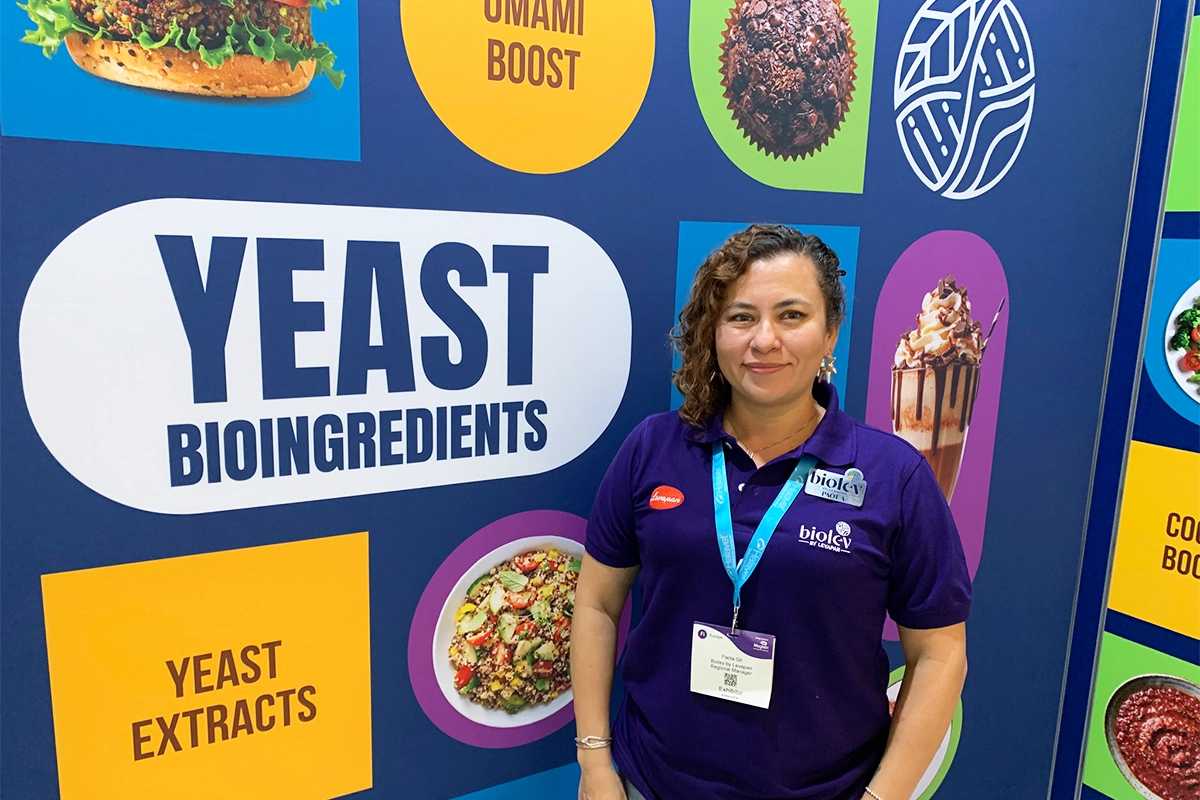 Paola Gil Bernal of Biolev explained how sodium reduction requires careful rebalancing of savory flavor.
“There are certain formulations that lose the punch,” she said.
The company’s work combines higher-umami ingredients with other low-sodium products to round out the flavor profile. Gil Bernal described the outcome as dependent on the recipe, with limits to how much salt can be removed.
Developers have to rebalance the overall flavor profile as sodium comes out. An increase in savory depth does not necessarily restore every aspect of the original taste.
Biolev also works with local technical partners to adapt applications to regional preferences. Gil Bernal said neighboring markets have distinct flavor expectations, making a universal formulation difficult.
Preservation stayed in the brief
In Frankfurt, Brenntag demonstrated a cabanossi concept without added nitrates, using a formulation that included fibers, soy protein, and other plant proteins.
Remedios Marcos, president of nutrition EMEA at Brenntag, said the development challenge covered appearance and storage performance alongside the ingredient list. The task included “keeping the same shelf life, the same texture,” she explained.
Marcos said the company achieved the original product’s shelf life and color in the concept. She also stressed the importance of safety and compliance when responding to nutritional and sensory briefs.
The example placed preservation within the wider formulation discussion. An ingredient change has to be considered against the requirements of the finished food, including its intended distribution and storage. Andrew Hart of Balchem explained how encapsulation delays leavening reactions until bakery products reach the oven.
Balchem illustrated another approach to managing acidification in meat snacks. Its MeatShure encapsulated acids enable direct acidification in place of a fermentation step.
Andrew Hart, director of strategic marketing and business development, said the coating protects the meat texture from the effects of adding acid directly.
“They’re encapsulated, so they don’t damage the meat texture,” he said.
Removing fermentation could also change other parts of the recipe.
“Because you’re not fermenting, you don’t need the starter culture or that sugar source,” Hart explained.
He said that could support no-added-sugar positioning. The process change also frees production time, although its formulation implications extend beyond manufacturing efficiency.
Controlling bakery ingredient reactions
In bakery, Balchem’s BakeShure range addresses preservation, sour flavor profiles, and chemical leavening. Hart explained how encapsulation helps manufacturers introduce preservatives or pH modifiers while protecting the texture and rise expected from the product.
The same control matters for doughs and batters held before baking. If a leavening reaction begins too early, gas can be lost before the product reaches the oven.
With encapsulation, Hart said, “you delay when that leavening reaction occurs until it gets into the oven.”
The approach gives manufacturers more control over production and supports refrigerated- or frozen-to-oven products. Hart connected that performance with consumers wanting the experience of freshly baked food at home.
Preservation has a sensory requirement, too. Bread has to retain the crumb, crust, rise, and appearance people expect while meeting the shelf life needed for distribution and household use. Kirsten Jacke of Hydrosol highlighted the need to manage viscosity during processing and in the finished drink.
Fat reduction changed the structure
Across the show floor, Olenex described a similar interdependence in pastry and confectionery. Lowering saturated fat affected the solid structure and plasticity needed for applications, such as laminated pastry, as well as mouthfeel and flavor release.
Raul Petrut, senior product development manager, explained that a pastry fat has to support separation and lift between layers. It also contributes to how the product feels during eating and how it retains moisture.
He said Olenex could use its specialty fats capabilities to “leverage enzymatic modifications and other ways of structuring liquid oil.”
The aim is to reduce saturated fat while maintaining functionality and sensory performance. Changing the nutritional profile, therefore, requires attention to the physical behavior of the fat throughout the application.
Hydrosol highlighted comparable challenges in fortified beverages. Kirsten Jacke, senior product manager, explained that achieving the right consistency during production did not necessarily mean matching the texture of the finished drink.
“We know how to make sure that you have the right production viscosity, which often isn’t the same viscosity as the viscosity in the final product,” she said.
Heat, homogenization, fermentation, and storage could all affect product performance. Jacke also stressed that hydrocolloid selection had to reflect local market expectations.
“We use the type of hydrocolloids that are accepted and desired in the local markets,” she told Food Ingredients First.
Her explanation returned the discussion to the product’s full journey. A recipe that meets a labeling target still has to perform during processing and storage and deliver the intended eating experience. Manufacturers need to establish those requirements early enough to select ingredients and processing conditions that work together.