


Amazon-backed Circular Grain turns brewer’s waste into high-protein milk alternative


Key takeaways
- Circular Grain develops Tremi, a milk alternative made from brewer’s spent grain.
- Tremi is positioned as a high-protein, reduced-sugar dairy alternative, with the founders claiming it has three times more protein and six times less sugar than conventional oat milk.
- The start-up is part of the Amazon Sustainability Accelerator 2026, which supports companies turning by-products and waste streams into everyday products.?

Food tech company Circular Grain is set to launch Tremi — a nutrient-rich milk alternative made using spent brewer’s grain, a byproduct of beer production often used as animal feed. The innovation will feature alongside nine others at this year’s Amazon Sustainability Accelerator program. The program is focused on upcycling waste products from various industries into new everyday products.
Circular Grain’s solution adds to the growing dairy substitutes category. Milk alternatives are the fastest-growing subcategory, as consumers increasingly choose them for their perceived health benefits. From April 2021 to March 2026, high-protein dairy alternative product launches grew by 5% globally, according to Innova Market Insights.
The company’s founders say that Tremi contains “three times more protein and six times less sugar than conventional oat milk.” It also reduces manufacturers’ dependency on new farmland or imported ingredients.

“The comparison is based on the nutritional analysis of our prototype conducted by independent accredited laboratories from the Technical University of Munich and benchmarked against commercially available oat milk products,” Marina Hijano Moreno, CTO and co-founder of Circular Grain, tells Food Ingredients First.
“Since nutritional values vary between brands, we intentionally refer to ‘oat milk’ as a category rather than comparing ourselves with a specific product.”
The launch of its nutritious milk substitute is slated for September this year. Initially, the Tremi Original and Tremi Barista varieties will be available in the greater Munich area (Germany) in cafés, retailers, and tasting events.
Turning brewer’s spent grain into better-tasting food
Brewer’s spent grain is a particularly challenging raw material, Hijano Moreno tells us.
 Nathalie Stellwag, Marina Hijano Moreno, and Denise Ilogu founded Circular Grain to turn brewer’s spent grain into a nutritious food ingredient.“Besides its short shelf life, most of the sugars have already been extracted during brewing, while the remaining cell wall components contain phenolic compounds that can lead to a very bitter taste.”
Developing a product with a pleasant flavor, smooth texture and good nutritional profile required balancing all of these factors. “It took us more than two years and over 200 prototype iterations to reach our current formulation,” she adds.
Circularity drives milk alternatives
Milk substitutes are needed to diversify the dairy aisle with products that can meet demand for plant-based, reduced-sugar, high-protein, and more resource-efficient options.
Tremi can be used similarly to other plant-based drinks, says Hijano Moreno. “It is suitable for direct consumption, baking and cooking, and performs particularly well when foamed, making it well suited for coffee applications.”
Circular Grain’s Tremi adds a circular economy angle by using the brewer’s spent grain instead of relying on newly grown crops or imported raw materials.
It utilizes an existing raw material stream to follow a circular approach to food production. The milk substitute leaves a “potentially smaller carbon footprint,” notes the company.
Hijano Moreno explains that in general, one of the biggest technical challenges with brewer's spent grain is that it is highly unstable and can begin to spoil within hours after brewing.
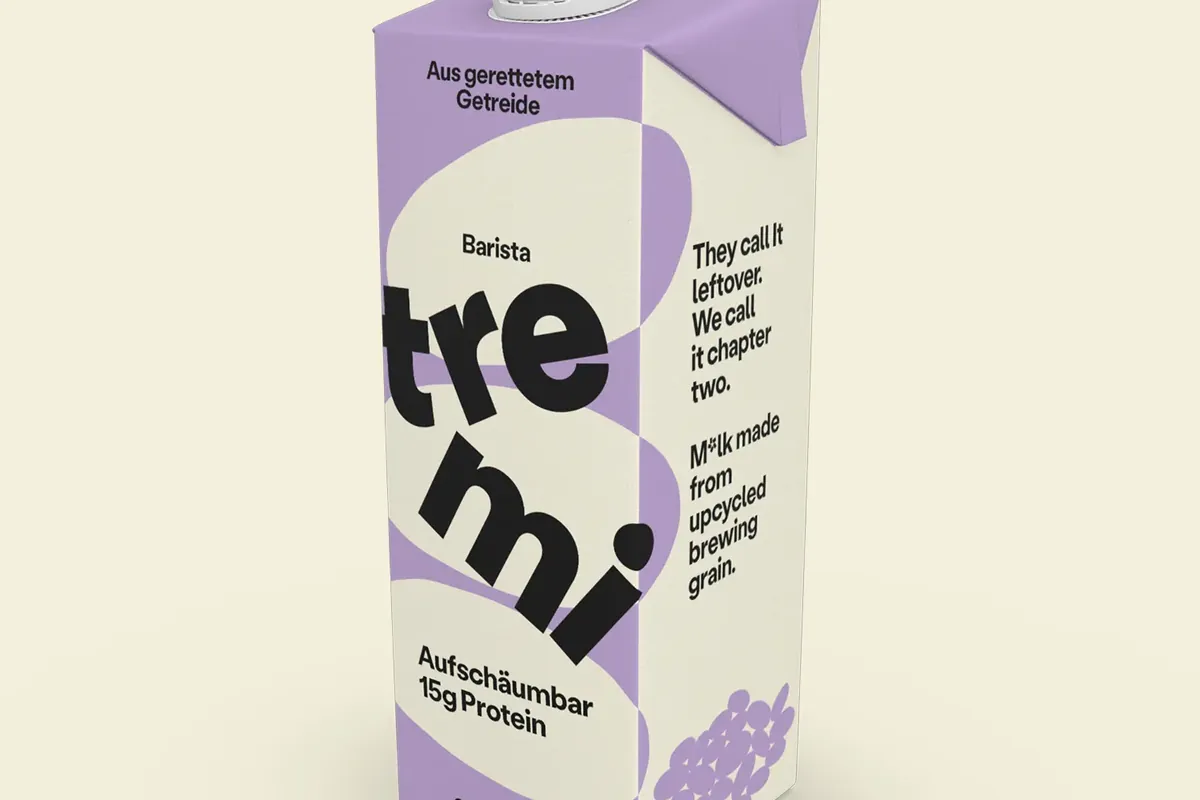 Tremi Barista milk substitute contains 15 g of protein, calcium, B12, B2, D3, and no sugar (Image credit: Circular Grain).“Many existing approaches rely on energy-intensive stabilization steps, such as drying. Our process was specifically developed to avoid these costly interventions, while working directly with the fresh material, making the approach more resource-efficient and better suited for large-scale production.”
Amazon Sustainability Accelerator
Nathalie Stellwag, Marina Hijano Moreno, and Denise Ilogu founded Circular Grain as a student project the Technical University of Munich. Their aim was to make the valuable nutrients in spent grain available for human consumption.
This was followed by product tastings with 1,500 participants and over 250 iterations over the past two years. The company also secured over €500,000 (US$571,000) in funding through grants and angel investments.
The company is participating in this year’s Amazon Sustainability Accelerator in 2026 alongside Wasted ApS (Copenhagen, Denmark), which upcycles surplus bread to develop pasta, BRØL (Copenhagen, Denmark), which transforms wheat bran into beer, and Coffee Based (Gorinchem, Netherlands), which turns coffee waste into reusable cups.
The initiative supports young companies in establishing more sustainable products and offers them technical support to scale their businesses with Amazon’s guidance.
“Whether it’s bread, coffee grounds, or grain, each of these companies creates a new product from waste materials. Waste is seen not as a problem, but as a resource. This shift in perspective excites us,” says Xavier Flamand, responsible for Amazon’s selling partners in Europe.


Upcoming webinars
Oat-Standing Ingredients - Showcasing Irish Grain Through Innovation
Tirlán Ingredients

2027 Food Safety Risks for Quality & Compliance Leaders
FoodChain ID

Formulating for function: Developing benefit-led beverages with natural colours, botanicals, and flavours
Givaudan Sense Colour