


CO₂ to protein: Novonesis and DTU drive sustainable food innovation

Key takeaways
- BRIGHT-Novonesis collaboration to engineer microbes that convert waste CO2 into sustainable protein for industry-level microbial food production.
- BRIGHT Biofoundry will optimize yeast strains for acetate-based fermentation to address key challenges in the CO2-to-protein conversion process.
- The partnership focuses on making CO2-derived proteins economically viable and advancing circular food production systems.
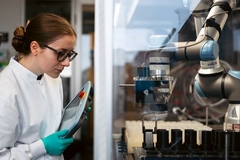 Martina Fricano from BRIGHT with one of the robots used in adaptive laboratory evolution by the organization (Image credit: Daniel Rasmussen).
BRIGHT at the Technical University of Denmark (DTU) and Novonesis have teamed up to engineer microbes that convert waste CO₂ into nutritious and sustainable protein at an industrial scale.
The collaboration is positioned as a “blueprint for circular bioeconomy,” as BRIGHT’s evolutionary research combines with Novonesis’ industry expertise to explore cost-effective and sustainable microbial food production.
The Novo Nordisk Foundation Biotechnology Research Institute for the Green Transition (BRIGHT) is a science innovation hub based at DTU, focused on sustainable materials, microbial foods, and microorganisms for net-zero agriculture.
Researchers at BRIGHT will use engineering techniques to optimize yeast strains for better microbial production on acetate, tackling challenges in the “CO₂-to-protein” conversion process. The initiative aims to enhance the microbes’ tolerance to acetate, speed up consumption rates, and boost protein yields, while reducing fermentation times and costs.

Food Ingredients First speaks with Carsten Hjort, senior science director for Production Strain Technology at Novonesis, and Adam Feist, professor of Bioengineering at the University of California, San Diego, and head of the Adaptive Laboratory Evolution team at BRIGHT. They discuss the commercial viability of CO₂-derived proteins and their role in advancing the food industry’s sustainability goals.
 Adam Feist: BRIGHT is exploring new partnerships to demonstrate the scalability of its microbial food production solutions.“CO₂-derived protein represents a renewable and flexible production platform independent of traditional agriculture. This enables more resilient, geographically adaptable food systems and offers a pathway to strengthening global food security,” says Feist.
The collaboration directly supports BRIGHT’s mission to develop “efficient, safe, and nutritious” microbial food solutions. “By partnering with Novonesis, we can translate and apply our platform technologies into scalable, real-world applications with meaningful impact,” Feist says.
Food proteins from CO₂
BRIGHT’s technology complements Novonesis’ existing “cell factory toolbox,” Hjort explains.
“Since 1986, Novonesis has continually developed recombinant cell factories for the production of enzymes, using glucose and other carbohydrates as the carbon source. Enzymes are proteins, and since cell factories are platform technologies that can express essentially any enzyme, they are also capable of producing a wide range of food proteins.”
However, he adds that glucose/carbohydrates as a carbon source differs from using acetic acid. “Not only do they enter the metabolism at very different pathways, but acetic acid is also toxic to the cells,” he says.
Hjort emphasizes that Novonesis’ metabolic engineering experience and mutagenesis technologies can help develop “rewired cell factories” that can utilize acetic acid as efficiently as glucose, while removing acetic acid’s toxic effects.
Scaling microbial food proteins
Describing CO₂-based proteins as a “long-haul effort,” Hjort says various conditions are needed to achieve industrial-level production.
“Technical feasibility is the first thing to consider: is it realistic to produce protein from acetic acid with the same efficiency as from glucose? Being more than two years into the Acetate project, we believe that the answer is yes. While we are not there yet, we have made significant progress and have a roadmap for continued cell factory development.”
He points to the need for acetic acid production from “only CO₂ and energy,” adding that the team has made progress in this space.
BRIGHT accelerates this CO₂-based protein production process by enabling “faster strain optimization” through its unique technological assets, such as automated, high-throughput adaptive laboratory evolution (ALE).
“This allows partners to rapidly generate and select improved strains at scale that would be difficult to replicate on their own at partner sites. This significantly shortens development timelines.”
However, the team faced challenges feeding microbes with acetate, as they are not optimized to “efficiently consume it at maximum capacity” due to their evolutionary adaptations to varying environments, Feist explains. BRIGHT addressed this issue by using ALE to identify the naturally occurring mutations that enhance industrial acetate utilization.
Advancing circular proteins
CO₂ proteins can offer manufacturers an “economically viable setup” if they close the price gap compared to traditional plant-and animal-based proteins, and through technological progress and the shift toward green transition, says Hjort.
 CO₂-based proteins require technical feasibility to produce protein from acetic acid as efficiently as from glucose at an industrial scale, says Carsten Hjort.However, this will depend on bringing production costs “on par with prices for other protein sources like plants or whey.”
“Regarding sustainability, the key argument for acetate-based precision fermentation is that it enables a circular carbon economy with no- or low-net GHG emissions.”
“Based on current process simulations, we can reduce the GHG emission with a factor of 10–100, the land use with a factor of 100–1,000, and the water usage with a factor of 10–200 compared to current protein sources.”
Shaping the future of CO₂ proteins
BRIGHT plans to continue advancements in its automated strain engineering platforms to further increase the speed, efficiency, and scale of CO₂ protein production.
“At the same time, we are expanding into new use cases and partnerships to demonstrate the scalability and industrial relevance of our approaches for solving challenges in viable microbial food production,” says Feist.
Hjort says that BRIGHT’s adaptive evolution platform will help Novonesis develop faster-growing strains with a higher protein yield and better robustness toward acetic acid.
“All these things will have a very direct impact on the production costs for the future process as well as the environmental performance,” he concludes.