


Tetra Pak launches first industrial bioreactor for fermentation-derived ingredients

Key takeaways
- Tetra Pak launches its first industrial bioreactor, the Bioreactor RF, for fermentation-derived food ingredients and new food production.
- The company says the system can cut operating costs by up to 12% and investment costs by up to 8%.
- Available from 10 to 50,000 liters, the bioreactor uses a consistent platform to help producers scale from pilot runs to full industrial production.
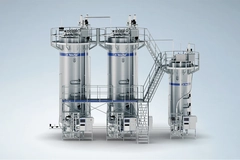 Tetra Pak’s Bioreactor RF.
Tetra Pak has launched its first industrial bioreactor. The move expands the company’s fermentation equipment portfolio, as food and ingredient manufacturers move from pilot-scale development to commercial production.
The Tetra Pak Bioreactor RF is designed for producers of fermentation-derived ingredients and new food products, including applications using yeast, bacteria, and fungi to convert raw materials into food ingredients. The launch follows Tetra Pak’s acquisition of Bioreactors.net in December 2025.
Tetra Pak says the system can help reduce operating costs by up to 12% by improving process stability, reducing contamination risk, and simplifying day-to-day operations.

Targeting the scale-up challenge
As fermentation-based ingredients companies scale production, equipment reliability, process repeatability, and operator workload are becoming critical concerns. Tetra Pak says the Bioreactor RF is designed to support stable conditions from pilot validation and first industrial runs through to full-scale manufacturing.
“Industrial fermentation succeeds when performance is repeatable, day after day,” says Rafael Barros, director of the new food business stream at Tetra Pak. “Tetra Pak Bioreactor RF is designed to reduce operational risk and remove complexity, helping operators stay in control.”
The bioreactor is preassembled and factory-tested to support faster installation and commissioning. Its integrated platform design removes the need for separate support structures. Tetra Pak says this can help reduce investment costs by up to 8% compared with conventional industrial bioreactors.
Magnetic agitation aims to reduce contamination risk
At the center of the system is a patented magnetic agitation technology that removes the need for mechanical seals, which can be a source of contamination risk and process instability in conventional designs.
Tetra Pak says its magnetic agitation system is designed to maintain power and oxygen transfer across the full size range, addressing a common scale-up limitation in traditional magnetic agitators. The company says this can help stabilize process conditions and lower the risk of batch loss, which it values at about €1,000 (US$1,142) per cubic meter.
The system also includes self-adjusting control functions, predefined operating strategies, and integrated data monitoring to help operators respond as processes evolve. The product page notes features including self-tuning control loops, integrated mass balance, OPC UA (Open Platform Communications Unified Architecture) connectivity, and event logging for process analysis and data extraction.
Built for multiple production scales
The Bioreactor RF is available in sizes from 10 to 50,000 liters, with larger vessels available on request. Tetra Pak says each unit uses the same design platform, control logic, and operating philosophy, allowing producers to simplify training and standardize operation across sites and production scales.
The modular configuration allows users to adapt alarm thresholds, impellers, and other settings as process requirements change. Optional features include an easy-open upgrade for access to impellers and baffle configurations, as well as a dual exhaust option designed to keep production running if a filter becomes clogged.
The launch broadens Tetra Pak’s role in industrial fermentation as ingredient producers look for systems that combine scale, operational efficiency, and reduced process variability.
Tetra Pak recently released its latest sustainability report, highlighting significant strides in reducing GHG emissions across its operations and global value chain, while reinforcing food system resilience.



Upcoming webinars

2027 Food Safety Risks for Quality & Compliance Leaders
FoodChain ID

Formulating for function: Developing benefit-led beverages with natural colours, botanicals, and flavours
Givaudan Sense Colour
Let's reveal the grain potential: Innovate
Meurens Natural