



Hershey profitability rebounds as higher prices pressure confectionery demand


Key takeaways
- Lower commodity costs, pricing, and productivity gains lifted Hershey’s margins in Q2 2026.
- Sharp volume declines indicate that higher prices could be weighing on confectionery demand.
- Ingredient suppliers have opportunities to support affordability through cost-efficient formulations, sourcing, and processing improvements.

Lower commodity costs, pricing, and productivity gains helped rebuild Hershey’s profitability in the second quarter of 2026. However, steep volume declines underline the pressure on chocolate manufacturers to balance ingredient costs with consumer affordability.
Hershey’s adjusted gross margin reached 41.6% in the second quarter, up 350 basis points from last year and 120 basis points from the first quarter. The growth was supported by lower net commodity costs, price increases, and supply chain productivity savings.
The improvement signals some relief after a period of intense raw material volatility. Hershey entered 2026 under significant pressure after fourth-quarter net income fell 59.9% to US$320 million, despite a 7% sales increase.
The American confectionery and snacks company’s latest results show the limits of passing higher input costs to consumers. Hershey recorded approximately 12 percentage points of organic price realization across the business, while volume and mix declined by about 8 percentage points.
The divergence was even more pronounced in North American confectionery, where pricing contributed roughly 14 percentage points, and volume fell approximately 10 percentage points. Hershey attributed the decline to price elasticity and normal quarter-to-quarter shipment variability, partially offset by retailer inventory replenishment.
Hershey’s results reflect a trend seen elsewhere in the industry. Barry Callebaut similarly reported higher gross profit and recurring net profit despite lower sales volumes, although recurring operating profit declined. By contrast, Mondelēz and Nestlé reported positive company-wide volume and mix growth in their latest results.
Commodity relief requires cautious interpretation
Hershey said lower net commodity costs contributed to its margin expansion, but it did not provide a breakdown for cocoa, sugar, dairy, nuts, or other key inputs.
The results, therefore, should not be interpreted as evidence that cocoa cost pressure has fully subsided. Commodity hedging, purchasing cycles, inventory timing, and contract structures can delay or reshape how market movements appear in quarterly financial statements.
Hershey also said that its reported gross margin benefited from commodity derivative mark-to-market gains. The company excludes these gains and losses from adjusted results until the related inventory is sold, meaning reported and adjusted performance may reflect commodity movements differently.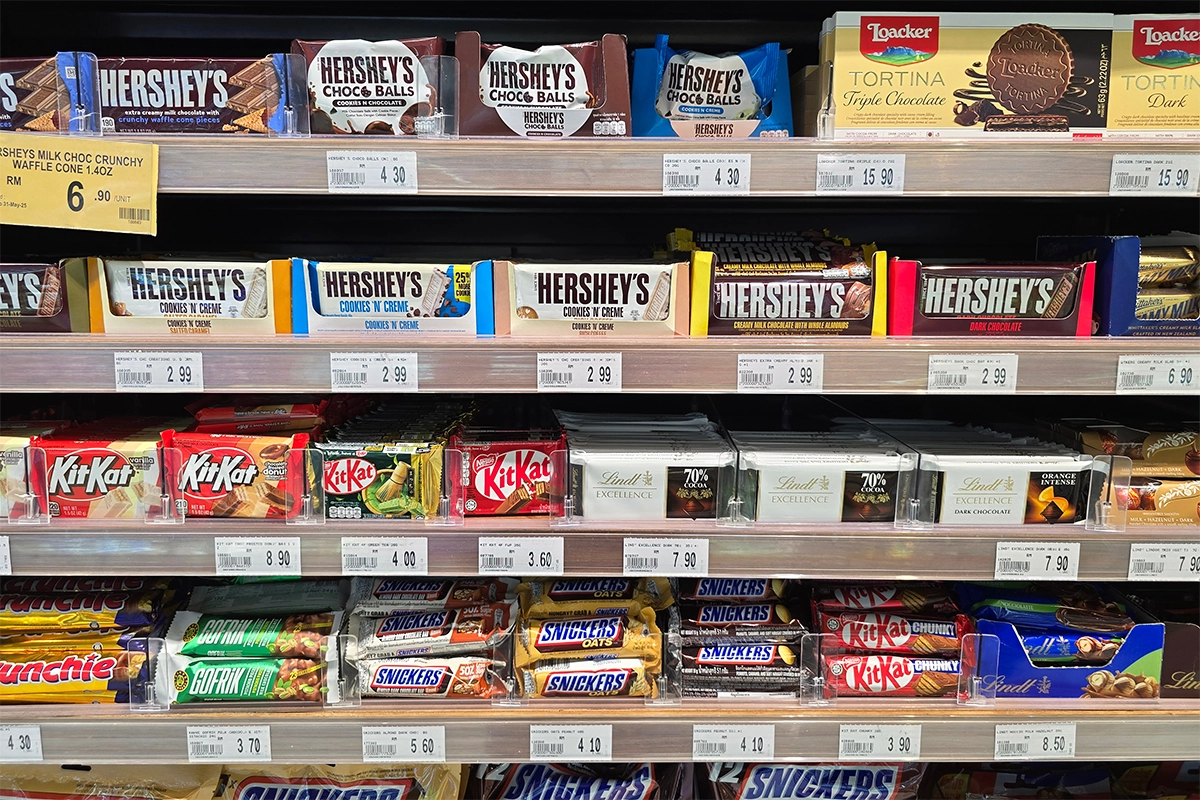 Hershey’s margins rose as higher prices weighed on volumes.
Affordability drives formulation priorities
The size of Hershey’s price-led volume decline is likely to intensify demand for ingredient technologies that preserve indulgence while reducing cost.
Chocolate manufacturers may increasingly evaluate cocoa-efficient flavor systems, compound coatings, inclusions, fillings, and texture solutions that deliver a strong sensory experience with lower exposure to high-cost ingredients. Portion size, pack architecture, and product format will also remain important tools for maintaining accessible consumer price points.
Reformulation requires careful execution. Reducing cocoa content or replacing traditional ingredients can affect flavor release, mouthfeel, melting behavior, and appearance. Ingredient suppliers that can demonstrate cost savings without compromising recognizable chocolate quality may gain a stronger role in innovation pipelines.
The challenge extends beyond cocoa. Sugar, milk ingredients, fats, emulsifiers, nuts, packaging, and energy costs all influence the final economics of confectionery production.
Productivity becomes a second margin lever
Hershey’s results also demonstrate that commodity purchasing alone cannot resolve profitability pressure. Supply chain productivity and transformation savings contributed to the confectionery margin improvement, while the company expects to generate about US$100 million in 2026 savings through its Agility & Automation initiative.
This focus creates opportunities for ingredient systems that improve processing efficiency, reduce waste, increase yield, and simplify production.
Manufacturers may favor ingredients that perform consistently across multiple lines, support faster changeovers, extend shelf life, or reduce formulation complexity.
A fragile recovery
Hershey’s profitability recovery shows that pricing, lower commodity costs, and operational savings can offset some of the pressure facing confectionery manufacturers.
However, the accompanying volume declines indicate that higher prices are weighing on demand, although shipment variability also affected North American confectionery volumes.
For the ingredients industry, the central challenge is helping manufacturers rebuild the affordability of indulgence while maintaining product quality, brand equity, and margins.