



Fermentation emerges as key flavor lever for premium Australian cocoa


Key takeaways
- University of Queensland research found that fermentation driven by naturally occurring microbes has a greater influence on Australian cocoa flavor than the cocoa variety or growing location.
- Understanding Australia’s unique fermentation environment could help producers create distinctive flavor profiles and strengthen the country’s position in the premium chocolate market.
- The findings support efforts to position Australian cocoa as a high-value specialty product, where quality and flavor differentiation are more important than competing on volume or price.
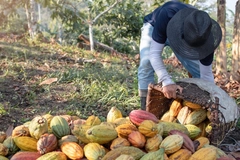
Research from the University of Queensland (UQ) suggests Australia’s unique cocoa fermentation environments could help local chocolate producers develop more distinctive flavor profiles and strengthen their position in the premium chocolate market.
The researchers found that the fermentation environment, which is driven by naturally occurring microbes, may have a greater influence on the flavor of Australian-grown cocoa than either the cocoa variety or where the trees are grown.
The findings provide new scientific evidence for an idea that many premium chocolate makers have long suspected: that careful management of fermentation is central to producing distinctive, high-quality chocolate.
The study examined cocoa beans from three growing regions: Fishery Falls, Shannonvale, and Mount Etna.
Microbes shape flavor
Dr. Marlize Bekker, senior lecturer in Food Chemistry in the School of Agriculture and Food Sustainability at UQ, compared the aroma, flavor, and chemical composition of cocoa nibs to better understand the factors shaping chocolate flavor.
“We had different types of cocoa trees, and we thought that would have a big impact on the flavor, but the tree’s genotype had a much smaller role to play than the fermentation process itself,” she says.
“Whatever is in the environment drives the natural fermentation; nothing is introduced, and we know it is critically important for flavor and quality.”
Fermentation is one of the most important post-harvest stages in cocoa production. After cocoa pods are harvested, the beans are fermented for several days, allowing naturally occurring yeasts, bacteria, and other microorganisms to break down sugars in the pulp surrounding the beans.
Science behind fermentation
This process generates flavor precursors that are later developed during roasting, playing a major role in the finished chocolate’s aroma and taste.
While the role of fermentation has long been recognized within the chocolate industry, UQ’s findings suggest the local microbial communities present at individual fermentation sites may have an even greater influence than previously understood.
Dr. Bekker says understanding those microbial interactions could allow producers to better manage flavor development.
“Cocoa can display a remarkable diversity of flavor characteristics, ranging from classic chocolate and roasted notes to buttery and even tropical aromas,” she says.
“By understanding Australia’s unique fermentation environment, we can intervene during the process and start to direct those flavor profiles.”
A premium positioning strategy
The research paper, published in ScienceDirect, comes at a time when premiumization continues to shape global chocolate markets.
Australia remains a relatively small cocoa producer compared with major growing nations such as Côte d’Ivoire, Ghana, Ecuador, and Indonesia, making it unlikely to compete on volume.
Instead, industry stakeholders increasingly see opportunities in producing higher-value specialty chocolate where origin, flavor differentiation, and production methods can justify a premium position.
Dr. Bekker also highlights that positioning is central to the industry’s future.
“This is a preliminary study, and we are hoping to do more work, so we can position Australia on the world stage and show the unique characteristics Australia has,” she says.
“We don’t want to compete with the mass-produced chocolates — it is about positioning Australia as a premium unique market.”
Cocoa disruptions
The findings also arrive after several years of unprecedented disruption across the global cocoa supply chain. Cocoa prices reached record highs during 2024 after poor harvests in West Africa — which produces roughly 70% of the world’s cocoa — driven by adverse weather, aging tree stocks, and crop disease.
Although cocoa futures have eased from those historic peaks during 2025 and into 2026 as supply expectations improved, prices remain well above long-term averages, continuing to pressure manufacturers, ingredient suppliers, and retailers.
For smaller producers, particularly those focused on premium products rather than commodity volumes, improving consistency and creating distinctive flavor profiles may prove more commercially significant than attempting to compete on price alone.
Meanwhile, food innovators have been developing cocoa alternatives to mitigate high prices and supply chain disruptions. Some examples include Puratos, via its venture arm Sparkalis, investing in cultured cocoa with California Cultured to future-proof chocolate, Foreverland raising €6 million (US$7 million) to scale its Choruba line, and Barry Callebaut opening a global innovation center in Singapore, featuring the “world’s first” AI center of excellence for chocolate.
Chris Janke, president of the Cocoa Association of Australia, says Australia’s economy makes premium positioning essential.
“In Australia, we have high labor costs compared to where most cocoa is grown in West Africa, so we are focused on an absolute premium product,” he says.
“In order to have a premium product you must control the processes very tightly and understand the likely outcomes.”
The study confirmed that the mix of microflora present at a location influences the fermentation, which is a key part of flavor development.
The UQ researchers stress that their work remains at an early stage. Having identified aroma compounds associated with particular flavor characteristics, the next phase will focus on linking those compounds to sensory evaluation and identifying the specific microorganisms responsible.