



AI enters the food lab: The rise of predictive ingredient development


Key takeaways
- AI is becoming a practical tool for food and beverage R&D, helping teams research, formulate, test, and refine products faster.
- Its biggest value lies in narrowing options, predicting ingredient behavior, and connecting consumer, safety, sustainability, and formulation data.
- Human expertise remains essential because taste, manufacturing performance, regulation, and trust still require real-world validation.

Artificial intelligence has moved beyond brainstorming and into the working infrastructure of F&B innovation. Ingredient suppliers, product developers, and major brands are using specialized systems to organize research, model formulations, predict ingredient behavior, interpret consumer signals, and reduce physical trials before commercialization.
Before reaching the bench, developers can use AI to eliminate obvious dead ends, compare competing constraints, and decide which formulations are worth testing.
Still, food must ultimately be tasted, processed, manufactured, regulated, and trusted. The technology is not replacing food scientists. It is helping them decide what to test, what to discard, and where to focus their expertise.
A faster route from question to experiment
Early-stage research is one of the most accessible applications. Food developers must connect information on ingredients, nutrition, consumer behavior, regulations, culture, and technical feasibility before a formulation can take shape.
Mattson’s MattsonIQ is designed to shorten that process by giving food professionals structured, industry-specific responses rather than generic search results. Steve Gundrum, Mattson’s chief AI officer, describes AI as a “24/7 thought partner” for expanding an innovation team’s creative and technical reach.
Ingredion is applying that approach directly to ingredient selection through Ask Ingredion. A developer can begin with a practical challenge, such as replacing an ingredient, meeting a clean label target, lowering cost, or achieving a particular texture. The assistant asks about the application, processing conditions, and required functionality before presenting options that can be compared, sampled, or discussed with a technical expert.
The handoff from digital guidance to physical testing is essential. Chris Regan, head of Ingredion’s Digital Marketing Center of Excellence, says “no problem is solved by AI alone in this space.” The tool is intended to speed the route to a pilot or side-by-side trial, not declare a finished answer.
From recipe generation to formulation intelligence
The next stage is more ambitious: using AI to reason across the constraints that make food formulation difficult.
TraceGains’ Formula AI allows scientists to generate candidate formulas, compare variants, explore substitutions, and preserve the reasoning behind changes. Its recommendations can account for cost, nutrition, allergens, sourcing, claims, regulation, and ingredient functionality. John Thorpe, TraceGains’ senior director of product management, says the objective is “not just producing a recipe,” but helping scientists understand the formulation logic behind a recommendation.
A plausible ingredient list is not the same as a manufacturable product. Sugar reduction may affect texture and preservation, while a new protein may change viscosity, flavor release, or processing tolerance. AI’s value lies in considering more of those relationships before teams commit time and materials.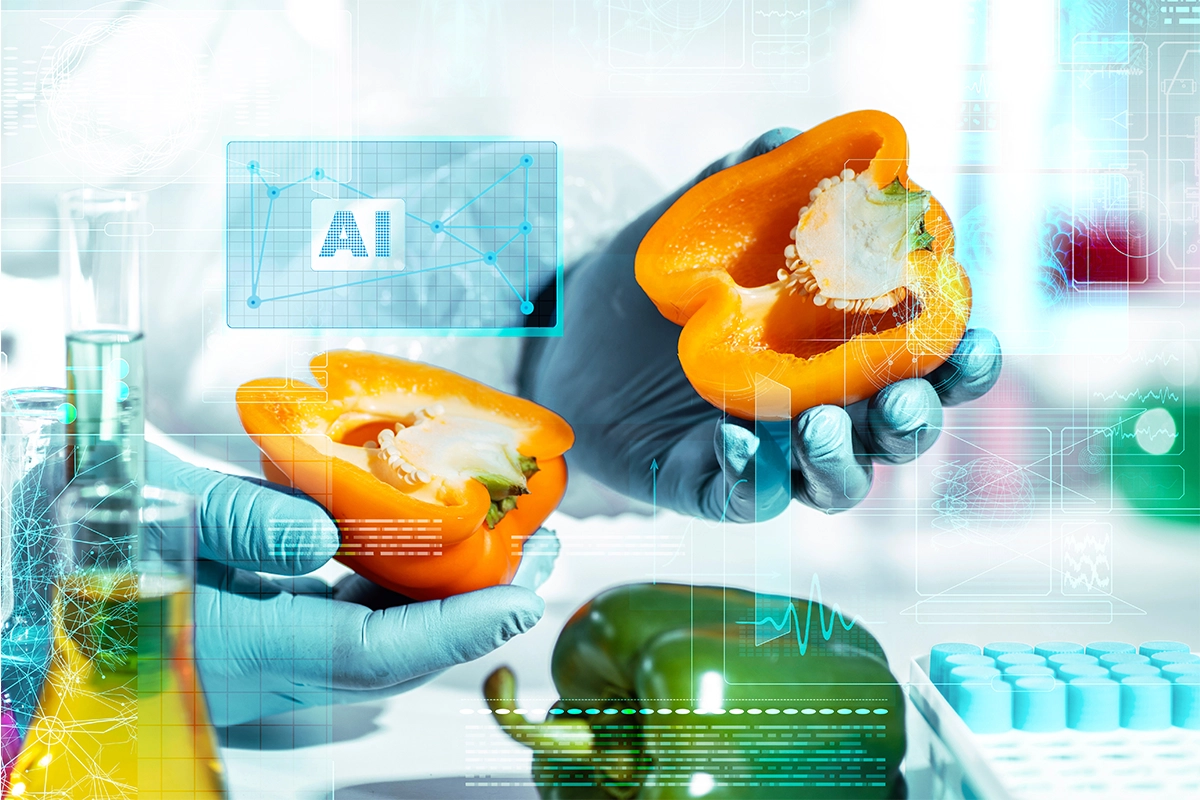 AI is helping food scientists narrow formulation options before products reach the test bench.
Corbion and IFF are also using AI to connect complex datasets with formulation decisions. In our special report on AI-driven ingredient innovation, Corbion project management director Symone Kok says the technology can model interacting variables that conventional development would test sequentially. Her summary is also a useful rule for the sector: “This does not replace deep scientific expertise — it amplifies it.”
IFF is embedding AI across insight development, concept creation, testing, validation, and supply. The company uses consumer and market signals to identify emerging demand, then links those insights more directly to formulation. Instead of sitting in a trend report, those signals can now feed directly into formulation decisions.
Taste and texture remain the decisive test
Alternative proteins show both the promise of predictive development and the difficulty of applying it to food.
Food System Innovations’ Food Intelligence Lab is combining trained sensory-panel results with instrumental measurements, including texture profile analysis, pH, shear tests, and molecular composition data. The goal is to build models that can predict how closely sustainable protein products resemble animal-based benchmarks.
Anna Thomas, the lab’s director of machine learning, frames food design as an “optimization problem,” balancing consumer liking against constraints, such as cost and nutrition. In early tests involving two plant-based dairy categories, the lab reported that expert-guided optimization improved sensory satisfaction over one week.
Yet the project also shows why general-purpose AI is insufficient. Human perception is contextual and difficult to reduce to ingredient lists or laboratory measurements. Thomas says “specialized AI models could efficiently screen formulations,” but sensory panels will remain central to determining whether consumers actually like a product. The near-term gain is not eliminating sensory work. It is reserving expensive human evaluation for stronger candidates.
A collaboration between True Nexus and quantum computing company Pasqal is attacking the related problem of protein functionality. Their protein-modeling project aims to predict how proteins gel, bind water, emulsify, foam, thicken, and behave under industrial conditions.
True Nexus CEO Dominik Grabinski calls functionality “one of the most critical frontiers in food innovation.” Proteins are not interchangeable commodities, and their performance depends on source, extraction method, purity, concentration, pH, temperature, shear, and the surrounding formulation. Better models could move development from repeated substitution toward designing ingredients for a defined functional outcome.
AI reaches beyond the laboratory
AI is also connecting product development with sustainability, safety, and consumer discovery.
Corbion is using predictive modeling to simulate microbial growth under production conditions, allowing manufacturers to assess Listeria risk and adjust formulations before problems arise. The company argues that avoiding a recall is both a safety and sustainability outcome because it prevents waste. IFF is integrating supplier, benchmark, public, and internal data to estimate the carbon impact of flavor formulations while preserving performance. Predictive tools can speed ingredient development, but taste, safety, and performance still require human validation.
Downstream, Unilever is using AI to accelerate recipe development and improve how products appear in AI-generated recommendations. Digital simulation helped the company identify promising ingredient combinations for Knorr’s Fast & Flavourful Paste before physical trials, cutting development time in half.
AI-powered search is also influencing which recipes and brands consumers encounter. Olivia Kirby, director of integrated demand generation at Unilever Foods, says, “AI is changing discoverability by raising the bar on how we show up.” Brands now need content that is useful to people and structured clearly enough for large language models and recommendation systems to interpret.
The same systems identifying consumer demand may soon influence both what gets formulated and which finished products consumers see. That connection may speed innovation, but it also gives opaque algorithms more influence over what is developed and discovered.
Trust is the final ingredient
The need for verification extends beyond product development. Food Alert has warned of AI-fabricated food complaints, including manipulated images of contamination or undercooking and highly structured complaint letters intended to trigger refunds or regulatory concern.
Technical director Annabel Kyle tells us that “the barrier to creating a highly convincing food image has plummeted.” The example is outside formulation, but it illustrates the broader governance challenge. When AI can generate convincing recommendations, evidence, and narratives, companies need reliable source data, preserved decision records, clear accountability, and people capable of identifying when an output does not fit reality.
AI is becoming part of the food industry’s innovation infrastructure, but adoption alone will not create a durable advantage. The strongest systems will combine proprietary, food-specific data with explainable recommendations, physical validation, and experienced scientific judgment.
Generating a recipe is the easy part. The harder test is whether AI can help produce food that survives the bench, the factory, regulatory review, and, ultimately, the consumer.