


Deep-tech firms apply quantum computing and AI to transform alt-protein texture

Key takeaways
- Pasqal and True Nexus partner to use quantum computing and AI to improve protein functionality modeling for replicating gelatin and texture in alternative proteins.
- The collaboration aims to develop a predictable, scalable approach for creating proteins that match the functional properties of animal-based ingredients.
- The goal is to help food manufacturers overcome challenges in alternative protein texture and accelerate the development of sustainable, functional proteins for the food industry.
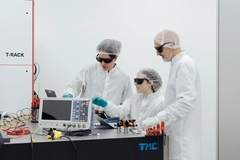 The Pasqal team monitoring optics and laser systems (Image credit: AgenceOblique/CyrilMarcilhacy).
Saudi-based AI computational intelligence company True Nexus has partnered with quantum computing firm Pasqal to solve a major challenge in the alternative protein and food industry — accurately modeling and predicting protein functionality. The collaboration aims to address challenges in gelatin, texture, and overall protein behavior in complex food products.
Challenges in consistently replicating animal-protein functionality have been a significant barrier to the adoption of alternative proteins, according to the companies, which are developing a dynamic 3D model of protein gelation. The model integrates data on protein extraction, molecular structure, processing conditions, and end-use application requirements to optimize protein functionality for food industry applications.
While Pasqal will use its quantum computing technology, True Nexus’ AI-driven computational intelligence will offer innovators accurate simulations and real-world applications of protein behavior in food systems.

The long-term goal is to help food and ingredient companies provide a “reference model” to guide seed development, crop optimization, and precision fermentation to overcome challenges posed by existing proteins.
Speaking to Food Ingredients First, True Nexus CEO Dominik Grabinski describes protein functionality as “one of the most critical frontiers in food innovation,” highlighting that the industry’s main limitation is no longer simply access to protein, but to the right functionality.
“Over the last two decades, major investment has gone into alternative proteins, yet many products still struggle to match the texture, stability, processability, and eating experience delivered by animal-based ingredients,” he says.
Why focus on protein functionality?
Grabinski attributes these hurdles to proteins not being interchangeable commodities.
 Dominik Grabinski: Despite two decades of investment, many alternative proteins still cannot match the texture, stability, and eating experience of animal-based ingredients.“Their value in food comes from how they behave under real industrial conditions — how they gel, bind water, emulsify, foam, thicken, or interact with other ingredients during processing. If you cannot predict and control those functionalities, you cannot reliably create products that meet consumer expectations,” he explains.
“This is why protein functionality design matters so much now. It is the key to moving the industry from trial-and-error substitution toward the rational creation of ingredients and formulations fit for purpose.”
Replicating animal‑derived gelatin
Innova Market Insights’ research suggests that gelatin faces obstacles because it is animal‑derived, leading manufacturers to invest in vegetarian or vegan alternatives.
The True Nexus and Pasqal collaboration addresses long-standing challenges in replacing gelatin and other protein functionalities in products like gummy bears. “Even in something as familiar as a gummy candy, gelatin delivers a highly specific combination of properties — gel strength, elasticity, bite, water management, thermal behavior, and stability over time. Reproducing all of that at once with alternative proteins is extremely difficult,” says Grabinski.
He points to functionality challenges due to complex interactions between protein source, extraction method, purity, concentration, pH, salts, minerals, temperature profile, shear, cooling conditions, and the surrounding formulation matrix.
True Nexus builds its protein models that learn from fragmented scientific and experimental data to “predict how proteins behave under real-world conditions,” Grabinski explains.
“Instead of relying only on long cycles of formulation testing, food companies can use this intelligence to understand better which protein systems and process conditions are most likely to deliver the target functionality.”
He emphasizes that with gelatin replacement, the collaboration’s objective is not simply to find a substitute ingredient — it is to “understand, model, and ultimately reproduce the functional behavior that makes gelatin so valuable in the first place.”
Quantum computing in foods
Scientists’ growing interest in computational efforts to improve alternative protein texture highlights broader industry progress in using technology to address sensory and functionality challenges.
France-based Pasqal says it will use its quantum processors to simulate complex interactions in food systems to advance sustainable protein development.
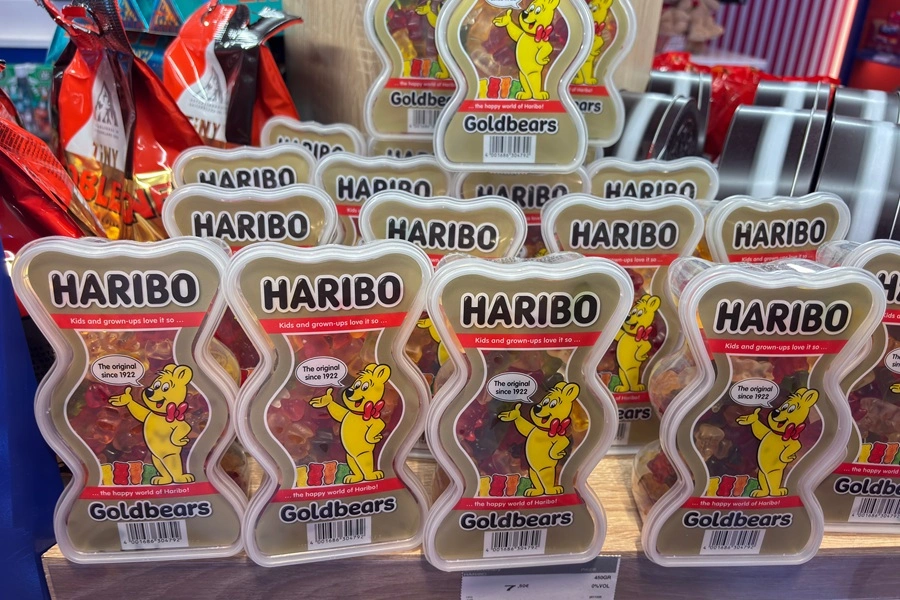 The collaboration uses quantum computing and AI to model gelatin’s properties like gel strength and elasticity to create better gelatin alternatives for products like gummies.Pasqal’s quantum computing technology opens up promising opportunities through its “Quantum Feature Mapping,” which allows for more complex and detailed information about proteins than traditional methods, Florent Verthuy, general manager of Pasqal Arabia, tells us.
“This can help better explore beyond the well-covered regions of the data feature space, progressively expanding controllable and optimizable parameters in the model, and therefore pushing the model from prediction of gelation quality to understanding the mechanisms behind said transformation.”
Quantum computing does not directly simulate molecular-level processes like gelatinization, but helps by enhancing data representation through Quantum Kernel-based similarity measurements and graph-based embedding, enabling richer models, Verthuy explains.
“This paves the way toward future incremental improvements to move toward a data-driven, physics and bioinformation-aware machine learning model.”
Future of programmable food proteins
True Nexus expects programmable protein design to fundamentally reshape future food innovation.
“Today, the industry still works largely through fragmented data, partial understanding, and repeated experimentation. Tomorrow, companies will increasingly be able to define a target functionality first, then work backward toward the most suitable protein system, process conditions, and formulation pathway,” says Grabinski.
Programmable protein design opens up possibilities of moving from “reactive formulation toward predictive design,” which means faster development cycles, better use of R&D resources, and more consistent product performance.
It also leads to a much greater ability to create alternative protein products, which he says can “truly compete with animal-based benchmarks.”
The “next generation of alternative proteins” will be unlocked not just by producing more protein, but by making protein functionality computational, predictable, and eventually programmable.
“The broader vision is a food industry where functionality is no longer discovered mainly through trial and error but increasingly designed with precision,” Grabinski says.