

Chickpea as a Protein Alternative Ingredient
10 Apr 2017 | Chick P
This is Rob Wires and I'm here with Professor Ram Reifen from the University of Jerusalem, who is also the founder of a new company called Chickpea.
Ram, can you tell me a bit about the product that you've developed because it's a very innovative protein product based on chickpea.
Yes, it is.
We've been working on chickpea for many years and we've actually began by improving or enhancing the nutritional quality.
Over the last two years, we've been able to come up with a product of very high, with very high protein, in fact, 70 to 90%, so that could be.
Either a concentrate or an isolate of chickpea protein.
Chickpea protein, as you may know, is, is, as good as, soy protein, but, there are no phytoestrogens, none whatsoever, negligible amounts.
A chickpea protein is non-allergenic.
And of course chickpea is a non-GMO.
So this, among others are the advantages of this product.
Also, our product has got a bland taste.
In fact, you can see the powder here, and it does not have the beany taste.
Of soy, nor does it have the sandy taste of pea or other protein.
It's got a bland taste.
It is colorless and tasteless, and therefore you do not have to camouflage it with sugar or anything else.
Can you explain a bit about the technology, about how you came around to creating it?
Yes, this is I.
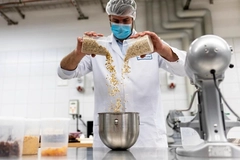
The technology, I can only tell you that the technology or, or, the technology is similar to extraction of other proteins, but we've got a few tricks in, if you will, in the process, and the order is different and it is IP protected.
We can come up with many, many products and we've so far.
I tried that this is just two examples of a hamburger, and this is the prototype and and schnitzel made of these high protein, very, very tasty.
As as meat-like products, if you will, and cheese-like products like tofu, and we've got many snacks and winning foods for children and a variety of other products.
Many proteins have been spoken about as alternatives.
Why has it taken so long for a chickpea protein to really be developed and why is it not commercialized so far?
I wonder myself.
And I wonder myself, I think.
I think that chickpea, people are much more acquainted with chickpea nowadays than they were before.
Chickpea was used for a paste, for hummus, but not for other replications.
Anyway, we are lucky to be the first ones to do that.
What are your plans for the company?
What are you trying to achieve at the moment?
We're looking now for potential strategic partners in the US and in Europe.
I should, I should also say that there are other ingredients in chickpea that you know, we are working on now.
So what is left during the procedure, the, is, we, we are working on that as.
So the complex sugars of the prebiotics are, are very, very peculiar and plans for production.
What, what have you achieved so far?
We've, we've completed the upscale in Germany in alliance with the TTZ in Germany in Bremmerhaven, and then we're actually looking for, for plants to produce it in Europe and in the US.
And what type of plant is required in order to, I think that any plant that does legume or pulses protein would fit fit.
There would be some modifications, but in general that they would fit for that.
OK, and I guess one of the advantages really is the is the non-GMO area.
Absolutely non-GMO.
It is a green crop and clean label.
And non-allergenic and no phytoestrogens.
OK, something to watch out for.
Thank you very much, Ron.
Thank you.