

Banner with cereal bars and Biospringer logo with a learn more button in the right bottom corner
Home
Videos
Vitafoods Europe 202...

Vitafoods Europe 2026: Cargill’s approach to scalable, health-driven F&B innovations

18 May 2026 | Cargill

Cargill’s Nathalie de Clercq, director of R&D application for Health and Nutrition, and Manuel Meggiolaro, application specialist for General & Specialized Nutrition, dive into the company’s latest health ingredient solutions for F&B, including GLP-1 companion products, reduced-sugar beverages, and hybrid plant-dairy protein bars. They discuss how F&B manufacturers can innovate in these spaces while overcoming challenges around cost, taste, and scalability to meet evolving consumer demands.
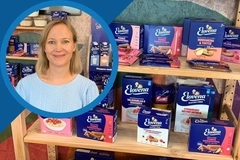
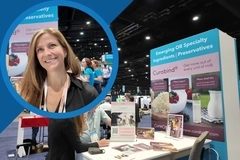
Food Greens first reported from Vita Foods Europe 2026 in Barcelona, Spain, and we're here in the Cargill booth with Natalie de Clerr, who is director for R&D application for health and nutrition, and Manuel Megalaro, who is Aation specialist general and specialized nutrition.

Welcome to you both.

Welcome.

Thank you.

So we're going to discuss GLP1 today.

Much of the conversation around GLP1 has been centered on supplements and medical nutrition.

But what concrete shifts do you expect in mainstream F&B formulations as this trend scales?

And how should large F&B manufacturers be rethinking product design?

First of all, I don't think it's a real single shift, but it's more an acceleration of existing trends in food and beverage.

So what we see is there's a clear, clear shift to, nutrient density, of course, portion flexibility and more more nutritional balanced profile of products.

And if you do that, and if you look at practice, what does that mean?

We see 3 formulation shifts.

The first one is, of course, we go higher in protein and fiber, so protein and fiber enrichment driven by consumer needs and also closing nutritional gaps.

The second one, the second formulation thing is that we , let's say, still focus on removing the nutrients that are of concern, that's sugar, salt, or sodium, and, saturated fats, because that's still a concern of the consumers and also public health guidance.

And the third shift is the one that is linked to smaller, more flexible, convenient portion sizes of products.

Of course, for manufacturers, so for our customers, I think the implication is quite clear what they need to do.

Product design needs to don't look at single parts, but really look at an integrated way.

Taste, texture, nutrition, and convenient format needs to come together in one prototype.

Yeah, OK, so as you say, your companion concepts for GLP1 users, they, they offer higher protein but also reduce sugar.

So how do you balance the society-driven formulations with the sensory expectations that drive repeat purchase in mainstream speaking?

Can you tell us more about that?

First of all, GLP1 therapies, they.

What we see is that there's a move or they're reshaping how people eat.

The preferences of people are are changing.

So we're also running priority insight studies, consumer insight studies to understand how these consumer behaviors are changing.

For example, we try to understand or we try to We understand that, and what we see is that people are have reduced appetite for sweeteners and texture preferences might also change.

So if you design a product, you need to combine nutritional dense products combined with a desired taste and texture.

So that's quite important.

So if you want to have a repeated purchase, and you want to have a product that has a good nutritional profile, it's key that your product still has a good taste and texture.

Otherwise people will not buy it a second time.

OK, interesting.

So, cargo is showcasing a 30 30% reduced sugar isotonic drink with an optimized glucose-fructose ratio.

So in practical terms, how scalable are these solutions across categories like soft drinks or, or dairy?

Where cost, labeling, and taste constraints can be challenging.

Yes, indeed, so these solutions are technically scalable but not universally transferable, of course, like, , formulation metrics like a soft drink or a dairy beverage can be different.

So here it comes also like Cargill expertise in be able to adapt and adjust the formulation according to the different metrics.

Of course, , when we talk also to sugar reduction, it doesn't come only with simply like the reduction of sugars or other ingredients, but it comes also with, , extra challenges, because of course the sugar bring a certain like organoleptic profile in terms of, texture, mouth feel, and also taste so, with our technology in a sugar reduction.

We can showcase our expertise and our broad portfolio, and thanks to this solution, we were able since 2012 to reduce 2.5 billion pounds of sugars.

When it comes to cost and labeling, it's also an important factor for Customers, we see that more than 61% of people are actually checking the labeled ingredients when they purchase.

So of course this is also something that has to take into consideration when we formulate something that is like sugar reduced.

OK, it's interesting.

So if we turn our attention to your hybrid plant dairy protein bar.

Which you say offers a middle ground approach to protein.

So do you see hybrid proteins as a long term solution for mainstream products, or as a transitional step as plant-based technologies continue to improve?

Yes, we don't think it's actually like a short term solution now or.

Something that we expect to stop, we actually see like something that it's about to stay as a solution in the market.

We see that a hybrid solution can be a good middle ground for more conscious and flexitarian consumers that are like.

Really paying attention to the amount of protein, but not only the amount, but even the source of protein that they are intaking in their diet.

So for sure something that will stay plus the hybrid solution using plant-based protein or in this case.

Dairy protein helps like overcome certain challenges or like differences that we find within the sources in terms of cost, nutritional profile, and also like organoleptic experience for our customers.

So definitely something that will stay.

OK, that makes sense.

So, many of the concepts you're presenting this year at VAA Foods like the GLP-1 companion systems and your performance snacks, they're compelling obviously at prototype level.

But what do you see as the biggest barriers to preventing these concepts from reaching mass market shelves at scale within the next, say, 2 to 3 years?

First of all, Cargill is a B2B producer, so we don't really bring end products to the markets.

We bring them to our consumers that are like B2C.

So we developed the prototypes with one idea to really bring our ingredients life in a in a fruit matrix.

That's the main goal, to really showcase our ingredient portfolio.

But when we develop these prototypes, we always keep in mind some important factors.

And first of all, that's, for example, sensory performance, we try to understand what consumers need, we have an ingredient tracker, we have trend tracker so that the prototypes that we developed are on trends, on trends and also on taste and texture.

Another thing that we keep in mind is costs and affordability.

We know that we are either customer our customers are under economic pressure.

So cost and use and affordability is something that we really also keep in mind when we formulate.

Another factor is scalability.

We make the prototypes in our lab, typically on a pilot scale, but we believe that these processes are quite representative for a later industrial scale, and we also try to understand the processes of our customers, and that should also help us or should help the customers, if they want to upscale it, and it's really representative.

And of course, ingredient performance is also something that we need to take in mind.

So that's another one.

And of course, regulatory is something that we always also need to keep in mind when we formulate.

So by combining these four things, when we develop prototypes, we believe that we lower the barrier for our customers to, if they want to bring it to the market prototypes, it should be not that difficult.

More videos

Image