

- Industry news
Industry news
- Category news
Category news
- Reports
- Key trends
- Multimedia
Multimedia
- Journal
- Events
- Suppliers
- Home
- Industry news
Industry news
- Category news
Category news
- Reports
- Key trends
- Multimedia
Multimedia
- Events
- Suppliers
June Lin, vice president of global innovation marketing at ADM, discusses how the company is bringing gut health and metabolic wellness into everyday consumer products, while addressing challenges in taste and texture for proteins, fibers, and bioactives. June also explores the balance between sugar reduction, clean labels, and evolving consumer expectations in large-scale F&B products.
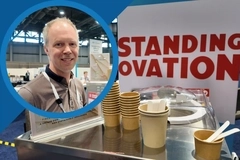
Foos first reporting from Vice Foods Europe 2026 in Barcelona.
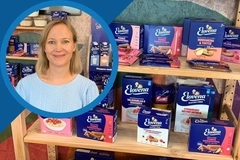
We're here at the booth with Jun Lin, who is vice president for global innovation and marketing.
Welcome to you.
So positions itself as a provider of end to end solutions rather than individual ingredients.
In practical terms, how does that change the way manufacturers develop?
And where is the measurable value?
Yeah, so when a customer comes to us with a rate, we're not just handing them a list of ingredients.
We're really starting with what is that consumer problem that they're trying to solve and what it is that they're solving for.
So I've been in both the B2B and B2C industry for a really long time.
And I know that products that win in the market aren't just the ones that have a long list of ingredients, they're really built around a consumer need and delivered in the formats that they're actually looking for in terms of how they live.
So in practical terms, we know that how our postbiotic strains work along other products like plant proteins and a lot of different applications.
We understand how flavor modulation also plays a role to address sensory challenges that come.
Along with high protein as as functional formats and for the customer that really saves them time and improves their feasibility when we're working on them with formulations and so there's value in two ways.
So number one, there's the speed to market.
So in functional nutrition trends move really quickly, so brands that can get to the market faster have a competitive edge.
And the second is really what makes us unique.
We've got that deep.
Formulation expertise, the technical know-how, the consumer insights to bring it together, and we can also make finished formats for consumers so they can go right into the market.
We also know how to bring that science together along with the formulation as as that sensory optimization so we're really able to scale them up together so brands that are willing to pursue innovation, they're able to move faster than they.
Would allow.
And so that's really where innovation comes from.
OK, it's really interesting.
Today you highlighted areas like gut health and metabolic wellness.
How do you translate these areas into mainstream F&B formats that consumers buy every day as opposed to just niche functional products?
Yeah, so the question really comes is, really matters to me because the science is there, but the gap is getting it to products in enjoyable formats that consumers want.
So how do Make microbiome wellness something that a consumer encounters in their morning coffee routine or their evening wind down routine rather just in the supplement aisle, so the ingredient really starts, or the answer really starts with ingredients that are stable and really effective enough to work through all those mainstream production processes, and that's where postbiotics come in.
So they're highly effective through heat and harsh conditions of food and beverage manufacturing.
Which means you're really able to put those microbiome benefits into a wide range of formats from gummies to stick packs to beverages, bars, shakes, so you're really able to bring it into consumers' everyday lives so we have a couple of examples here.
So this is our sip of wellness which includes fiber saw and BPL1.
So it's really geared for metabolic.
Health as as digestive health and it just gives consumers like a great option because you could take this any time of day it's very flexible and it's convenient.
We also have something that's really exciting that we're showing too which are these fast melt postbiotics.
So again it's a great convenient on the go format so it gives people options in terms of how they want to get their nutrition any time, any day.
So those are some of those examples that's great, yeah.
So as you know, combining proteins, fibers, and bioactives can create challenges in taste and texture.
So how does ADM address these trade-offs, particularly in categories like beverages and snacks, where consumer expectations can be high.
Yeah, yeah.
So for us, it's really that combination of ingredient portfolio and capabilities.
We start with a portfolio that has a very clean sensory baseline and flavor.
Modulation capabilities, so we have our taste spark solutions that can help to rebuild the taste experience along with our plant proteins that we choose for their clean profiles.
And then within our postbiotic strains, those are very easy to work with.
They are not at all complex from a sensory perspective, so they're tasteless, they're odorless, which means that a formulator can get meaningful benefits without adding any challenge to that formulation.
OK, so if we turn our attention to sugar reduction.
Sugar reduction remains a major priority for companies like yourself and your customers.
The solutions can impact taste and cost.
So how do you see the balance evolving between cleaner labels, reduced sugar, and consumer acceptance in large scale F&B products?
Yeah, so when we looked at what consumers prioritize, so we did research and we really found that consumers are looking for 3 things in this order.
They're looking for taste.
They're looking for price and they're looking for ingredient quality, so there's not a compromise between any of those and so they want taste and health to work together and not trade off so we build around that consumer expectation so we're not just swapping out a sugar for a sweetener and saying we're done we're really rebuilding that entire sensory profile, looking at the sweetness, how the flavor works, the mouthfeel, and the structure.
So the goal is to develop a product that consumers can't really distinguish from the original, right?
In fact, it's better for them too.
OK, so with so many overlapping trends like protein diversification, gut health, sustainability, the list goes on.
Do you see future product development becoming more complex or more streamlined?
And what role does ADM play in simplifying that process for its customers and for, for manufacturers?
Yeah.
The honest answer, it's both.
So which one depends on a given brand also depends on who they're working with.
So at AD.M we really strive to make that process simpler.
So as a partner we have the deep expertise across all the different platforms.
We have the full ingredient portfolio and we know how to bring it together into finished solutions.
So we've got our.
Proteins, our fibers, biotics, sweetening and flavors and colors derived from natural sources to bring it all together.
So for a partner, they're not managing multiple relationships, hoping that the ingredients work, you know, they're working with a partner who can see the whole picture end to end.
So that's really how we differentiate.
That's great.
Thanks for your time today.
Thanks so much.