
- Industry news
Industry news
- Category news
Category news
- Reports
- Key trends
- Multimedia
Multimedia
- Journal
- Events
- Suppliers
Suppliers
- Home
- Industry news
Industry news
- Category news
Category news
- Reports
- Key trends
- Multimedia
Multimedia
- Events
- Suppliers
Suppliers
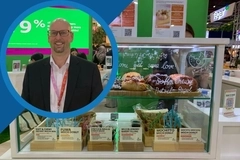
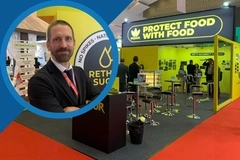
Noble Health Food presented two of its 38 offerings — vegan tartar with pea protein and vegetables and a cheesy croquette containing no cheese. The products contain less than 8% fat and are not meat or cheese replacements. Noble Health Food aims to recreate popular vegan Belgian products using sustainably sourced ingredients and production methods.
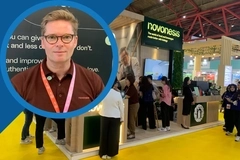
Hi, this is Ingri Jung here for food ingredients first.
I'm at Hanuga 2023.
I'm here with Eric Vanden Berger, the sales rep for Noble Health Foods.
Hi Eric.
Hi.
What are you showcasing this year?
So we are here at Anuga to to present two products.
We have a range of an average of 40 different products.
We are here to present our tartare.
It's like it's like real tartare but vegan.
There's absolutely no meat inside.
It's made with pea protein and vegetables.
It's absolutely healthy and natural.
There is less than 8% fat in our products in general, so there's absolutely no fat inside.
It's completely healthy.
That's that's our main product that we want to present here in Annua.
And we have also our cheesy crocketts, so it's it's crockets with no cheese inside, so it's a special recipe, but there is no cheese.
It tastes like cheese, but there is no cheese inside.
That's our two main products that we want to present here.
So you mentioned that your product is not a meat replacement.
Can you, can you describe like what, what your product really is?
So for example, those two products are very popular in Belgium and it's new on the market.
We don't want to create burgers, for example.
We don't want to create meat substitutes.
We don't want to create products that are going to replace what exists in the meat sector because there is too much, too much companies who are.
Proposing burgers and things like that.
So that's that's not our goal.
That's what we want to do.
We want to propose vegan products, but original products, innovative products, and not especially a copy of a burger or a copy of gyrus.
We are selling it.
We have that in our range, but our goal is to propose vegetable bowls who are quite.
Crunchy outside and smoothly inside with real pieces of vegetables, not not a puree with mashed inside.
That's not, that's not our goal.
We want to give to the market, a healthy product with quality ingredients inside, so we are not using fat, only vegetables and pea protein.
And what are your main ingredients?
Like what are the top featured ingredients in your products?
The first, the first ingredient is pea protein.
So we have 38 different products and we have 2 or 3 products with soy, but we are not really using, we don't want to use a lot of soy because it's nonsense for us to bring soy from China.
You can't be sustainable and bring to the market innovative products and healthy product and not taking care of the planet.
It's a nonsense for us.
So if you are using soy, soy is coming from France.
So yes, it's more expensive, but we want to bring to the market a quality product.
So all the rest is made with pea protein.
So what's your approach to sustainability?
All our raw materials are coming from 200 kilometers around the factory, so we are based in Belgium, so it's coming from France, Germany, and of course Belgium, but it's a nonsense for us to go to go far away to bring products.
And in terms of processing, is it?
Like how much processing goes into your product?
Our products are all frozen for the food service or the retailers, so we bring it to the market frozen.
It's frozen with the IQF technology and it's pre-cooked, so you just need to.
To heat the product and it's ready to heat, so we are not using, we are using ovens to pre-cook the product.
We are not putting it in in the fat in oil, only one or two references because you need it for the process to do it, but otherwise it's with the.
Interesting.
Does this mean because you're using a local footprint for your product, does it mean that your market is also only local?
We are of course in Belgium, of course it's our local market.
We are selling also in the Netherlands, in France, but we are going a little bit far away also because we are selling in Japan for example.
And in Taiwan and so in Asia it's very popular and we are discussing now for the moment to go to the Arabic countries because we have also the halal certification for some of our products.
Excellent, thank you for your time.
You're welcome.