
- Industry news
Industry news
- Category news
Category news
- Reports
- Key trends
- Multimedia
Multimedia
- Journal
- Events
- Suppliers
Suppliers
- Home
- Industry news
Industry news
- Category news
Category news
- Reports
- Key trends
- Multimedia
Multimedia
- Events
- Suppliers
Suppliers
Fi Europe 2025: Healy Group upcycles micronized cocoa shells in PrimaFi cocoa alternative
08 Jan 2026 | Healy Group
Amid the cocoa crisis, Healy Group is promoting PrimaFi, a cocoa replacement made from ground cocoa shells that would otherwise have been incinerated. The powdered ingredient is finely milled into particles of 30 microns and exhibits chocolatey notes. Gareth Healy, CEO, says it can replace cocoa up to 50% in bakery applications, while increasing fiber and reducing costs and emissions.

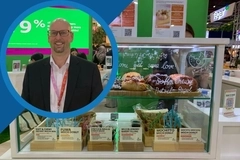
This is Missy Green at FI Europe 2025.
I'm here with Gareth Healy, who's the CEO of Primay, the Healy Group, mainly, but we produce Primafi Cocoa.
Yes.
Ah, so you have the Healy Group.
OK, yes, and your last name is Healy.
It is, yes, it's a family business, so we, my dad set it up at 40 years ago actually this year.
We're predominantly a, a distribution business in the UK and Ireland, but we've branched into production now with, with a, with a big focus on sustainability, and that's led us to Primafi cocoa, which we produce in our site in Poland.
OK, so what was, what was the inspiration behind Primafi?
It was, it was actually the, the milling technology.
So, so the, the cocoa came after the technology, so.
We built a factory with our, our business partner in Poland who was an engineer.
He designed the mill.
It's a very unique mill, so it micronizes particles down to a very fine particle size.
About 30%, this product in particular is about 30 microns, 70% through, through 30 microns.
So it's a very fine particle.
So it was the technology that led us to, to cocoa, and then we started looking for, what we want, we're, we're very.
Passionate about upcycling material and and sustainability, so we looked at what waste stream products could we put through the mill and make food safe and and then put back into the into the food industry.
So, cocoa was one that was top of the list and because there's a lot of issues around cocoa supply.
Particularly now, but, but back then, even, even from a sustainability perspective, there was, there was a lot of issues around, around, around the, the geopolitical issues behind cocoa supply, climate change, and how that's affecting farmers and, and, and, and, farm gate prices, everything like that.
So it was a perfect, it was a perfect product for us, and then we had to get into obviously how we, how do we source the, the shells, which is a A journey in itself.
It's a journey in itself, yes.
So, so this technology is using the shells.
But yes, so we, so effectively what we do is we take waste stream shells from chocolate manufacturers, cocoa processors.
So typically the bean would be roasted and the shell would break away, and it would be sent for incineration predominantly, which of course releases carbon back into, into the atmosphere.
So it was a perfect, it was a perfect raw material for us.
It is a raw agricultural product.
It's a waste product.
So, you know, there's a lot we have to do with it in terms of treating it.
So we, we use some heat and some pressure treatment to make it food safe, and then we put it through the micronization bill.
Yeah.
So what do you come out with in the end?
A really fine cocoa powder-like material.
So it looks very similar to cocoa powder and it has a really nice cocoa aroma to it.
It doesn't have the, the, the cocoa punch that you would get from the bean itself, but it's a great alternative.
Now we're, we're working with, with applications across the range where in baked goods you can get up to 50.
Some, some clients are using it more than 50% replacement.
We don't recommend that initially.
But you can get up to 50% cocoa powder replacement, which is, which is very attractive now from a, from a cost perspective for a lot of manufacturers, but also from a sustainability perspective as that they're.
They can contribute to a more circular food system, which is, which is, which makes us really proud, you know, yeah.
So are there certain applications where this like really shines bakery applications it works really.
So we have some brownies here that we're showcasing which is with 50% reduction of cocoa powder.
They taste great and obviously they're sustainable and it links back into the sustainability, but but ultimately from the work we've done, any application area where cocoa powder is used.
This is a great option for, for, for cocoa powder reduction, to help, as I said, mitigate costs, but also to, to, to feedback into a lot of these companies' ESG's policies as around sustainability, so really I, I, I wouldn't want to limit it to one particular application area.
Bakery is great because that's where we started with it, but we know it works in chocolate spreads.
We know it works in.
And dairy drinks with with with with cocoa powder in there anywhere because the particle size is so fine it gives them really creamy smooth mouth feel and so it, it, I wouldn't want to restrict it from any application area really and truly it's, it's, it's, it's quite a versatile ingredient should we say.
So is this a fiber essentially it's, it's ultimately a fiber.
It's about 60% dietary fiber.
Low fat content, it has to be low fat because it wouldn't go through our milk technology.
It's about 15% protein, and there's some, there's a small amount of carbohydrate in there, but it's, it's predominantly dietary fiber, yeah, OK, and also protein and some protein and some protein in there, a small bit, but yeah, but it's the fiber, the fiber element is probably the main nutritional impact it's going to have, but you know, gut health is, is.
Really important.
It's, it's a lot of people are trying to formulate fiber into their ingredients.
So this is another opportunity to increase a little bit of fiber in your product, right?
Yeah, reducing costs and also increasing a little bit of reduce your costs, increase your fiber, lowering emissions, lowering emissions.
It ticks a lot of boxes.
So are there certain challenges that you encounter with this?
Initially some challenges that we faced, where it's, it, it is a fiber, and it's a fine particle size, so it does take up a bit, a bit more water than you might be used to in, in, in bakery applications, so it's just a little bit about managing water inclusion levels.
And just processing of, of, of how you would typically make a cake or a, or a brownie, but that's where our technical team come in and, and we'll hold people's hand all the way through.
So is this product now available?
It's available now and there's only one region that we're working on is the United States.
Because we'll have to go through FDA approval for grass approval, which is a process, of course, and this is a relatively new ingredient, but every other market, Europe, Asia, we're, we're, we're shipping some material into Australia as , so.
South America is, is a really interesting market for it as.
So, so any market outside of the United States for now.
OK, thank you so much.
Not at all, thank you.