


Banner with cereal bars and Biospringer logo with a learn more button in the right bottom corner
Home
Videos
Drinktec 2025 live: ...

Drinktec 2025 live: IFF talks enzyme innovations for alcohol-free beer brewing

18 Sep 2025 | IFF

IFF is highlighting innovation in no- and low-alcohol beers. Jens Magnus Eiken, global product manager for Brewing at IFF, tells us more about the role of enzymes in improved brewing efficiency. We also discuss the effect of enzymes on sustainability and valorizing brewing by-products.
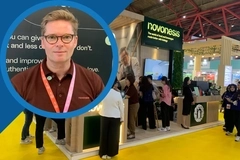

I'm at Drink Tech 2025 and now at the IFF booth with Jens Magnus Eichen, the global product manager and master brewer at IFF.

Hello Jens.

Hello, nice to meet you.

Very nice to meet you, Jens.

How is IFF driving innovation in low and low alcohol beers?

That's a very good question.

We have actually developed a new enzyme which can actually support the brewing of these new kind of beers.

We know that brewers.

We are looking into innovations within the low and the low alcohol.

What we have, we have actually a solution which can transform the sugars into a non-fermentable.

In reality, that means that you can make a better, full flavored beer with no alcohol or less alcohol, so.

For the low alcohol, you can actually make session beers which are characterized as alcohol below 4% alcohol.

With this technology, number 2 is actually that you can, if you have a de-alcoholization plant, you can make a Very nice 00 or 0.5% with even more body and you can save a lot on raw material costs up to about 40%, a little bit less.

OK, nice, that's interesting.

Now talking about enzymes specifically, what role do they play in improving brewing efficiency?

As you know, brewing is an art, and then you actually use different raw materials like barley mold.

You use corn, rice, sorghum, cassava.

It depends on where you are in the world, actually.

But what we normally do is we look at raw materials in different areas of the world, and then some of the raw materials we normally use in brewing is like for instance, barley mold.

If there is some lack of enzymes in the barley mold in that certain region or country, you can actually use exogenous enzymes, so you actually add the enzyme load a little bit so you can transform the mold into a functioning base to produce the right beers.

So the other functions of enzymes is that we can reduce loss.

In brewing processes, we also use enzymes, for instance, a new enzyme we have developed called Bclear, which is actually supporting making your colloidal stability of your beer better.

It's an enzyme solution called Beclear, which is removing gluten in reality, so it's degrading gluten.

All in all, it means that during processing you can save on water, which is important during processing.

Another solution is that increase the bruha yield, so yield in the process.

So you actually add enzymes and then you improve yield.

You get better, you can say or more through your filter.

When you have more through a filter, you can actually save.

And water.

So it's all about savings, and making your brewery more sustainable, right?

So now you already mentioned the water savings.

Energy can also be saved, right?

Can you elaborate more?

I can give you an example on energy.

Normally in processing, for instance, use maize or rice.

Normally you use high temperatures like 100 degrees in order to, it is a brewing term, you have to gelatinize the raw materials actually before the enzyme can gain access to the starch inside these raw materials, then the enzymes can go in and actually Degrade starch into sugars.

This is what we do in brewing with an enzyme called alphamalase.

When you add that during processing in the cereal cooker, you can actually lower the temperatures by about 15 degrees.

So instead of boiling, you can use 85 degrees.

So that's a 15 degrees improvement in temperature, meaning you need less energy.

OK, and Jens, how do enzymes help valorize brewing byproducts?

That's a tricky question, I would say because we have basically two byproducts in brewing.

One is spent grains, the other one is spent yeast.

And how we think about that is of course what do the brewers need, what do they want to do with their spent grains.

Of course with enzymes we we can probably make the spent grains containing less water, so in the downstream process you have a drier material meaning that you can process it more efficiently.

You don't have to.

Of course brewers are looking into you can say what else can I do.

We can probably help with removing more proteins from the spent grain before you sell it further on to you can say farmers maybe, but then you can take the proteins out and sell them as a protein material which is high value.

Now a final question.

What would you say?

Where do you see the future of bioscience in brewing?

If you look at sustainability, I see that it's a bright future.

Of course, regulatory and legislation has to follow, but I think that all in all we need bioinnation.

We need biotechnology of the future.

Thank you for speaking with food ingredients first.

More videos

Image