

Unilever’s Food Segment delivers solid growth as Hellmann’s and Knorr drive sales


Key takeaways
- Unilever’s food segment grew 2.5% in 2025, driven by iconic brands like Hellmann’s and Knorr.
- The company targets Condiments, Cooking Aids & Mini Meals, and Unilever Food Solutions for long-term growth, while divesting slower-growth brands.
- Power brands led growth with balanced volume and price contributions; Unilever expects 4–6% underlying sales growth in 2026, maintaining strategic focus on high-performing segments.
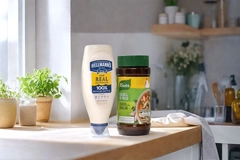
Despite some pruning of its food-related portfolio, Unilever backs its large, global power food brands while reporting fourth-quarter 2025 and full-year 2025 results. The company’s flagship condiment brand, Hellmann’s mayonnaise, helped drive sales growth in the food segment, while Knorr, one of Unilever’s long-standing food brands, and other condiments and cooking aids, showed steady growth in 2025.
The British multinational consumer packaged goods giant stresses that its capital allocation priorities remain unchanged — it focuses on growth and productivity. This has led to several moves in its Food business over the last year or so.
In Foods, Unilever has shifted its focus to sharpen long-term growth, scalability, and top-tier performance in its food portfolio, “rigorously” focusing on three attractive global categories: Condiments, Cooking Aids & Mini Meals, and Unilever Food Solutions.
Full-year review of Food
Unilever’s Food business represents 26% of the Group’s turnover.
Underlying operating profit in Foods was €2.9 billion (US$3.5 billion), up 2.7% against the previous year. Foods underlying sales grew 2.5%, with 0.8% from volume and 1.7% from price.
“Developed market underlying sales growth was flat despite declining markets as Hellmann’s continued to perform well, benefitting from the strength of its flavored mayonnaise range across over 30 markets. In the fourth quarter, underlying sales growth was 2.3% with 1.3% from volume, reflecting a continued slower market,” the company says in a statement.
“Cooking Aids grew in the low single digit, driven primarily by price. Knorr grew in the low single digits with a slight decline in developed markets offset by positive volume and price in emerging markets.”
“Condiments delivered mid-single digit growth with balanced volume and price. Hellmann’s grew mid-single digit, led by volume, with continued premiumization and particularly strong momentum in emerging markets. Unilever Food Solutions was flat, with positive volume in North America offset by declines in China, reflecting weaker out-of-home consumption and macroeconomic pressure.”
Unilever also reports that the underlying sales growth of 4.2% in the fourth quarter was the strongest of the year, despite slowing markets, with a balanced contribution from volume and price. Power Brands continued to lead growth, delivering 4.3% underlying sales growth in 2025, with 2.2% volume. Business Groups’ performance was led by Personal Care and Beauty & Wellbeing.
 Unilever is “rigorously” focusing on three attractive global categories: Condiments, Cooking Aids & Mini Meals, and Unilever Food Solutions.
Unilever’s portfolio transformation
Through a series of targeted acquisitions and divestments, last year saw the FMCG giant make several key changes to its portfolio, significantly leaning into growth in its personal and home care businesses and moving away from some of its food and drink businesses.
The primary example of this was completing the demerger of its Ice Cream business, with The Magnum Ice Cream Company listed as a standalone, global Ice Cream business in Amsterdam, London, and New York in December 2025.
Unilever’s board said that Ice Cream has a fundamentally different operating model from the rest of the business, requiring specialized cold-chain infrastructure and seasonal production patterns that do not align with those of other divisions. The board concluded that separation would allow both businesses to pursue more focused growth strategies.
Unilever also announced the sale of its Indonesia Tea Business — another move away from slower-growth legacy products. The transaction is expected to close in the first half of 2026.
In March 2025, Unilever announced it was selling its plant-based Vegetarian Butcher brand, which it bought in 2018, to Dutch plant-based foods company Vivera.
Having bought Graze, a healthier snacking brand, in 2019, Unilever said last December it was selling it to Katjes International. Completion of the transaction is subject to usual closing conditions and is expected in the first half of 2026. Financial terms of the agreement have not been disclosed.
Unilever's turnover was €50.5 billion (US$60 billion) for the full-year 2025, down 3.8%.
Unilever expects full-year 2026 underlying sales growth to be within its multi-year guidance range of 4% to 6%, with at least 2% underlying volume growth.


Upcoming webinars
Oat-Standing Ingredients - Showcasing Irish Grain Through Innovation
Tirlán Ingredients

2027 Food Safety Risks for Quality & Compliance Leaders
FoodChain ID

Formulating for function: Developing benefit-led beverages with natural colours, botanicals, and flavours
Givaudan Sense Colour