


ADM earnings slide as flavors and specialty ingredients offer relief


Key takeaways
- ADM’s full-year adjusted EPS fell 28% to US$3.43 as crushing margins collapsed 81% amid prolonged US biofuel policy uncertainty.
- The Nutrition segment was the company’s only growth segment, with flavors driving an 8% rise in operating profit.
- Weakening global food demand and EMEA corn crop quality issues added further pressure on starches, sweeteners, and refined products.

ADM has released its full-year earnings report for 2025, revealing that Nutrition, which includes flavors and specialty ingredients, was the company’s only growth segment. Full-year revenues fell to US$80.3 billion from US$85.5 billion, total segment operating profit dropped 23% to US$3.24 billion, and adjusted earnings per share came in at US$3.43 (down 28%).
The damage was sharpest in Crushing (the process of processing oilseeds, such as soybeans, to extract vegetable oil and protein meal), where operating profit collapsed 81% to US$159 million from US$844 million a year earlier, driven by compressed margins tied to prolonged US biofuel policy uncertainty.
Weaker global food demand, industry-wide corn crop quality problems in EMEA, and softening starch and sweetener volumes compounded the issues.
Flavors and nutrition boom
Despite the backdrop of decline, ADM’s Nutrition division — covering flavors, specialty ingredients, health and wellness, and animal nutrition — posted an 8% rise in operating profit to US$417 million.
Flavors drove the gains, with strong sales in North America supported by growth in Europe and Asia-Pacific. Specialty Ingredients, a weak point in recent years, “continued its recovery throughout the quarter,” according to the earnings release.
ADM has been investing here — at Fi Europe 2025 in Paris, France, the company showcased microbiome solutions and functional ingredients, including its postbiotic Lactobacillus gasseri CP2305 for gut-brain axis support, a finalist for Fi Europe’s Health Innovation Award.
The flavors growth fits with broader trends tracked by Innova Market Insights. “Sensorial Explorations” tops Innova’s global flavor trends for 2026, with 26% of Gen Z consumers actively seeking visually striking and surprising flavor combinations.
“In 2026, flavor is about more than taste — consumers are embracing texture, aroma, and visual appeal, transforming eating into an immersive, multi-sensory experience,” says Lu Ann Williams, Innova’s global senior vice president of research.
Animal Nutrition also grew, with full-year operating profit surging 66% to US$98 million through a pivot toward higher-margin products and portfolio streamlining. In September, ADM consolidated its soy protein production network, closing an Illinois, US, plant as part of wider restructuring.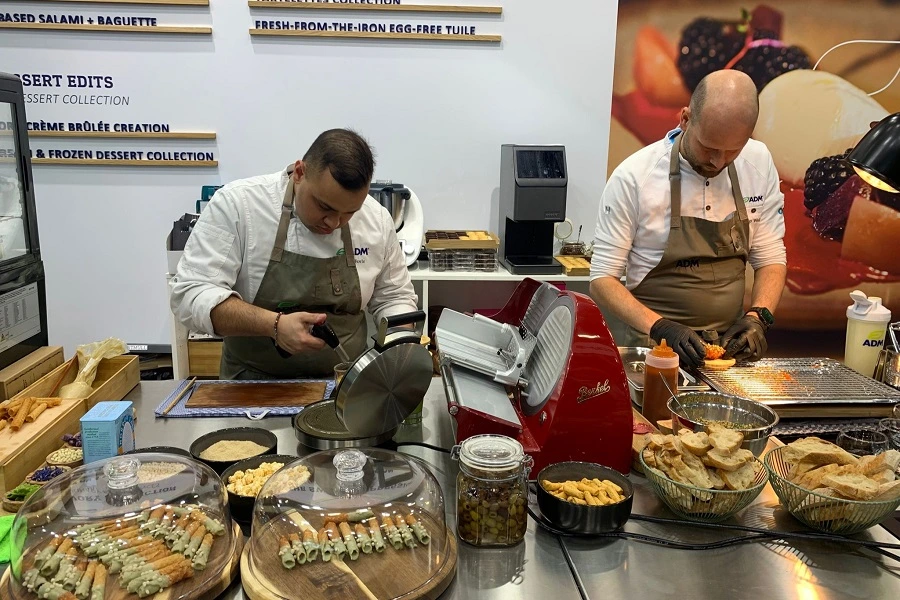 ADM’s flavors business drove growth in North America, Europe, and Asia-Pacific, as the company's Nutrition segment bucked the wider downward trend in 2025.
Weakening food demand
The results also exposed the impact of softening consumer demand on ingredient operations. ADM flagged “weaker food demand” as a factor pressuring refined products margins, while Starches and Sweeteners saw a 21% decline in full-year operating profit, driven by softer global demand hitting both volumes and pricing.
This tracks with Innova Market Insights data. The company’s Trends Survey 2025 identified accessibility and affordability as “leading values” when consumers consider their diets, with Innova noting consumers “may not be looking for anything fancy” during uncertain times.
Innova’s top F&B trends for 2026 reflect these pressures — economic headwinds are reshaping purchasing behavior across markets, and that caution is flowing upstream into lower volumes and weaker pricing power for starch, sweetener, and oil processors.
In EMEA, the picture was further complicated by supply-side disruption. ADM cites “industry-wide corn crop quality issues” driving up corn costs and squeezing Starches and Sweeteners margins across the region.
Biofuel policy drives oils drop
Running through the results was the impact of deferred US biofuel policy. Crushing saw its operating profit crater 81% to US$159 million. Refined product margins were also hit by “weaker fuel demand due to deferred US biofuel policy clarity.”
For the food ingredients sector, the biofuel dimension matters because it shapes how vegetable oils flow between food ingredients and fuel feedstock end-markets. The OECD (Organisation for Economic Co-operation and Development) has previously warned that the interchangeability between crops grown for biofuels, animal feed, and food has significant implications for ingredient pricing and food security.
ADM CEO Juan Luciano acknowledged the headwinds, noting that “2025 was marked by a dynamic global trade landscape, and ongoing uncertainty around US biofuel policy created a challenging operating environment.” He pointed to a cost-savings target of US$500 million to US$750 million over the next three to five years.
The 2026 outlook reflects the uncertainty: ADM guided for adjusted EPS of roughly US$3.60 to US$4.25, with the lower end assuming continued biofuel policy deferral and the upper end banking on crush margin expansion and strengthening customer demand. The company also raised its quarterly dividend by 2%, marking 53 consecutive years of dividend growth.