Big Dairy’s big win: UK’s highest court bans Oatly from using “milk” in advertising


Key takeaways
- The UK’s Supreme Court unanimously ruled Oatly’s “Post Milk Generation” trademark invalid for food and drink under retained EU dairy term protections.
- The ruling arrives as British dairy farms hit a record low of 7,010, while plant-based milk sales grew 24% in two years to £276 million (US$376 million).
- Greenpeace investigation reveals Dairy UK lobbied for stricter enforcement since 2017; legal experts expect further trademark challenges across the sector.
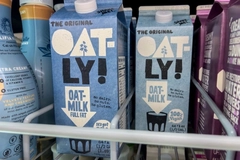
The UK Supreme Court has unanimously ruled that Oatly cannot use its “Post Milk Generation” trademark on oat-based food and drink, handing a landmark victory to the dairy industry, as it contends with record-low farm numbers, falling retail volumes, and collapsing wholesale prices.
The ruling, delivered yesterday, ends a four-year legal battle between the Swedish oat drink maker and Dairy UK, the trade association whose members include Arla Foods UK, Lactalis McLelland, Müller, and Saputo. The case was brought under an EU Regulation (1308/2013) retained in UK law post-Brexit, which reserves terms such as “milk,” “butter,” and “cheese” exclusively for animal-derived products.
The judgment arrives at a precarious moment for British dairy. The number of British dairy farms has fallen to a record low of 7,010 — an 85% decline from an estimated 46,000 in 1980, according to industry estimates and the Agriculture and Horticulture Development Board (AHDB).
The British milking herd stood at 2.51 million head in October 2025, down 1.3% year-on-year. Semi-skimmed milk, which accounts for 58% of all cow’s milk volumes, saw a 4% volume decline, while wholesale cream lost half its value over Q4 2025 and butter fell by a third, per the AHDB’s latest market outlook.
Meanwhile, plant-based milk sales in the UK grew 24% between 2020 and 2022 to reach £276 million (US$376 million), capturing a 7% market share, according to GFI Europe.
Innova Market Insights data shows plant-based milk is the most consumed plant-based category in the UK, with one in four European consumers purchasing dairy alternatives on a typical grocery trip. The UK milk substitutes market is forecast to exceed £850 million (US$1159 million) by 2029.
The legal reasoning
The Supreme Court judgment posed two questions. The first: Does “Post Milk Generation” count as using the word “milk” in a way the law prohibits? Oatly argued it does not, because the slogan is not the name of a product. The court disagreed, ruling that any use of a protected dairy term in connection with food or drink is caught by the EU regulation, not just product names.
The second: even if the word “milk” is caught, is Oatly saved by an exception that allows protected terms when they “clearly” describe a quality of the product, such as being milk-free? Again, the court said no. Lords Hamblen and Burrows, writing for the unanimous panel of five justices, held that the slogan describes a type of consumer — younger people turning away from dairy — rather than anything about the product itself.
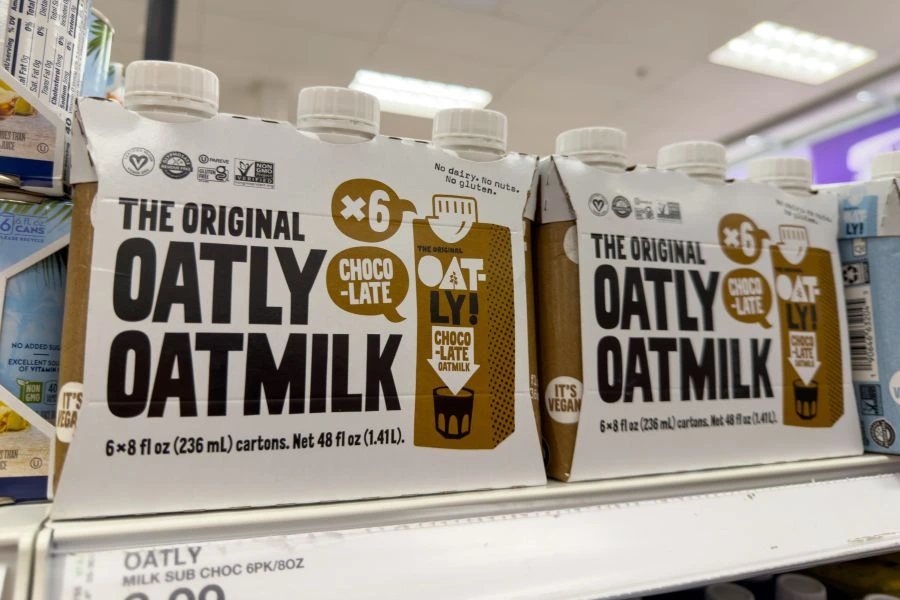 The UK Supreme Court has ruled that the word "milk" cannot be used in trademarks for plant-based food and drink, ending a four-year legal battle between Oatly and dairy trade body Dairy UK.Even if it could be read as referencing a milk-free quality, it does so in an “oblique and obscure way” that fails to clarify whether the product is entirely milk-free or merely low in dairy content.
The trademark will now be cancelled by the UK Intellectual Property Office for oat-based food and drink (Classes 29, 30, and 32), though it remains valid for merchandise, such as t-shirts.
A lobbying campaign years in the making
The Supreme Court has emerged from years of lobbying action. An investigation by Greenpeace’s Unearthed, based on documents obtained through disclosure, revealed that Dairy UK had been lobbying for tighter enforcement of dairy term protections since at least 2017.
Committee meeting notes showed the association presented “the issue of misuse of protected dairy terms” to a Business Experts Group panel and was subsequently tasked by Defra with developing a briefing paper for the Food Standards Information Focus Group (FSIG).
Dairy UK submitted a position paper to Defra in November 2022, backing FSIG draft proposals that would have gone significantly further — banning descriptors such as “yoghurt-style,” homophones like “mylk,” and even phrases like “not milk.” Forty-four plant-based companies and NGOs, including Alpro, Oatly, Quorn, and the Good Food Institute, co-signed an open letter opposing the restrictions.
Industry reactions
Bryan Carroll, general manager for Oatly UK and Ireland, says the company is “deeply disappointed,” calling the ruling “a way to stifle competition and not in the interests of the British public. This decision creates unnecessary confusion and an uneven playing field for plant-based products that solely benefits Big Dairy.”
Dr Judith Bryans, CEO of Dairy UK, says the association is “delighted,” adding that the ruling “helps ensure that long-established dairy terms continue to carry clear meaning for consumers.”
Jasmijn de Boo, global CEO of ProVeg International, says the verdict is based on a “very stringent” retained EU regulation that the UK could have revised post-Brexit, noting that “there are several studies that show that consumers are not being misled by the use of the term ’milk’ for plant-based milks.”
Regulatory divergence
The ruling places the UK at odds with the US, where the FDA permits plant-based drinks to use the word “milk”. Within the EU, “milk” is already restricted for plant-based products following a 2017 Court of Justice ruling, which would have banned terms like “creamy” and “buttery” — but was dropped after industry and NGO opposition in 2021.
The EU Parliament has since voted 355-247 to restrict plant-based meat from using terms such as “burger” and “sausage,” though trilogue negotiations collapsed in December 2025 without agreement, pushing the decision into 2026.
Trade mark attorneys behind the case have indicated that Dairy UK is likely to pursue cancellation of Oatly’s remaining UK trademark registrations and that EU counterparts may launch similar challenges.


Upcoming webinars
Oat-Standing Ingredients - Showcasing Irish Grain Through Innovation
Tirlán Ingredients

2027 Food Safety Risks for Quality & Compliance Leaders
FoodChain ID
Formulating for function: Developing benefit-led beverages with natural colours, botanicals, and flavours
Givaudan Sense Colour