


Upcycled marigold flower waste boosts flavor, texture & sustainability in foods, research finds


Key takeaways
- Scientists have examined marigold flowers as a sustainable protein source for plant-based foods, dairy substitutes, and bakery products.
- The flower protein offers umami flavor, emulsification, and heat stability higher than that of some plant proteins.
- The research focuses on upcycling waste and scaling production for the food industry.

Scientists in the US and India have examined the use of dried marigold (Calendula officinalis) flowers as an upcycled and sustainable protein source, as consumer demands for protein-rich and plant-based F&B continue to rise.
Manufacturers could potentially use protein extracts from these ornamental flowers to add umami taste to foods or as emulsifiers in dairy substitutes and salad dressings.
In India, marigold flowers are used in weddings and religious rituals, while their edible nature adds color and flavor to salads and soups in the US. However, nearly 40% of production is discarded as waste post-harvest, leading to an “environmental burden and a missed economic opportunity,” note the authors at the University of Georgia (UGA), US, and the Indian Institute of Technology, Delhi, India.
The findings come a year after the UGA used ultrasound to convert waste blooms into edible products for increasing the shelf life of edible flowers.
Nutritionally, the team found dried marigold powder to contain nearly 9% protein — highlighting its potential as a functional ingredient in future foods. This comes at a time when nearly 60% of global consumers are actively incorporating more protein into their diets, according to Innova Market Insights data.
The idea of using discarded marigold flowers as a protein source was sparked by a fundamental challenge in the modern food system — “the urgent need to identify sustainable, alternative protein sources that can meet increasing global demand while minimizing environmental impact,” author Anand Mohan, associate professor at the Department of Food Science and Technology at the University of Georgia, tells Food Ingredients First.
“From a research perspective, we identified a clear gap: while marigold has been extensively studied for its bioactive compounds (flavonoids and carotenoids), its protein fraction remained largely unexplored, particularly in terms of structure–function relationships relevant to food applications.”
The team aimed to bridge this gap by not only extracting the protein but also systematically evaluating its functional, thermal, and structural properties, positioning it as a viable ingredient for the food industry.
Elevating plant-based food flavors
The study, published in ACS Food Science & Technology, responds to a surge in plant-based and high-protein food demands, which significantly influenced the research’s direction, Mohan tells us.
 Anand Mohan: Our goal was to extract marigold’s protein and evaluate its functional and thermal properties to unlock its potential as a viable food ingredient.“The food industry is undergoing a transformation driven by consumer demand for clean label, plant-derived, and sustainable ingredients. However, current plant protein sources such as soy and pea face limitations, including allergenicity, supply chain constraints, and concerns,” says Mohan.
During the study, marigold proteins retained heat stability up to 105℃ — higher than temperatures tolerated by pea and chickpea. This opens up opportunities for their use in heat-processed foods, such as extruded snacks and plant-based meat analogs, “without significant loss of functionality.”
The researchers ground pot marigold flowers into a fine powder and isolated proteins in four sequential liquid extractions, and found high levels of the amino acids glutamic acid and aspartic acid in some protein extracts. This could help manufacturers add umami taste to foods.
“While the presence of these amino acids suggests potential flavor enhancement, the actual sensory impact depends on the food matrix, concentration, and processing conditions. In practical applications, we anticipate that marigold protein may contribute to subtle savory notes, particularly in formulations such as plant-based meats, soups, and sauces,” explains Mohan.
He also points to marigold protein use as a natural emulsifier and stabilizer in plant-based beverages and dairy alternatives, where stable oil-water interactions are essential. Manufacturers can also use it in bakery and whipped formulations to improve texture and aeration due to its strong foaming properties.
“In addition, its water- and oil-holding capacities indicate it could be used in sauces, dressings, and spreads to enhance consistency and stability. Furthermore, its antioxidant activity and amino acids linked to flavor enhancement suggest it could be used to improve both shelf life and sensory profiles in formulated products,” Mohan adds.
Testing marigold protein’s consumer acceptance
The researchers plan to test the health benefits of marigold protein and then use it as an ingredient in baked goods and products like salad dressings, followed by taste tests with consumers.
Mohan highlights the importance of consumer perception while introducing novel ingredients like marigold protein.
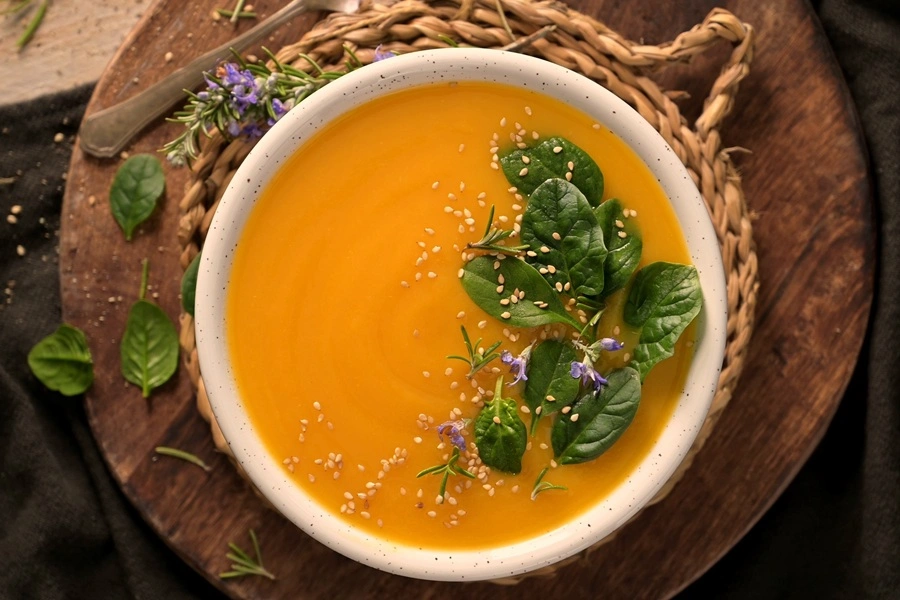 Marigold protein may contribute to subtle savory notes in plant-based meats, soups, and sauces.“While there may initially be some hesitation, we believe that acceptance will depend largely on communication and positioning. Edible flowers such as marigolds already have a history of safe use and are classified as GRAS (Generally Recognized As Safe) by the US Food and Drug Administration (FDA), which supports consumer confidence.”
When positioned not as an “unusual flower protein but as a sustainable, plant-based functional ingredient,” marigold protein aligns strongly with current consumer demand for natural and environmentally responsible foods.
“With transparent communication and integration into familiar products, we anticipate strong acceptance, particularly among health-conscious and sustainability-driven consumers,” Mohan says.
He also highlights close collaboration between academia and industry as essential to translating the innovation into impactful, real-world food applications.
“We are particularly eager to collaborate with industry partners in areas such as plant-based product development, functional ingredient formulation, and natural bioactive delivery systems.”
The team is also looking to engage in partnerships focused on scale-up, product validation, and commercialization.
Marigold flowers to sustainable food ingredients
Mohan says the team’s marigold upcycling approach can be readily extended to other commonly discarded flowers and plant by-products, with a focus on developing sustainable, value-added food ingredients.
“The success of marigold protein demonstrates that underutilized plant materials can be transformed into functional ingredients when they possess sufficient protein content, favorable extraction potential, and desirable techno-functional properties such as emulsification, solubility, and stability.”
The scientists are already actively working on other edible flowers, including broccoli, rose, and hibiscus, where they are investigating their protein functionality, bioactive compounds, and potential applications in food systems.
“This ongoing work reflects our commitment to advancing a circular and sustainable food model, where agricultural byproducts are repurposed into high-value ingredients.”
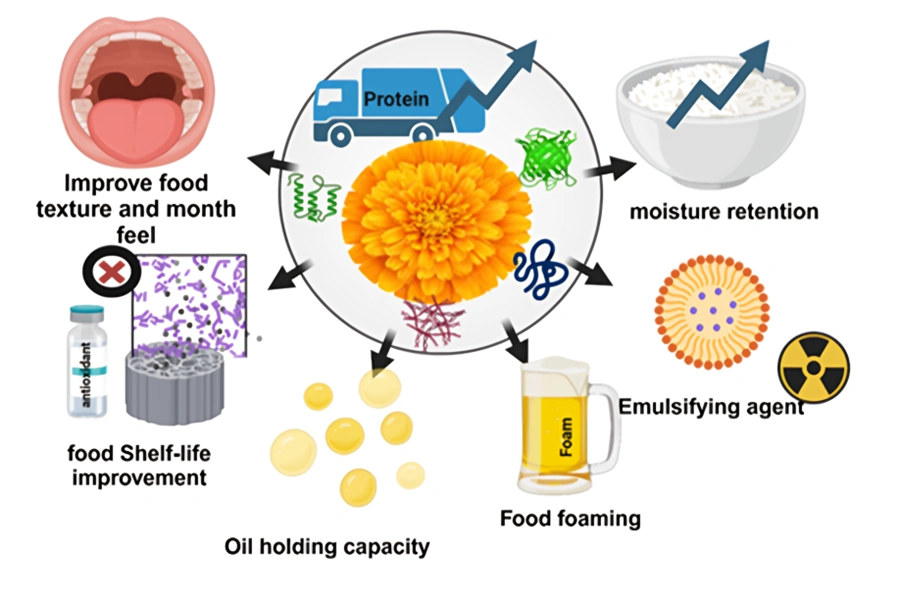 Application of marigold flower protein in the food industry (Image credit: ACS Food Science & Technology).
R&D to real-world food applications
The next phase of the research focuses on translating the findings into practical food applications and industrial scalability.
“We plan to incorporate marigold protein into prototype food systems such as plant-based beverages, baked goods, and meat analogs to evaluate functionality, sensory properties, and consumer acceptance,” says Mohan.
The team also plans to optimize extraction and processing techniques to improve yield, efficiency, and cost-effectiveness for large-scale production.
“Moving forward, we aim to expand this work by evaluating additional edible flowers and plant byproducts, with the goal of developing next-generation, clean label ingredients that support both innovation and sustainability in the food industry,” Mohan concludes.