


UN FAO and EFSA collaboration to strengthen food safety and regulatory science

Key takeaways
- EFSA and FAO have signed a three-year MoU to strengthen cooperation on food safety and science-based regulation.
- The partnership covers emerging areas, such as novel foods, biotechnology, AI, and microbiome research.
- The MoU focuses on the “One Health” approach, linking human, animal, and environmental health to support safe and sustainable food systems.
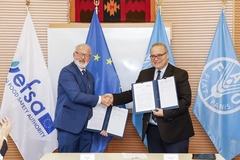
The European Food Safety Authority (EFSA) and the UN Food and Agriculture Organization (FAO) have signed a three-year Memorandum of Understanding (MoU) to deepen collaboration on food safety and public health protection through “sound regulatory science.” The aim is to promote science-based solutions for safe, sustainable, and resilient food systems.
The scientific cooperation agreement will also advance joint efforts on emerging issues and sectors, including novel foods, biotechnology, artificial intelligence, and microbiome research. The partnership could shape how new food ingredients are assessed and approved across markets.
The MoU was signed at the FAO headquarters in Rome, Italy, by EFSA’s executive director, Nicolaus Kritz, and FAO’s chief economist, Maximo Torero Cullen. Both organizations are committing to a “One Health” integrated approach with this partnership, considering human, animal, plant, and ecosystem health together to reflect an overall view of food safety and sustainability.

Combining their expertise will help the food governance bodies prepare better to “face emerging challenges and strengthen safe, innovative, and sustainable food systems,” says Kritz. “I am confident that, together, we can deliver real benefits for public health.”
“This agreement will allow us to deepen our cooperation across many crucial areas — from animal and plant health to pesticide risk assessment, sustainable agricultural practices, emerging technologies, and data-driven methodologies,” he wrote on LinkedIn.
“As science evolves rapidly, working hand in hand with global partners like FAO is essential to ensure that innovation translates into safe and effective regulatory science.”
Advancing safe food
The MoU supports the organizations’ further work on the Codex Alimentarius at FAO, the world’s common standards for safe food.
Daniela Solomon, regulatory affairs manager for Animal Biosolutions at Novonesis, describes the MoU as “big news for food safety, sustainability and innovation,” saying it signals a science-based future for food systems aligned with “One Health” principles.
“This is exactly the kind of framework that can unlock more opportunities for biosolutions — enabling innovation while keeping the highest standards of safety and public health,” she wrote on LinkedIn.
The “One Health” approach — which recognizes how human, animal, and environmental health are interconnected — is reflected in antimicrobial resistance challenges in seafood and poultry production. Experts cite the need for cross-sector surveillance and responsible antimicrobial use to safeguard the food system.



Upcoming webinars

2027 Food Safety Risks for Quality & Compliance Leaders
FoodChain ID

Formulating for function: Developing benefit-led beverages with natural colours, botanicals, and flavours
Givaudan Sense Colour
Let's reveal the grain potential: Innovate
Meurens Natural