



Affordability reshapes reformulation strategies at Fi Asia Indonesia 2026


Key takeaways
- Price-sensitive markets are pushing developers to rank formulation priorities before development begins.
- Suppliers are promoting sweetener blends and multifunctional systems over one-for-one ingredient swaps.
- Cost-in-use increasingly reflects an ingredient’s effects on taste, texture, functionality, and the complete formulation.

A cheaper ingredient does not necessarily produce a cheaper food. That message surfaced repeatedly last week at Fi Asia Indonesia 2026, where suppliers described reformulation as a chain of decisions involving price, nutrition, labeling, taste, and texture.
Affordability was less a separate trend than the boundary around every other ambition, as the formulation trends shaping the event made clear.
The price point comes first
Ingredion brought reduced-sugar and reduced-salt sauces, beverages, and texture concepts to Jakarta. Raymond Deidrick, vice president and general manager for Texture and Healthful Solutions for ASEAN and Texture Solutions food lead for APAC, says customer briefs usually contain competing ambitions.
“They want products to be cheaper. They want them to have a more indulgent texture. They want them to be healthier,” he tells Food Ingredients First.
The work begins by deciding which demand takes precedence. “In Indone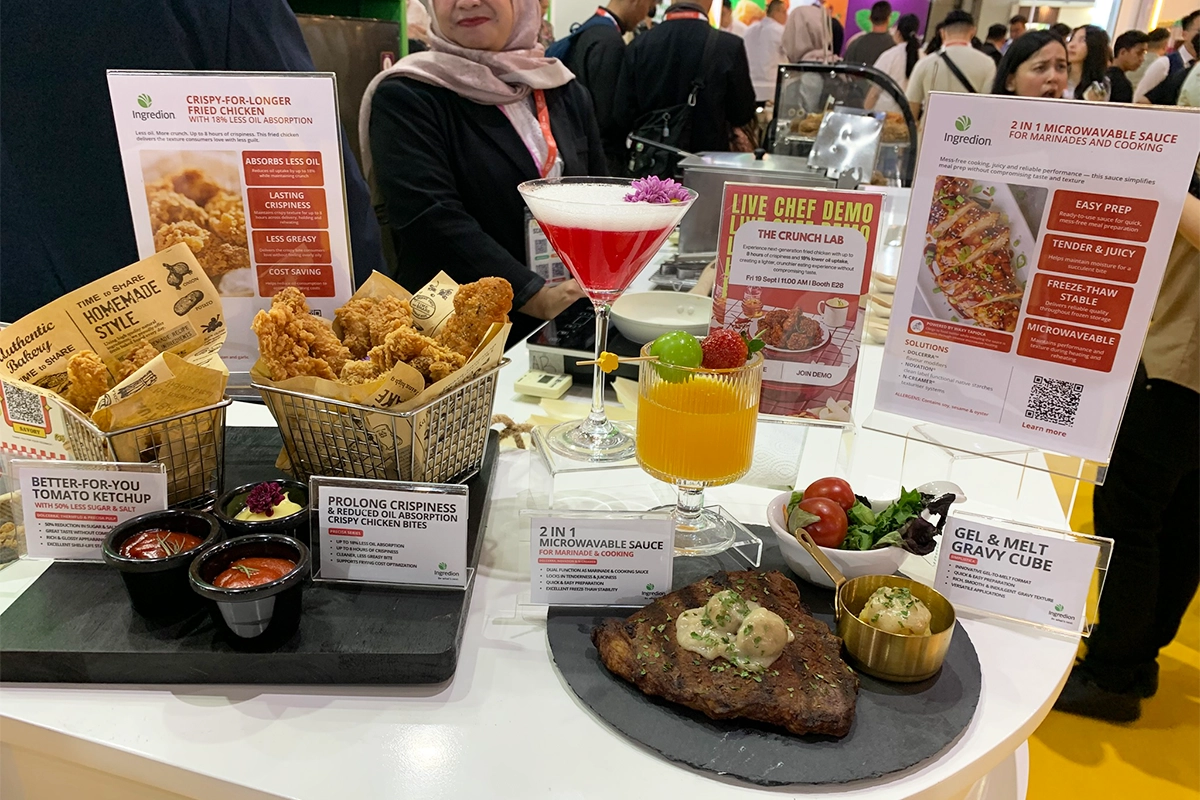 Ingredion helps manufacturers balance affordability, nutrition, texture, and labeling across the complete formulation.sia, you still see affordability leading,” Deidrick says. “They want affordability plus, except for some premium brands that want to lead with the healthy texture or healthy solution. It’s really about understanding the order of priority.”
Ingredion says customers in Indonesia are using its systems to reduce salt and sugar by 25% in savory sauces. Concepts at the event reached 50%, including a lighter tomato ketchup.
“It’s about giving something that’s a little bit healthier while maintaining or slightly reducing the total formulation cost,” says Deidrick. “Those are the projects that really excite customers.”
That helps explain the movement toward systems that work across sweetness, flavor, body, and texture. As our show-floor report on Ingredion’s ingredient systems detailed, a higher-priced component may replace another ingredient or restore functionality lost during sugar reduction.
“Don’t just give customers one product, but help them optimize their overall formula,” Deidrick says. “That’s the only way to give a premium texture, improve the label, and manage the cost at the same time.”
A sweetener is not a recipe
Delytose highlighted allulose, stevia, monk fruit, and sweet proteins alongside low-calorie ice cream, sugar-free gummies, and sugar-free toffee, while identifying opportunities across confectionery, dairy, ice cream, and bakery.
Founder and CEO Jingkai Shen says the brief has moved beyond inexpensive sweetness.
Shen says the challenge is balancing taste, naturalness, and cost. “That’s why we’re focusing on the new generation of sweeteners.”
Pei Chien “Philip” Lin, vice president of sales and marketing at Delytose, points to purchasing-power differences across Asia. “Here in Indonesia, consumer buying power is not as strong as in Japan or Singapore,” he says. “For them, cost-performance is still very important.”
A one-for-one allulose replacement can therefore be cost-prohibitive in price-sensitive markets. Delytose adjusts the proportion of allulose and stevia according to the market and application.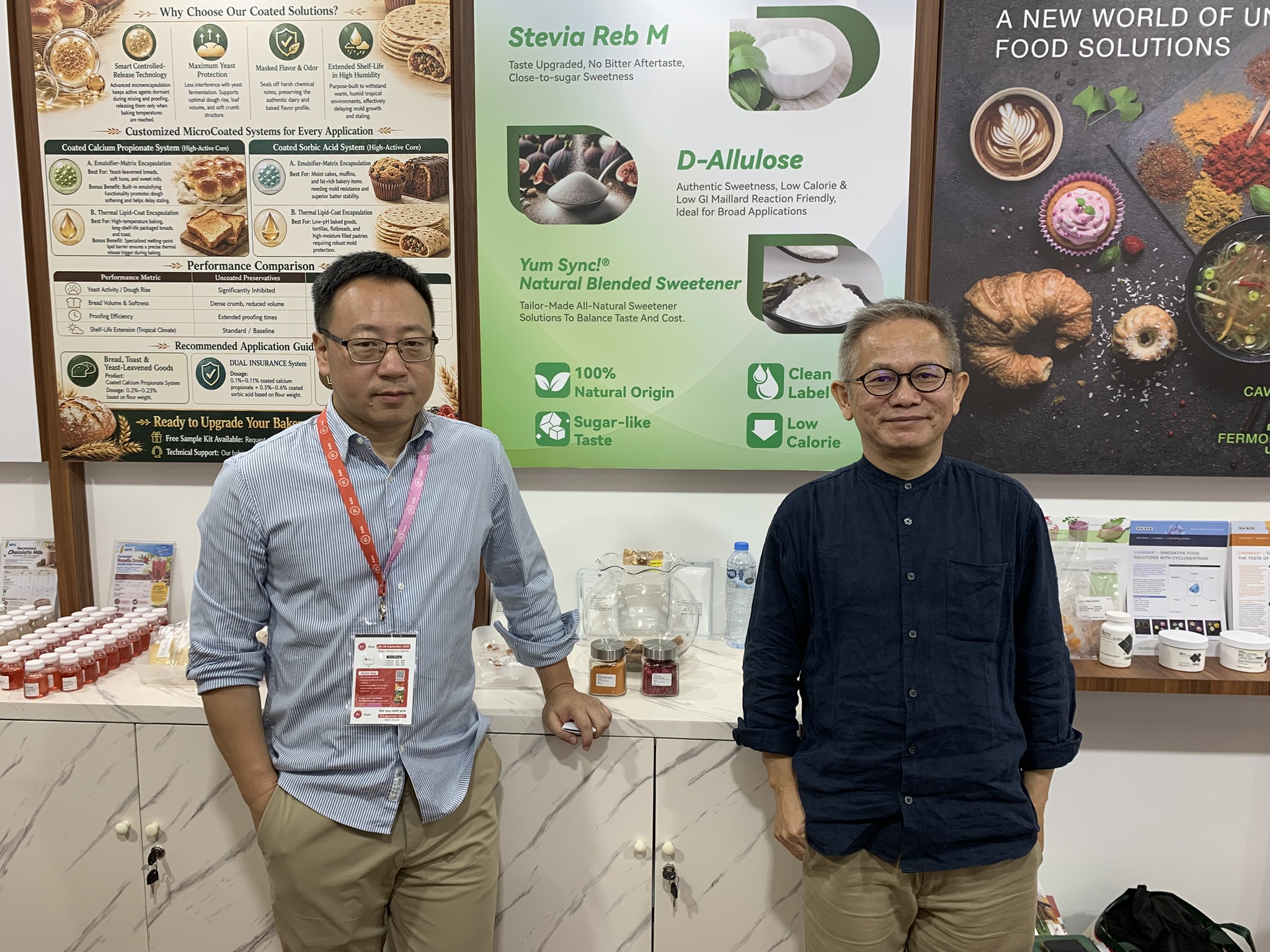 Jingkai Shen and Philip Lin highlight Delytose’s tailored sweetener blends for balancing taste, mouthfeel, naturalness, and cost.
“They say the cost-in-use is too high for them, so we say, in this case, we should use the blend,” Lin explains. “Blend the allulose together with stevia, so it gives them a good mouthfeel compared with the stevia taste. The cost-in-use is also quite a lot lower, close to sugar.”
“Sugar does not only give you sweetness. Sugar also gives you a lot of body and mouthfeel,” Lin says. Removing its volume can require bulking or texturizing ingredients to rebuild the experience.
That is why Delytose frames its offer around the complete formulation. “You are not just trying to sell one product,” Lin says. “You have to put yourself in the customer’s shoes and provide what we call a total solution. We give you the whole recipe, and we teach you to reformulate your product.”
Stacking value into one formulation
Cosun Ingredients paired Sensus chicory root fiber with Tendra fava bean protein, combining protein and fiber enrichment, prebiotic positioning, sweetness, and sensory support.
Eszter Heijnen-Nagy, commercial lead at Cosun Ingredients, says affordability is “always the biggest challenge for formulations: how to position and give the right value.” The question is whether an ingredient can support several targets and help produce something consumers will buy again.
“Bringing together more than just one ingredient does help customers in terms of their formulation needs,” says Michael Chow, sales manager for Asia at Cosun Ingredients. “We have grades of chicory fiber that actually add some sweetness, and that works excellently in a beverage application.”
Tendra adds soluble plant protein with a neutral flavor and stable viscosity at higher concentrations. Cosun also sees applications in dairy alternatives, bars, nutritional beverages, and powders.
Yet the economics eventually depend on repeat purchases. “Texture in general, and I would say also taste, are very important because consumers will repeatedly buy products if they taste good and the texture meets local preferences,” Heijnen-Nagy says.
“We see active nutrition coming into mainstream food, from supplements to standard food,” she adds. “The marketplace for food and beverages is moving to a different stage.”
Health still has to taste familiar
Lautan Natural Krimerindo (LNK) framed value through taste and ease of use. Its showcase included a zero-sugar FiberCreme variant, plant-based creamers, and a cold-soluble creamer.
“Customers nowadays are more concerned about health,” Hartanto tells Food Ingredients First. “They want a healthier version, but they don’t want to sacrifice on taste.”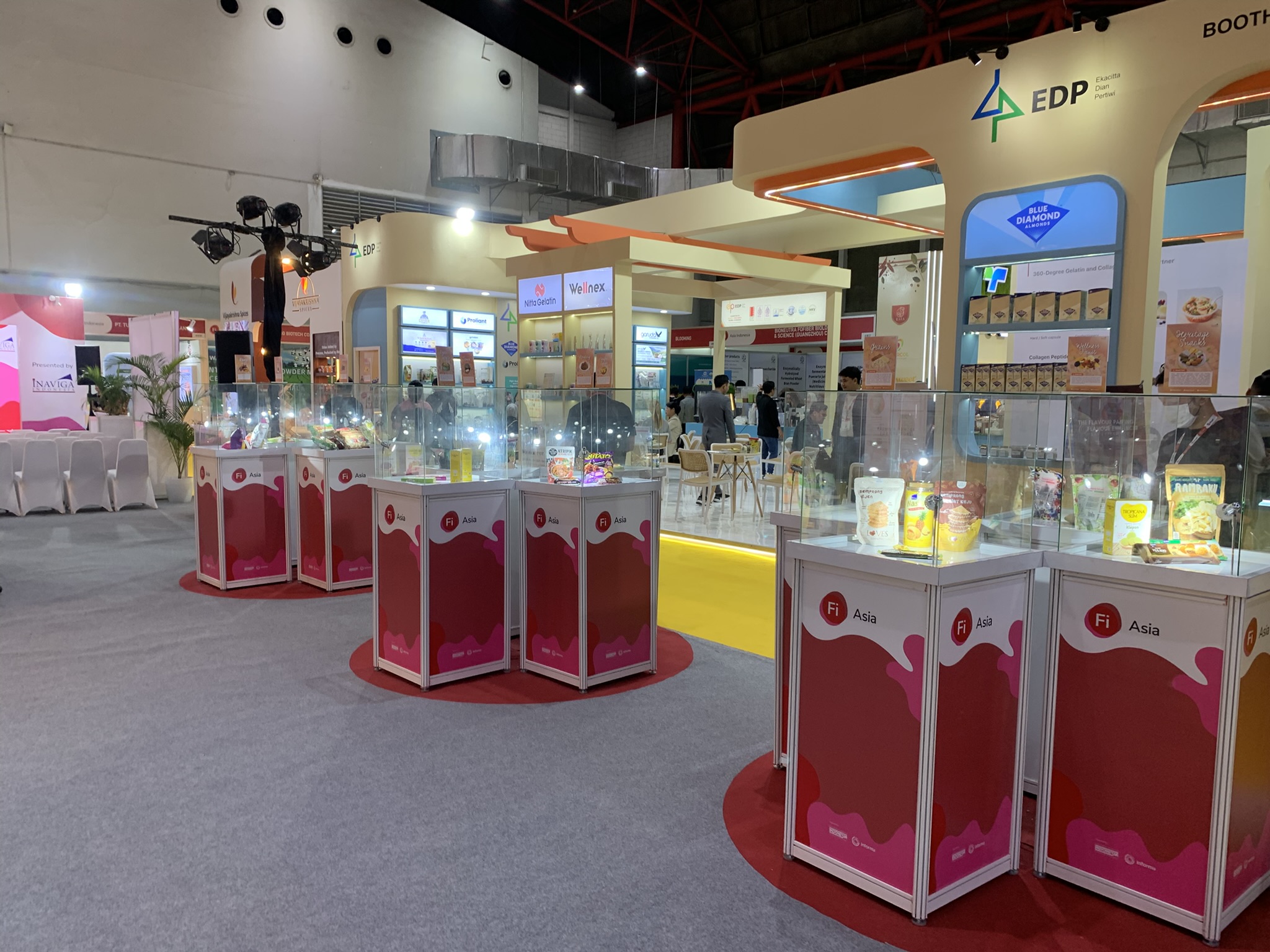 Fi Asia Indonesia 2026 suppliers demonstrate how whole-recipe reformulation can deliver healthier products at viable price points.
That tension is particularly clear in plant-based products. LNK offers fully plant-based formats as well as hybrid dairy-plant formulations for customers seeking a more familiar dairy profile. “The plant-based market is growing, but consumers still want good taste,” Hartanto says.
The cold-soluble concept addresses preparation as well as formulation. “Previously, the creamer normally needed to dissolve in warm water,” Hartanto says. “But we innovate and formulate, so this creamer can dissolve in room-temperature water and also cold water.”
For Hartanto, commercial viability begins with a basic sensory threshold. “Taste has to be good,” he says, “but it also has to be a healthier choice for the consumer.”
The real price of reformulation
Our conversations with suppliers at Fi Asia Indonesia 2026 pointed to one working rule: establish the hierarchy of pack price, nutrition, labeling, taste, texture, and processing requirements early, then judge every ingredient across the formulation.
A more expensive component can lower total cost if it replaces several ingredients or simplifies production. A cheaper one can become expensive if manufacturers must rebuild the taste, body, stability, or convenience lost with the original ingredient.
In Jakarta, affordability was not the end of reformulation. It was where reformulation began.