




Ashwagandha targets mainstream F&B as formulation hurdles test suppliers


Key takeaways
- Ashwagandha is expanding beyond supplements into functional beverages, hot drinks, snacks, confectionery, and dairy alternatives.
- Stress support, energy, cognitive health, and everyday convenience are driving interest, although global launch growth remains modest.
- Bitterness, sedimentation, botanical authenticity, and batch consistency remain key barriers for food and beverage manufacturers.

Ashwagandha (or Indian Ginseng) is moving beyond its traditional position in capsules and powders, as manufacturers explore its potential in functional drinks, coffee and tea blends, confectionery, bars, and dairy alternatives.
The botanical’s established association with stress management and broader well-being gives brands a recognizable functional story, but incorporating it into everyday products presents sensory, stability, and sourcing challenges.
Innova Market Insights tracked 1,904 F&B launches globally featuring ashwagandha from July 2021 to June 2026. In the latest year, Hot and Soft Drinks together accounted for 41% of launches, almost matching Sports Nutrition at 43%. Overall launch activity edged up at a 1% CAGR during the five-year period.
Although growth remains measured, suppliers see opportunities to bring ashwagandha into more familiar formats, as consumers increasingly seek functional benefits from everyday foods and beverages.
“Stress, sleep, and burnout have become mainstream wellness concerns rather than niche ones, and consumers are actively looking for everyday food and drink that does double duty rather than adding another pill to their routine,” Kratika Gupta, chief strategy and marketing officer at OmniActive Health Technologies, tells Food Ingredients First.
From supplements to everyday formats
Functional beverages are emerging as a key testing ground for ashwagandha. Gupta points to ready-to-drink shots, sparkling and still functional waters, coffee and tea alternatives, and drinks positioned around calmness or recovery.
She says liquid formats enable brands to connect consumption with an immediate experience, such as relaxation, stress management, or preparation for sleep.
Beyond beverages, OmniActive is seeing interest in bars, gummies, chocolate, yogurt, creamers, and dairy alternatives. These categories allow the botanical to participate in the broader functional snacking movement.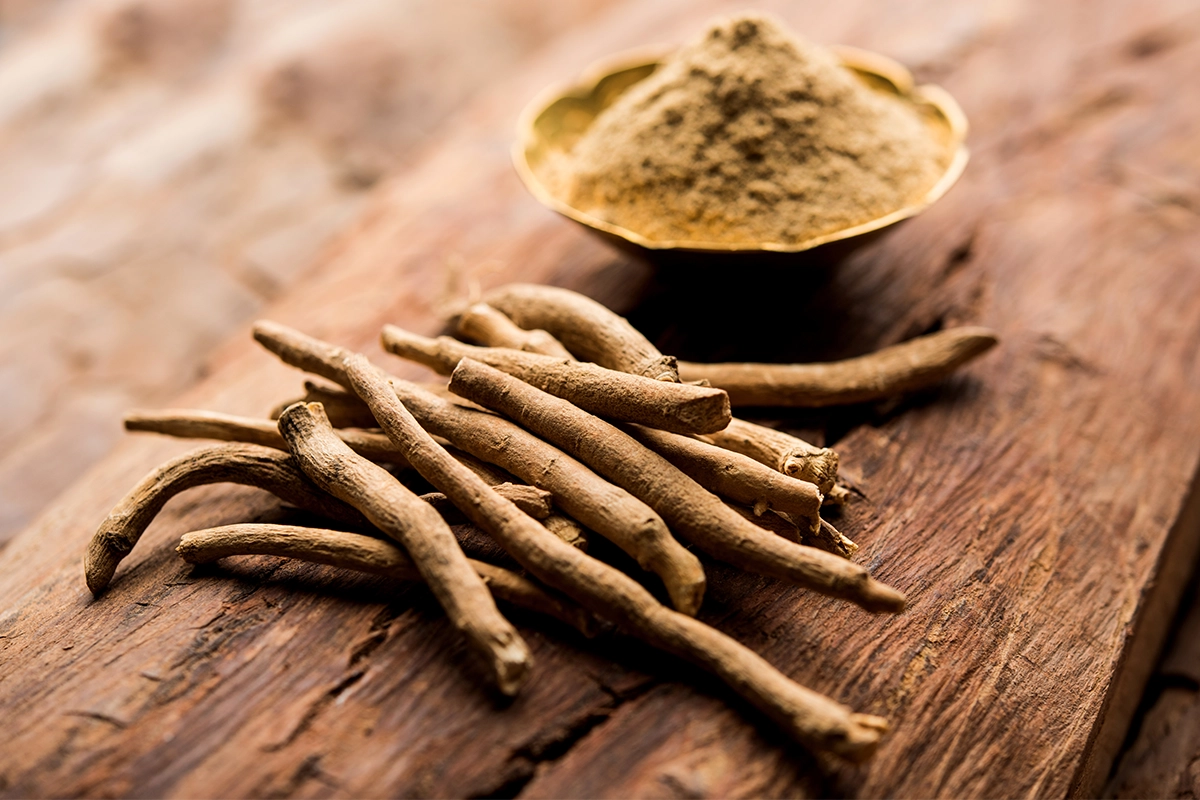 Ashwagandha is expanding beyond supplements into everyday food and beverage formats.
“Ashwagandha has built over a decade of consumer awareness and clinical research in the supplement world, so F&B manufacturers get a familiar, trusted ingredient story without having to educate the market from scratch,” says Gupta.
Prasanthi Sampara, manager of medical affairs at Ixoreal Biomed, similarly identifies ready-to-drink beverages, functional shots, and coffee and tea blends as areas showing strong movement.
“Ashwagandha is increasingly appearing in kombucha, sparkling water, smoothies, and other everyday beverage formats, moving it beyond the traditional capsule or powder aisle,” she tells Food Ingredients First.
Sampara adds that Ixoreal’s KSM-66 ashwagandha extract has been incorporated into more than 45 delivery formats worldwide, spanning beverages, functional foods, confectionery, and sports nutrition.
Innova data suggest that the botanical is also being positioned across several overlapping areas of health. Energy and alertness claims appeared on 35% of launches between July 2025 and June 2026, while immune and brain health positionings each appeared on 23%.
This positioning suggests that ashwagandha is not confined to relaxation concepts. It can also feature in formulations addressing focus, daytime energy, exercise performance, recovery, and resilience.
Regional and formulation opportunities
North America accounted for 43% of global F&B launches featuring ashwagandha from July 2025 to June 2026. Asia represented 27%, followed by Europe at 20%. Australasia accounted for 4%, Africa 3%, and the Middle East and Latin America 2% each.
The ingredient combinations appearing alongside ashwagandha provide further clues about how manufacturers are positioning the botanical. Excluding flavors and preservatives, stevia was found in 22% of launches, L-theanine in 20%, and vitamin C in 14%. Innova data indicates that hot and soft drinks comprised 41% of global F&B launches featuring ashwagandha in 2025–2026.
The presence of stevia points to demand for reduced-sugar or sugar-free functional products, while L-theanine reinforces ashwagandha’s role in calmness, focus, and mood-oriented formulations. Vitamin C enables manufacturers to connect the botanical with more established nutritional and immunity positionings.
However, low-sugar formulations can make ashwagandha’s sensory characteristics harder to manage.
Tackling bitterness and sedimentation
Ashwagandha naturally carries bitter, earthy, and vegetal notes that can conflict with the clean, refreshing profiles expected from functional waters and ready-to-drink beverages.
“At typical inclusion levels, it is very difficult to mask in a clean label, low-sugar product without heavy flavor masking,” says Gupta.
OmniActive developed its full-spectrum Zenroot root extract to deliver standardized withanolides at a comparatively low inclusion level. According to Gupta, reducing the amount of botanical material in a formulation helps limit its sensory footprint while improving dispersion and reducing settling.
Lower inclusion can also reduce the pressure placed on stabilizer and emulsifier systems in ready-to-drink products and powders intended for reconstitution.
Gupta says Zenroot is manufactured to maintain its withanolide profile under standard F&B processing conditions and throughout shelf life. This is intended to reduce the number of reformulation cycles manufacturers need to address taste and stability problems.
Ixoreal is taking a similar application-focused approach with KSM-66. Sampara says the extract has a comparatively neutral sensory profile and is produced through a proprietary alcohol-free extraction process. The company also offers a high-solubility grade for beverages to help address clouding, settling, and sedimentation. Suppliers are tackling bitterness, sedimentation, and ingredient consistency.
KSM-66 has demonstrated stability at processing temperatures of approximately 100°C, according to Ixoreal, making it potentially suitable for pasteurization, hot filling, and baking. However, Sampara stresses that manufacturers must validate performance in the final formulation.
“The product matrix, pH, processing temperature, packaging, and storage conditions should all be evaluated to ensure that the desired dose can be delivered without compromising sensory quality or stability,” she says.
Scrutiny shifts to ingredient identity
As ashwagandha enters mainstream products, suppliers argue that botanical identity and standardization will become as important as taste and processing performance.
Gupta says increased demand has been accompanied by adulterated and inconsistently standardized materials entering the market. OmniActive’s Zenroot recently earned USP Verified status through the USP Ingredient Verification Program for Dietary Ingredients. The process includes assessments of production practices and ingredient quality.
For manufacturers, third-party verification can support incoming-lot assessment and procurement decisions by independently confirming identity, purity, and potency. It may also help manufacturers communicate a stronger ingredient-quality and transparency story to consumers.
Ixoreal emphasizes root-only sourcing and supply chain control. Sampara notes that the root is the traditionally used portion of ashwagandha and has a different phytochemical profile from the leaf.
KSM-66 is standardized to at least 5% total withanolides by high-performance liquid chromatography. Ixoreal controls its supply chain from cultivation and harvesting through root segregation, extraction, manufacturing, and finished-ingredient testing.
For F&B manufacturers, ashwagandha’s transition into mainstream categories may therefore depend on more than consumer recognition. Suppliers that can combine low-impact formulation, processing stability, botanical traceability, and evidence tied to the specific ingredient will be better positioned to move ashwagandha from specialist wellness products into everyday consumption.