



Good Food Institute Israel: How open-source AI could tackle alt-meat R&D bottlenecks

Key takeaways
- GFI Israel’s MeatCode platform aims to reduce duplicated R&D and help alternative meat manufacturers focus limited budgets on priority experiments.
- Shared datasets and modeling tools could accelerate meaty flavor development and give smaller companies access to expertise beyond their in-house resources.
- Common benchmarks and testing in real products will be essential to turn shared research into commercially viable plant-based and blended meats.
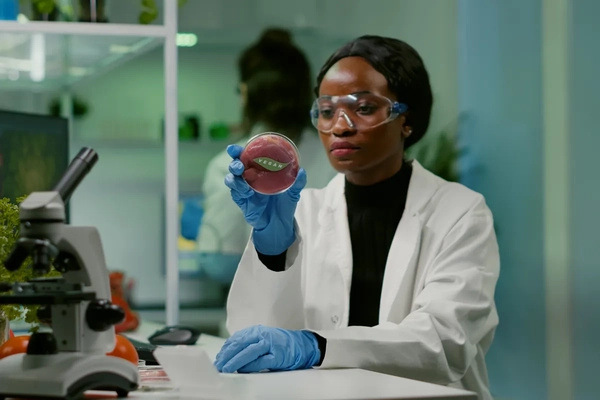
Good Food Institute Israel (GFI IL) is developing MeatCode — a free, open-source AI-powered knowledge platform that connects existing research, scientific benchmarks, and modeling tools to help alternative meat manufacturers reduce repetitive R&D. The organization highlights fragmented scientific knowledge as one of the barriers to innovation, particularly as companies face pressure to reduce costs and accelerate commercialization.
Developing authentic meat flavors in alternatives is a complex challenge for manufacturers as it involves flavor chemistry, ingredient functionality, and sensory science. MeatCode can help companies identify critical research gaps and develop more competitive alternative meat products without relying on extensive in-house R&D resources.
A soft launch for the platform is planned by the end of this year, with access expected early next year, Daniel Dikovsky, head of SciTech and chief scientific officer of Labs by GFI IL, told attendees at the recent Future of Protein Production (FPP) event in Amsterdam, the Netherlands.
Food Ingredients First catches up with Dikovsky to understand more about how shared scientific knowledge can accelerate “meaty” flavor development and help companies develop commercially viable plant-based and blended meat products.
In your FPP talk, what was the main message you wanted the industry to take away?
Dikovsky: My main message was that modern computational tools can connect knowledge across disciplines, geographies, and decades of research, giving teams a stronger starting point without requiring large R&D budgets. With our upcoming open-source, AI-powered platform, we are applying this approach first to a critical challenge: making alternative meat taste and smell truly meaty.
An open knowledge hub can help researchers build on existing evidence, identify gaps, and coordinate around the questions that matter most. Companies naturally protect their innovations, but there is also considerable scope for cooperation on shared scientific challenges.
Our motivation at GFI IL is to help build a food system that reduces environmental impacts and improves animal welfare. To achieve this at scale, alternative meats need to appeal to meat eaters and flexitarians as foods they actively want to eat. Shared science can help the sector move faster toward that goal.
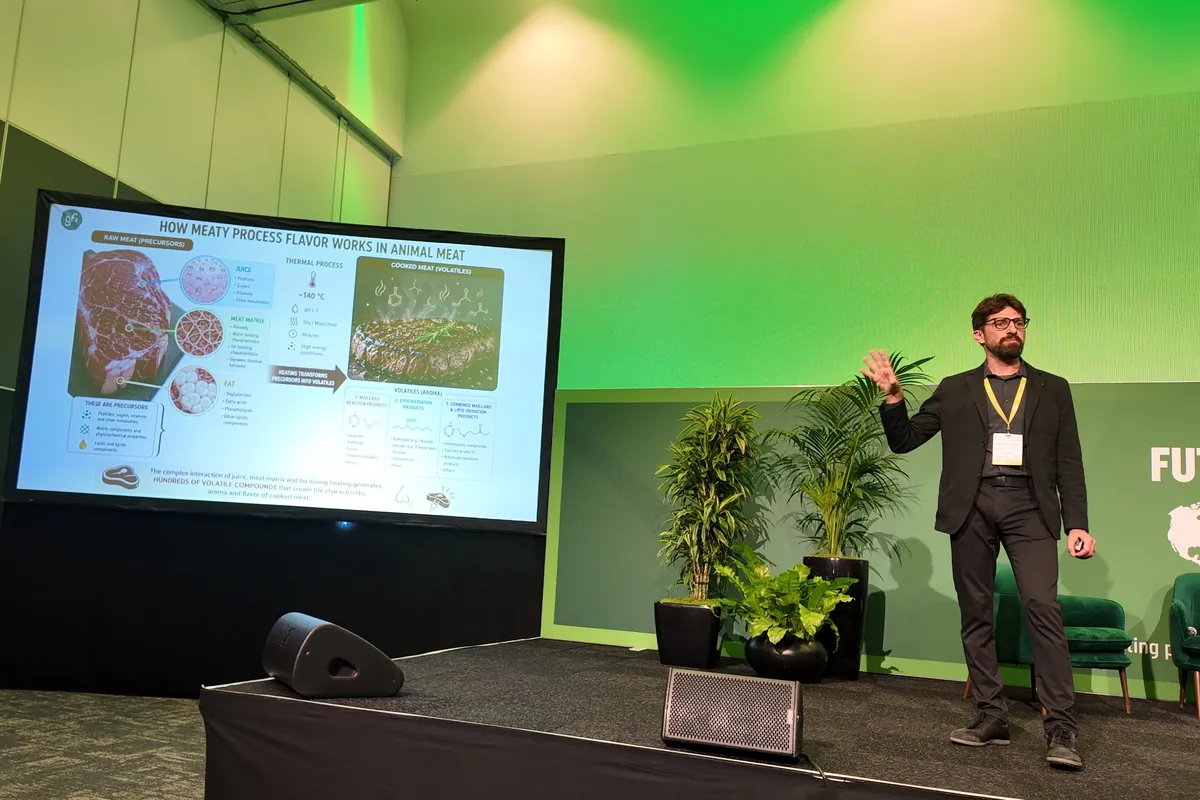 Daniel Dikovsky told FPP, Amsterdam attendees that recreating aroma formation during cooking could help close the taste gap with animal meat.
Where is the alt-protein sector wasting the most time or money by solving the same technical problems repeatedly?
Dikovsky: Teams often work in parallel on similar challenges, from protein texturization and formulation to preservative systems and manufacturing scale-up. Some repetition is necessary because products and processes differ, but shared foundations could reduce the need to start from scratch.
Meaty flavor is a particularly valuable opportunity. Flavor houses and food companies have developed substantial expertise through years of investment, and protecting that know-how is a natural part of their business. However, relatively little practical knowledge is openly accessible, so other teams may need to repeat foundational work before advancing their own solutions.
We see an opportunity to complement commercial expertise with open research on persistent scientific bottlenecks. Connecting industry experience with academic research can give more teams a stronger foundation for developing distinctive, competitive products.
How could shared datasets, benchmarks, and modeling tools help food and ingredient companies speed up product development?
Dikovsky: These resources can help companies focus their R&D time, budget, and equipment on the experiments most likely to advance their product goals. Shared datasets allow teams to build on existing evidence. Common benchmarks make results easier to compare and reveal where improvement is needed. Models and simulators, when validated against experimental data, can help predict outcomes and prioritize experiments before committing to expensive laboratory work.
With our upcoming open-source platform, our aim is to connect these resources with educational material and maps of relevant expertise. This can help teams understand unfamiliar topics, identify the work needed to reach a specific goal, and find collaborators with complementary capabilities. Together, these resources can shorten the path from a technical question to a useful product development decision.
 GFI Israel highlights taste, price, perceived health, and convenience as key priorities for winning over meat eaters.
Could open-source research help smaller companies compete with businesses that have much larger R&D budgets?
Dikovsky: Yes. Smaller companies can bring exceptional ideas, expertise, and ambition, yet struggle to fund the full range of R&D needed to deliver a competitive alternative meat product. Shared research and tools can lower those barriers, particularly around complex challenges, such as flavor.
Philanthropy has an important role in making this possible. We are grateful to GFI’s global community of donors for supporting scientific resources that companies can build on, helping teams turn promising ideas into products even with limited R&D budgets. These resources are intended for businesses of all sizes, and we welcome larger companies as both users and collaborators. But for a small team, access to shared knowledge and capabilities can be especially consequential — it can make a research direction feasible that would otherwise remain out of reach.
What needs to happen next for greater collaboration and knowledge sharing to translate into more commercially viable alt-protein products?
Dikovsky: We need to make collaboration a practical part of how the sector develops products. Alternative meats must deliver on taste, price, health, and convenience, while meeting the needs of both food service and retail. Achieving all of these together remains a substantial challenge.
We should also explore different routes to meeting those needs. Blended meats, combining animal and plant proteins, offer a promising opportunity to reduce reliance on animal ingredients while preserving familiar eating experiences at competitive prices. Their development involves many of the same questions around flavor, texture, and ingredient functionality, making them another valuable application for shared research.
With investment more constrained, there is a stronger case for pooling resources around these technical bottlenecks. That means agreeing on priority research questions, developing common benchmarks, and testing shared findings in real products, with commercial feasibility considered from the beginning. The goal is to turn collective scientific progress into products that consumers choose and buy again.