
- Industry news
Industry news
- Category news
Category news
- Reports
- Key trends
- Multimedia
- Journal
- Events
- Suppliers
- Home
- Industry news
Industry news
- Category news
Category news
- Reports
- Key trends
- Multimedia
- Events
- Suppliers
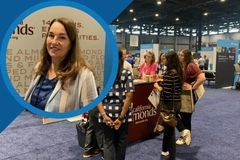
The Hansen sweet potato is unique for its red shade and natural positioning. It can replace carmine and Red 40, which is difficult to obtain from a normal erythrosine, explains Pernille Borre Arskog, Senior Manager, Chr. Hansen, at FiE 2019 in Paris, France. The company touted how the colorant is suitable for a wide variety of applications, ranging from beverages to plant-based meat alternatives.

This is Lakshmi Haig reporting from the SIE in Paris.
I'm here at the Christian Hansen stand with Perilla Bora Arsal, and she's gonna tell us about the Hansen sweet potato.
So tell us a little bit about the launch.
Yeah, so this is a new range of products that we launched last year and during this year, so it's been 8 products that we have launched based on the Hansen Sweet potato.
The Hansen Sweet potato is very unique because of its red shade that it has.
It's a carmine replacer and a red 40 replacer as , which is quite difficult to get from a normal cyanin.
And this color is minimally processed.
It's a heat stable in bakery applications and cereal applications, and it's also, to say when you are using it in a milk-based, like a milkshake type of products, it's more reddish than other anticyanin based colors, because it has a wider range.
It doesn't turn bluish.
Higher pH.
OK, brilliant, so it's very stable in that way, so obviously it taps into quite a few trends, and one of them would be the kind of vegan plant-based, , the fact that the sauce is a potato, but, how important is that to the ingredient?
So this is a plant-based ingredient and it fits very into the pan.
Based in the vegan trends, a lot of the emulsified meat products has also that pinkish shade, and the Hansen sweet potato works very in that application, also because it's a more neutral pH product and the Hansen sweet potato compared to others are more reddish in the shade and it's unstable.
And in the kind of R&D process of getting this coloring to market, what, what barriers did you face in developing a satisfying red shade but only from a potato?
So when we found this potato in.
In the field 10 years ago, it was a very weak shade or the shade was perfect, but the intensity was not high enough, so you would not be able to extract the right amount of color at it.
So we've spent a lot of years breeding, so selecting the right crop and developing that shade, so it was higher in intensity, having, having the right shade and also the.
Right yield at the end because in the beginning we could not extract enough.
So after 10 years we have developed a color that is a high yield, a high intensity product and still natural.
Yes, brilliant.
And what could the next steps be?
If you've already got a satisfying color, but maybe in the cost effectiveness of it, or do you have any plans for next year?
So we are continuously improving the process so we ensure that it's Becoming more and more cost efficient over the coming years and of course we will also try to expand on the platform to improve into other sub-applic applications where we are not covering with the with the ranges today like higher strength products or blends that are specific into, for example, extruded snacks brilliant.
One last note is I believe the ingredient won an award last night.
What was it for exactly?
So we won the Clean Label and Natural award, which was a good step for us, and we are very proud to receive this award, especially because we've worked so many years on developing something that is so unique and natural.
Yeah, done.
Congratulations.
Thank you.