
A banner featuring a sample box and dried vegetables
Home
Videos
IFFA 2025: ProteinDi...

IFFA 2025: ProteinDistillery upcycles brewer’s yeast for clean label egg replacer and binder

20 May 2025 | ProteinDistillery

We catch up with Ian Bothello, business development associate at ProteinDistillery, who discusses Prewtein, the company’s yeast protein derived from brewery side-streams. He tells us the product has functionalities similar to egg whites, such as gelling on heat, making it a sustainable egg replacer or a clean label binder in meat analogs.
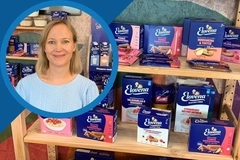

This is Anvisha.

I'm reporting live from Ife, Frankfurt, Germany.

I have with us today Ian Bothello, who's business development associate at Protein Distillery.

Welcome, Ian.

Thank you, Avisha.

Thanks for the opportunity to speak.

We're excited to speak with you.

Can you tell us what you're presenting at IFA this year?

For sure.

So at IA we showcase both protein.

Which is our flagship ingredient, which comes from the side stream of the brewing industry.

We create a functional yeast protein with functionalities very similar to an egg white.

So the most special is the heat set jelling.

It gels on heating and then stays a gel, so it can of course be used as an egg replacer, but also as a clean label binder in meat analogs, for example.

Apart from that, we also showcase our latest development in Prumix, which is a functional blend to improve on the bite and texture of meat analogs, and we show this through an application in meatballs, which also has pru fat, which is like a fat mimetic very similar to an animal fat and renders out it slowly.

But also in an omelet patty, an eggless omelet patty where protein is used for its functional properties there as.

Can you tell us more about the improvements that Prumix delivers in bite and texture for meat analogs?

Absolutely.

So the most common feedback that we received was a very interesting ingredient also from its nutritional properties, but It requires time to develop around the protein and to reduce this development time and to help the end customer deliver a better bite and texture, which is always, I would say the biggest hurdle in plant-based meat analogs.

We try to have a functional blend developed where protein is of course the main ingredient, but also some additional.

Clean label ingredients to to deliver what the customer needs in terms of a good texture and bite while remaining clean label in the end.

Now why is diversifying protein sources beyond soy and pea becoming more and more critical for the future of meat alternatives?

So soy, pea, of course, much better than.

Animal protein in terms of sustainability, but we have an opportunity to upcycle spent yeast which is normally given as animal feed, but it has much more value.

We of course showcase the protein.

At IFA, but we also have our own, side streams that we valorize through the yeast extracts or, you know, an open yeast cell where it can be used in multiple applications, not just in in human food but also pet food.

Cosmetics, it's the start of a very interesting future at protein distillery and one step at a time.

Your protein is classified as non-novel food.

How much of an advantage does that give you when it comes to market entry?

I would say quite a bit.

Of course there's less regulation.

Also customers are much more open to, you know, trying a new innovative ingredient when they know that it can directly be used in their recipes without having to wait for government approval, etc.

So I would say it's a huge.

Advantage for us.

What would you say are the biggest barriers to scaling fermentation-based proteins?

The good thing about our process is that the fermentation happens on the brewer's side, and what we do is a downstream processing to extract the protein and also the other elements of the.

The spent yeast, so for us personally it's much easier in terms of traditional precision fermentation.

Yeah.

Great.

Where do you see the most promising applications for clean label proteins in the next few years?

I would say of course the meat industry is the largest, is the most mature, and I think consumers demand for cleaner labels, lesser E numbers, a more nutritious product in the end because of its protein content, it also, you know, kind of matches the like to match the nutritional profile of of animal protein, also eggs.

So yes, of course Arifa meat is our main focus, but not limited to meat in the end.

There's also sauces and creams and cheese, alternative cheese products.

Bakery, of course, remains the biggest target market to reduce and replace eggs, but as I said, it's not just limited to human food applications, but also.

Cosmetics or pet food, pet feed, it still remains.

Massive markets to explore.

Great, thank you for sharing your insights with us today, Ian.

Thank you.

More videos

Image