

- Industry news
Industry news
- Category news
Category news
- Reports
- Key trends
- Multimedia
- Journal
- Events
- Suppliers
- Home
- Industry news
Industry news
- Category news
Category news
- Reports
- Key trends
- Multimedia
- Events
- Suppliers
IFFA 2025: Meatable CEO on using cell-culture to mitigate meat industry’s supply and price woes
27 May 2025 | Meatable
We spoke with Meatable CEO Jeff Tripician at IFFA, where the Dutch biotech company pushed the conversation around cultivated meat. He told us that Meatable’s strategy for scaling cell-based meat is “fundamentally different” as it wants to be a vendor, not a competitor, to the US$2 trillion meat industry, offering reliable and cost-effective alternatives.
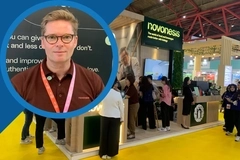
This is Anvisha reporting live from IFA in Frankfurt, Germany.
I'm here with Tripp, who's the CEO of Meetable.
Thanks for joining us today, Tripp.
We're so excited to be speaking with you.
My pleasure.
What's Meatable showcasing at IFA this year and what can visitors expect at your sessions?
Hopefully some big thinking.
We have a significant challenge in the food industry, specifically in the meat industry, supply over time, and that's stability and confidence in it.
And as we have population growth and demand increase, we've got to be able to have that supply arrive at quality and in time so we have some solutions to help the industry.
Are consumers ready for cultivated meat, and what are they really looking for in these products?
So first, I think consumers in any food product look for safety.
It's for them.
It's for their family.
And so regulators are doing a great job in the food system in general, and they are also with cultivated meat.
Specifically, they are ready, especially younger consumers, because cultivated meat is a technology first thought.
And as we all know, younger consumers are so much more open to technology solving problems.
Cultivated meat fits in perfectly.
How does cultivated meat fit into and support the existing meat industry?
Our strategy is fundamentally different than most in the cultivated meat space.
We are a vendor to the meat industry.
Simply put, we're an option for sourcing raw material.
Not very sexy, but really important.
It's a $2 trillion industry annually, growing at a nice pace every year predictably.
And so being able to have the meat industry have alternatives to real meat to meet that demand, no pun intended, is crucial to their success, and we're just the technologically advanced answer for that.
Let's talk more about your approach to cultured meat.
How does it make cultured meat more scalable and cost effective to other products in the market?
Yeah, so what we're able to do, cultivated meat in general is able to dramatically decrease the amount of time that it takes to produce product.
And to do it much more efficiently from a feed conversion standpoint, two big, big issues for the meat industry.
So lead time and balance.
You're not raising an entire animal to get the part you really want.
In cultivated meat, you just make what you need and you make it very quickly.
Now we do it in 11 days.
Most of the cultivated meat industry takes about 45 days, and obviously the livestock industry takes a year or two or longer depending on the protein.
Let's get a bit deeper into that.
What are the biggest challenges you're solving right now in bringing cultivated meat to market?
Sure, it's a couple of things because it's a very young industry, just like the first electric car, the first computer, the first of anything.
It takes time to figure out the difference between does it work in a laboratory setting or in a desktop setting.
And how does it apply at scale?
The meat industry is massive, so being able to prove you can do it in a little bit.
Gives people confidence, but people aren't going to commercialize until you have volume, so scale is the issue.
How do you get enough to make the meat industry say it's worthwhile?
So that's the big issue with scale you get price or cost.
So we can see in the next 4 years we have a clear line to cost at a price that the meat industry will embrace and consumers will embrace.
Scale is the key.
We're scaling with partners, both vendors in the industry as as pharma solutions that know how to do this.
And so it's a fundamentally different approach.
We're working with the industry to figure out scaling.
And trying to be a vendor to them versus going it alone and trying to compete with them, that is not our plan.
We're not going to be a competitor.
We're going to be a supplier.
Makes sense.
What's your outlook on regulatory approvals for cell-based meat in Europe and how are you preparing to navigate?
Sure, that's the other issue.
Out of our control, out of any company's control, is the regulatory process.
So first you applaud it because it keeps everybody safe.
And then you try to figure out how to navigate it.
So today we're working with 11 countries on how best to navigate their regulatory environment on a novel product.
It's not like they have a history of doing this, so we're figuring it out together, very collegial, very supportive, and so that's going.
Each one takes their own amount of time.
Some are as quick as 6 months from now, and some will be years.
Certain countries we know or certain areas we know have some rules that knowing them you can navigate.
So we have multiple product lines, some GM driven, some non-GMO.
There's different things we can do to facilitate speed through regulatory, and we're doing that right now.
Speaking of the future, what role do you see cell culture playing in the global protein mix in the upcoming years?
Upcoming year, gosh, we'll continue to scale, embrace meat companies, but it's not a year from now.
The size of the prize.
Is a global answer we have a global problem soil degradation, water pollution, water supply, climate, and hunger those are global issues.
There needs to be a global answer.
We could make money more quickly if we picked one plant in one country and said let's go make some money.
That's not the goal.
We're still going to make money, but we're going to do it on a global level by getting the meat industry to accept as part of the answer, why not get additional supply.
That they can do quicker, more efficiently, fits right in with what they're doing.
They don't need one new piece of equipment.
They don't have to deploy Capex.
None of those things are required, so it's easy for them to do what they do , and they have a hard job.
We're going to make supplying some more meat relatively simple.