


- Industry news
Industry news
- Category news
Category news
- Reports
- Key trends
- Multimedia
- Journal
- Events
- Suppliers
- Home
- Industry news
Industry news
- Category news
Category news
- Reports
- Key trends
- Multimedia
- Events
- Suppliers
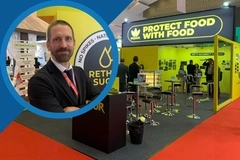
Rob Wires at the Vita Foods in Geneva and here with Holger Ribensberger from Fruitrom Health and Fruit Rome have had a pretty busy start to 2016 already with a spate of acquisitions.
Can you tell me first a bit about the acquisition of Alglo and how that strengthens your position in Asanan?
Small startup company in Israel and we decided to move into that as it is for us part of our biotechnology strategy.
So algallo is producing aztexanthin from red algae as a I would say more or less regular type of Aztecan, and nothing really special about that, but a growing market, a market that was full of constraints with supply, and that was one of the main reasons for us to move into that.
They have an innovative method, however, of growing the xanthin.
Can you explain a little bit about that?
That's correct.
Basically you have two types of technologies that are used for growing algae.
The one is closed systems.
You grow it in pipes, so to say, or in open ponds.
The system we have is a little bit in between, so it's a semi-open system.
It's a modular system which allows us to adapt very, very fast to change of demand, to increasing capacity.
When are you going to start pushing estaxanthin as an ingredient?
We are launching the project now in the next weeks in the US.
We'll start in the US as we have.
To obey the novel food regulations in Europe and submit a substantial equivalent to the second acquisition you made was a company called Grow Products in the US.
What did they do?
Grow Products is a very interesting company.
It's very long in the market, and they have developed a unique technology to increase bioavailability of nutrients.
By incorporating the nutrients into yeast, so what they do is they take nutrients such as vitamins or minerals, put it into an amino acid complex, and feed it to the yeast, so the yeast starts metabolizing the nutrients and brings it back in a more natural form and so in a higher bioavailability.
What type of ingredients could we be thinking of as the end product of this process?
Like I said, it's all types of vitamins, for instance, B12.
Also there is bioavailability studies like, any type of minerals you can think of.
That's the typical ones.
What we are looking into is also to go beyond that and feed, for instance, carotenoids from vegetables or extracts polyphenols to the yeast.
This company has existed since the 80s.
So it's quite an established company.
What is Fruitro going to bring now in terms of increasing the distribution for this company?
So what Fruitter particular can bring in is that we have a global reach, a global sales and marketing organization that can bring this product out of the US, as you are right, was established in the US a long time ago.
It's very deeply rooted US company, and they have never gone beyond the borders of the US.
Finally, at the beginning of May, you acquired a company called Extract Chemie in Germany.
What do they do and what does that bring to the food business?
Extraction Chemie is a German botanical extract manufacturer with a Pharma manufacturing site near Hanover in the north of Germany.
So for us it's mainly on acquisition.
We work as part of a larger one in our industry.
In the consolidation of this industry, so it's mainly a hold on increasing a little bit our portfolio on the farmer side, strengthening there, yeah, that's that's the main points.
So obviously it's been a busy time.
Can we expect this to continue?
Are there more things in the pipeline, I guess, in terms of acquisitions?
As my boss called for 2 billion in 3 years, I would be sure you can expect more to come.
How far are we down that route already then?
We have a run rate now for this year of 1.2 billion.
So 800 million to go, still a long way to go, but only 3 years' time.
OK, thank you, Holgers.