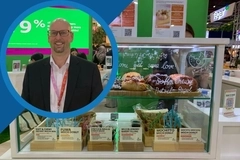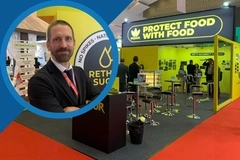



A banner featuring a sample box and dried vegetables
Home
Videos
FiE 2024: Planteneer...

FiE 2024: Planteneers advances affordable and nutritional plant-based steak

28 Nov 2024 | Planteneers

Planteneers was nominated for the FiE Food Manufacturing Innovation Award for its plant-based Steak 2.0 concept. Dr. Dorotea Pein, director of technology and innovation at the food-tech firm, explains why the product is innovative both from a manufacturing and price perspective. She also tells us about the company’s plans for 2025.


Fin Grins first reporting from FIE 2024 in Frankfurt, Germany.

I'm here at the Plantaineers booth with Doctor Dorothea Payne, who is the director of Technology and Innovation and member of the global leadership team.

Welcome to you.

So you have been nominated for an FAE award this year for your plant-based steak 2.0 solution.

What makes this solution so innovative?

So it's, it's from a manufacturing point of innovative because it, it needs a certain technology to produce it, but it's also innovative from a price point of view because it's really with this technology.

That stands behind the steak.

It's really possible to produce a certain amount per hour.

What makes it more cost effective than other solutions that are on the market.

On the other hand, the quality is high, so we have this fiber structure that you need for a steak, and you have the taste of a steak, so it's really a delicious product.

OK.

And how do you manage to balance cost effectiveness, clean label, and indulgence with this solution?

Of course the people want.

Have indulgent products, that's the main thing what they want to have from plant-based alternatives.

So this is always the first point, the first thing that we have to, the first characteristic that we have to meet.

Then of course price is important here.

We can play with different proteins, so we have more expensive protein sources and protein sources that have a lower price.

Point and we can really manage to meet any price point you want to bring into the market.

Consumers are increasingly concerned about the nutritional quality of their foods.

What sort of nutritional value do your products provide?

Of course we need a certain amount of protein in our products.

That's of course critical because people choose meat and also cheese for their protein intake.

So we need to meet.

Certain protein level, but we also don't want to miss the indulgence.

So there is a border or a limit that we can't cross.

Of course we also have as much fibers inside as possible because we really think in new categories.

So we need to enlarge the fiber intake in Germany and also in Europe and of course over the world because this helps us with digestive problems.

So this is really critical and of course.

We want to have to choose other protein sources, fat sources that we have a lower amount of saturated fatty acids inside, so we choose liquid fats for our products so that we have many unsaturated fatty acids inside the products.

And the industry and consumers are also increasingly privatizing the environment.

In what ways are your solutions for planetary health?

Plant-based alternatives to animal products are more sustainable per se because we directly use the plant-based proteins instead of going through an animal to produce another protein, so this is more sustainable, and we also proved that with a study that that this this is the case also with our products, especially with the meat alternatives.

This is more sustainable.

Do you think the average European consumer is aware that plant-based alternatives are more eco-friendly, particularly in terms of climate change mitigation than conventional meat products?

I think they are aware, but maybe the proof is outstanding so that we have certain figures or labels or things like that on the products, but it's not easy to calculate that because you have the production process, you have the production of the raw materials.

We can prove it for the raw materials, of course, and then also the production has to take care of this point.

And as a final question, what can we expect from Pines next year?

We have many, many new products in the pipeline, so we are focusing on new proteins, of course.

We work with microproteins and we also look into precision fermented proteins and cellular agriculture together with our sister company, and these are things where we are.

Sure that we can stabilize any protein that comes up there, and we are already working on that.

That's brilliant, thanks for your time.

Enjoy the show.

Thank you.

More videos

Image