
- Industry news
Industry news
- Category news
Category news
- Reports
- Key trends
- Multimedia
- Journal
- Events
- Suppliers
- Home
- Industry news
Industry news
- Category news
Category news
- Reports
- Key trends
- Multimedia
- Events
- Suppliers
Demand for shea rises, ingredient touted as attractive for vegan bakery
21 Jun 2021 | Global Shea Alliance
The Global Shea Alliance recently hosted its annual conference, which delved into sustainability, quality practices and standards, and the demand for shea ingredients in food and beverage applications. FoodIngredientsFirst speaks with a Global Shea Alliance leadership member, who flags the growing demand for shea and the goals the non-profit organization has achieved to date.
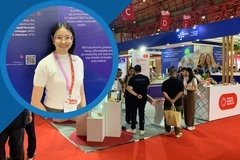
This is Elizabeth Green reporting for Food Ingredients First.
The Global Shia Alliance is hosting its annual conference which will promote and delve into sustainability, quality practices and standards, as as the demand for Shia ingredients in food.
Aaron Adu, the managing director of the Global Shia Alliance, is with us now.
Aaron, thank you for joining us today.
I know you're very busy this week with the conference.
Firstly, maybe you can share some insights with us on the demand for share across the F&B industry.
Thank you very much, Elizabeth, for having us and pleasure speaking to you.
We have seen increased application of share in the food industry, especially in niche markets such as, the vegan markets, and, specialized food like Spreads, in, in, in, in baked goods.
We have also seen some in, croissant, and then other foods, , such as ice cream, applications.
OK, that's very interesting.
Why do you think that it's becoming more of an attractive component in today's industry then?
We see that previously, the FMB industry was dependent a lot on, Palm and derivatives in palm.
Because of the issues with palm, it's given a lot of highlights to share.
And not just that, share on its own, it's a good sell, right?
The ingredient is natural, it is non-GMO.
It does not, its cultivation does not destruct forest.
And it also makes both climate and community impact.
And so, FNB companies are really interested in buying different share derivatives.
And I must also add that, There are a lot of different derivatives for application and share that can be produced by companies.
And so, in our opinion, that is why it is becoming very popular now.
And it's also a bit cheap, not too cheap, but a bit cheaper than other ingredients.
Mhm.
And then in terms of using it in formulation, how does it, how is it comparable against that of palm oil then?
Share is fractionated into, the share market is fractionated into steering and then holding, then different application or then the the steering or the oling is further processed.
The different companies have different derivatives that they propose.
To their clients for application in the food industry.
So all of these are like, a lot of them are company kept secrets, all right, because they produce very different derivatives and they proposed this.
Derivatives, , to their clients in the FNB industry.
But one, One thing that is common in the share application is that it's very flexible, all right, to be used for different ingredients, like in big goose, like in, spreads, Like in applications, such as even oils, right?
In croissant, it is very flexible and then so they're able to use it for all of these different applications.
Mhm, OK, fantastic.
So more on the the annual conference which is going ahead this week.
What is this year's event spotlighting?
And can you tell me a little bit more about the importance of spreading awareness of sheer practices?
Thank you very much again, Elizabeth.
Share is sustainable, sustainable, not just the fact that you can trace it to where it originates.
But the, the trees, the parklands sustain the entire savannah Sahel zone.
It sequestrates carbon and then it's, it's the main source of income for over 16 million women from 21 African countries.
So when people buy food containing share, they are not just buying a non-GMO.
They are not only buying a traceable product, they are helping to sequestrate carbon, they are helping improve the lives of communities in these very rural areas.
So the, the, this year's conference is highlighting the progress we have made by raising awareness for consumers to become aware, opening new markets for share, thereby increasing demand for shared kennels and shared butter from Africa.
What that does is that it helps the communities to keep the trees on the land.
So the conference is spotlighting.
The impact we have made so far and then Making a decision or agreeing with stakeholders to look into the future of Shell.
OK, that's fantastic, thank you.
And what has the Global Share Allowance Alliance achieved to date then?
Can you give us some sort of stats that.
Of of goals that you've actually met so far.
So the, the, the, on the, we have quantitative and qualitative impacts that we can talk about on qualitative ones.
We have conducted advocacy projects that has seen India now allow the use of shared derivatives in the food industry, or in chocolates.
We have seen the US FDA, Give a look, comment, , feedback to one of our members in their application, for the utilization of shareholding, in the food food industry.
Those are quantitative.
In terms of qualitative, we have seen that this increased demand has caused export from West Africa to jump.
By over 600% over the last decade and or, or, or, or two.
We have supported, provided capacity building to over 450,000 women over the past six years whose cumulative income has increased by over 47%.
We've been able to encourage industry, government, and donors to Invest over $70 million over the last 10 years in women empowerment and, and, and protection of the, of the resource.
We have put these women into cooperatives and provided over 400 warehouses that enables them to aggregate and operate as small businesses.
So instead of small-scale women working, we have now You know, turn them into small businesses, doing additional income generating activities, and thereby improving their livelihoods.
We have worked with producer countries and advocated for the Implementation of local bylaws that ban.
Tree cutting, shade tree cutting, and destruction of the environment.
Our members have implemented projects in beekeeping to improve pollination, among several other additional income generation activities, which is increasing or improving the livelihood for millions and millions of rural communities on the, on the, on the African continent.
That's fantastic, Aaron, thank you very much.