
Banner with cereal bars and Biospringer logo with a learn more button in the right bottom corner
Home
Videos
Anuga FoodTec 2024 l...

Anuga FoodTec 2024 live: Balancing Europe’s food system challenges and demands

22 Mar 2024 | German Agriculture Society DLG

Resource management and food system change are among the industry’s most pressing issues. We speak with the managing director for DLG’s Competence Center Food, Simone Schiller, about the food industry’s current challenges and the effects of supply chain disruptions on the industry.
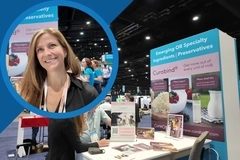
This is Natalie Sch Wertheim for food ingredients first.

I'm at the German Agricultural Society DLG stand now with Simon Schiller, the managing director for the DLG's Competence Center for Food.

Hi Simon.

Simon, what can you tell us about the shift in resource management you're observing?

Managing management, is shifting.

The sign of energy management, raw material management, and, especially also, the part of of the of.

Machinery and so on, and especially the energy management is one of the biggest points for resource because energy is very expensive and we have a shift in the direction of.

Green energy and that's important also for the food, food producer, food industry, because they want to reduce their CO2, carbon footprint and that's one of the possibilities.

Mhm.

And besides resource management challenges, the food system is also changing.

What can you tell us about all these changes here?

Yes, we have a lot of changes, especially in the food system, because on the one hand we have the consumer demand for.

Original products for healthy products.

For green products and they want to cook very delicious products for themselves.

On the other hand, we have a challenge for reducing meat, and this is one of our biggest challenges because on the one hand, we have to look for to have a lot of lentils, peas, and all this stuff to make alternative products.

And on the other hand, we, have to, to bring good products for all consumers who decide to don't eat, meat.

Mhm.

Now earlier we also discussed.

Differences in generations regarding food system change.

What can you share with us?

Yes, that's very interesting because the younger generation, young people, so we eat peas, we eat lentils, we eat chicken beans, and we can enjoy this delicious food, and the older generation are not.

So flexible, they want alternative products to bring something on their bread, to have something like meat, like sausage, and so we need some new products, alternative products which you can use like the sausage and the normal.

And besides the changing demands for plant-based alternatives, what are other consumer demand changes you are currently observing?

They sustainable products.

And they are looking, if the products, are sustainable, produced.

The, they want to have to know the CO2, carbon footprint, the water footprint, they want healthy products.

They want, , they want, to know transparency of the ingredients, and, this is, a demand of the consumer on the one hand, on the other hand.

Is also very important.

The price if you have inflation and a lot of costs in the surrounding of the consumers, they look for the price and for cheaper products and so we can.

We can see that the that the consumer on the shelf decide sometimes for private labels, and they prefer to go to the discounter and not to the supermarket and so there's a lot of change in the consumer demand.

So although more sustainable products might be available, consumers end up choosing the cheaper options.

Moving on to something else regarding trade challenges in Germany and the EU.

What can you tell about challenges and retailers' demands?

Yes, retailers want the raw material of the product.

Regional and regional products it's sometimes difficult to have enough raw materials because in Europe we don't have so much peas and lentils and so it's a challenge for delivering for the farmers and also for the food.

And then what can be done to support farmers that they can that they can deliver the products?

We, we have to say to the farmers what what characteristics the raw materials must have.

They have the right proteins, the right carb, the right ingredients in the in the raw materials, the right product.

And that is our responsibility to to have a discussion with the farmers and to bring the development, for, for their products right.

And also regarding challenges, you're observing supply chain issues, mostly for food technology.

What can you tell us about these?

We have some challenges in the supply chain for the machinery because sometimes parts are not available because the supply chain is incorrupted.

It can be a very sort of challenge.

And now finally Simon.

The organization also conducted a scientific packaging survey.

What can you tell us about how the survey was conducted and some insights into the main findings?

We surveys.

Consumers with 11,000 interviews and on the other hand, one interviews with the food industry and we had 186 interviews and the consumer said on the first place.

If they decide for a product, for food product, it's the taste.

And only on the 7th place is sustainable packaging.

So that's 11 point.

The next point is sometimes consumers decide to take another product if they think the packaging is not sustainable enough.

Consumer thinking that they know what is sustainable packaging.

On the other hand, they want a label which is very easy and transparent claim like claim, for example, reusable.

The climate, climate, , no, no, no, yes, neutral, climate friendly, neutral, yes, thank you, and, that's, that's, the, the demand of the consumer.

And Yes, and not 11 point, the consumer, thinks that, glass is the most sustainable material and, the food industry, so, Reduce packaging on the first step and the first target, and the second target is to close up recyclability.

That are the two big targets for the food industry.

The food industry knows that the retailers sustainable packaging materials.

Brilliant.

Thank you very much for speaking with Food ingredients for us today.

It's a pleasure for me.

Thank you.

More videos

Image