- Industry news
Industry news
- Category news
Category news
- Reports
- Key trends
- Multimedia
- Journal
- Events
- Suppliers
- Home
- Industry news
Industry news
- Category news
Category news
- Reports
- Key trends
- Multimedia
- Events
- Suppliers
Anuga 2025: AB Technologies launches lower-emissions hybrid cheese for ready meals
13 Oct 2025 | AB Technologies
AB Technologies launched From Up, a new brand of hybrid cheese, at Anuga. The product features 60% dairy cheese, potato ingredients, and grapeseed oil, which boasts additional health benefits. Alexandre de Ferrier, sales manager at AB Technologies, explains how convenience foods can benefit from From Up.
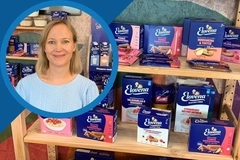
This is Missy Green with Food Ingredients First at Innuga 2025.
I'm here with Alexander, who's a sales manager at From Up, which is a brand of AB Technologies.
So Alexander, could you tell us what is From Up presenting here today?
From was born after an analysis of the market and specific needs of some customers asking her for reducing the carbon footprint and with a better nutritional value for our cheese, so we developed during a long time a specific.
With these double objectives of carbon footprints and nutritional value, keeping a very nice taste and functionalities for the food industry, so good melting point, good sliceability, perfect for shredding, for topping.
So this is a formulation developed by our R&D team.
A Technology is a leader in the formulation for alternatives of cheese processed cheese, analog cheese, vegan cheese, and now hybrid cheese is a new category which helps us to give an answer for the market for carbon footprint impact and for nutritional value impact.
What percentage of real cheese is it to plant-based ingredients?
It's around 60% of real cheese, and the rest is mainly grape seed oil and potato, so very clean short list, no additives and In that way you can have a good nutritional value because in the form of cheese you have omega 6 and vitamin E which is not present in normal cheese, so it helps you to have a better nutritional value with a low saturated fat in percentage and about the carbon footprint, the impact is around 40%.
Less than a natural cheese.
Why are vitamin E and omega 6 added?
It was not added.
It's naturally present in the grape seed oil, so it's a better value because in cheese you don't have it, and these two omega 6 and vitamin E, help for the health and for vascular disease.
Helps to avoid it, so we say that OK, it's a perfect oil to be used in that way because you have many oils to make hybrid cheese, but this one, grape seed oil, is clearly better than rapeseed or coconut or palm oil.
So the important thing is how we can help people eating a nice product with a good nutritional value.
Where is this product available today?
Today we're just starting presenting the concept and all the prototypes we have.
We are ready to produce.
So in Anuga Fair, it's the first time we explained this project to all the customers.
We have very good feedback in those days, mainly for the Scandinavian country.
Belgium, Netherlands, in France, we have some industry very interested in replacing part of natural cheese with ivory cheese to help them to reduce their carbon footprint, and little by little we are looking for distributors and people to help us to extend the presence of the product.
So first we would start with France and Europe.
And the next step would be mainly American and Eastern countries.
Do you see companies more looking to use this product in order to reduce the cost of the carbon footprint without per se declaring it on the package, or do they think that they also want to be really clear that this is partly Plant-based.
How are you seeing that develop?
We see that the big companies, the big ready meal producer, must present a lower carbon footprint in the next year.
They have a programmer for the shareholders, for their partners, and they must explain how they can reduce it.
They already worked on the structure on how they can buy better some plastics, some cartons to reduce their own production, but now they have no more way than working on the carbon footprint for the raw materials, so they start working on the two principal impact on the carbon footprint, which is The meat and the dairy.
The dairy is our job, so we help them to reduce through the cheese.
It's a big demand for industry.
Is this due to regulation or so because you said within the next year, so it sounds like there's a deadline.
It starts to be present in all the regulation in Europe.
The impact of what they would pay if they are not reduced, it's so important that they must find some solution, and we are here to help them for the future to keep a good move with their own governments to develop their activities with a low carbon footprint.