
Engineered yeasts turn PET bottles and crop waste into 3D-printed protein cookies

Key takeaways
- SIU Carbondale researchers will present programmed yeasts that turn PET plastic and corn waste into edible protein, at ACS Fall 2026.
- A pretreatment step opens up the plastic and biomass, a three-strain yeast consortium rebuilds the fragments into protein and fats, and a 3D printer extrudes the result into cookies.
- Waste carbon becomes an ingredient feedstock, but the cookies are still a demonstration as taste tests await institutional approval.
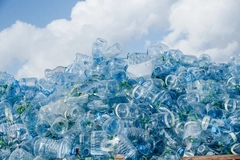
Researchers reveal that programming yeasts can make them convert PET, a type of plastic that is often used to make soda and water bottles, and crop residue into edible protein, vitamins, and flavor compounds. The team of scientists has created a concept in the form of a 3D-printed cookie dubbed µBites, pronounced “microbites.”
According to the researchers, plastic pollution and food insecurity are usually treated as separate problems. The team at Southern Illinois University (SIU) Carbondale, US, say they are instead treating one as feedstock for the other. The project began as plastic upcycling, and the food application came later.
“We were trying to develop technologies for plastic upcycling to make more valuable products. We thought, why not focus on making food?” says Dr. Lahiru Jayakody, an associate professor at SIU Carbondale. “Because plastic is carbon and food is carbon.”

Breaking down PET
The team from SIU are presenting the work this week at American Chemical Society’s Fall 2026 conference (Aug 23–27) in Chicago. The findings and prototype cookie will be exhibited during the “Undergraduate and Graduate Research in Biochemistry and Chemical Biology” symposium.
PET is among the most common plastics in circulation. Its molecules carry a lot of carbon, and the researchers state that carbon can be rebuilt into something closer to a protein. Chemical reactions and solvents can do that work in a lab. However, the SIU team is outsourcing the work to microbes.
“Microbes are very clever,” Jayakody explains. “So we are using their traits to solve the problems we created.”
He points out that yeast has served as a production platform for decades and offers insulin as a prime example. It is no longer extracted from animal pancreases, rather it is made with engineered yeast.
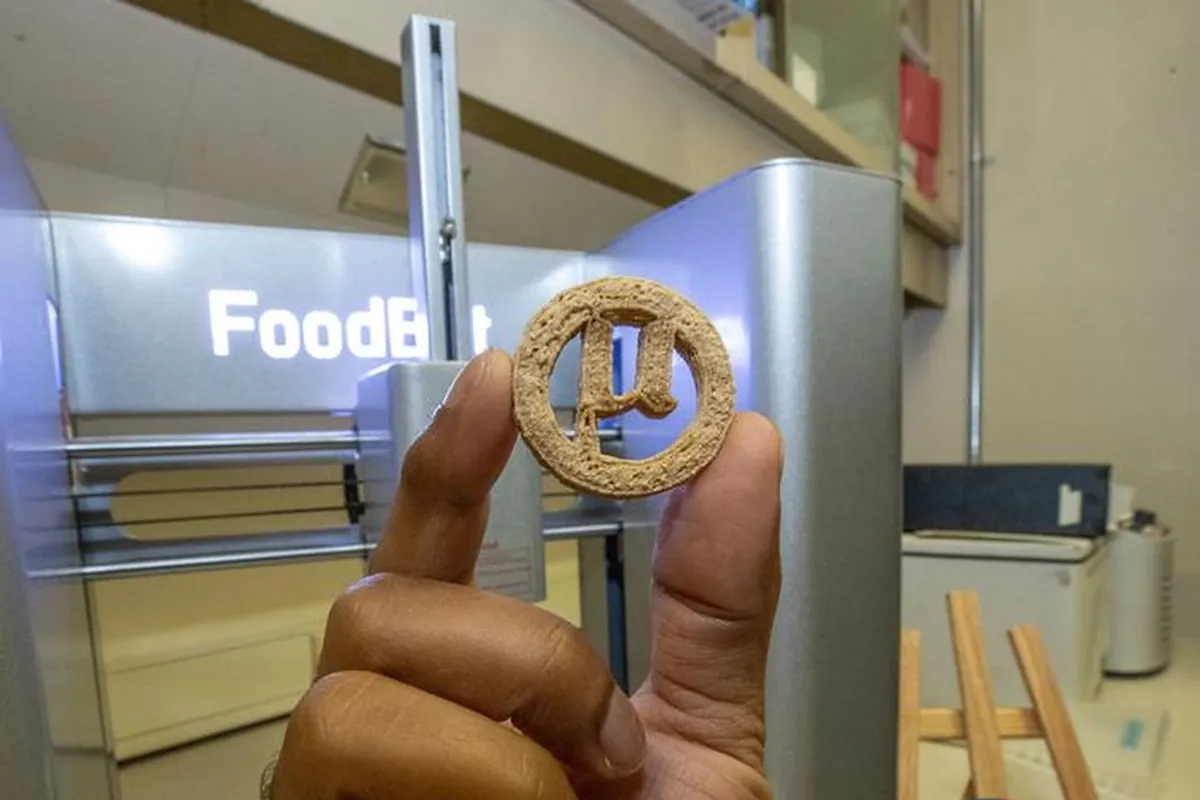 The cookie is made from PET and biomass transformed by yeast into an edible food (Image Credit: SIU Carbondale Communications).Jayakody and graduate student Sandhya Jayasekara applied the same approach to waste carbon, programming several yeast strains, including baker’s yeast, to convert molecules from plastic and agricultural waste into proteins, vitamins, and flavoring ingredients.
From waste to dough
The feedstock is PET, discarded corn stalks and leaves, and other biomass. It runs through a proprietary process called oxidative hydrothermal dissolution, developed by Ken Anderson, a geology professor at SIU Carbondale. The method uses water and oxygen at high temperature and pressure to break tough material into pieces that microbes can access.
The programmed yeasts take over from there, reforming the fragments into proteins, fats, and acids. Jayakody says that the researchers add fiber, starch, and sweetener, and then extrude the mix through a 3D printer.
The team has already demonstrated the 3D printing of the protein cookies using plastic-derived substrates and yeast biomass, according to the conference’s abstract. The current work is targeting flavor, aroma, and color.
The team says its data show the cookies are safe to eat, but no taste panel has run as those tests await institutional approval. Assessments so far cover aroma, where the cookies scored well, and most participants told the researchers they would be willing to eat them in resource-limited situations. Currently, the cookies carry no regulatory clearance in any market.
Jayasekara has engineered yeasts that make additional food additives with the aim of turning the cookies into something consumers would pick outside of a resource-limited setting.
Vanillin and beta-carotene
A strain of Saccharomyces cerevisiae, commonly referred to as baker’s yeast, has been engineered to produce vanillin, the compound behind vanilla flavor and aroma, from ferulic acid.
A second strain, Rhodosporidium toruloides, a type of yeast found in the wood pulp of conifer trees, went through adaptive laboratory evolution to improve its use of ethylene glycol from PET as a carbon source. It uses that to produce beta-carotene, which the body then converts to vitamin A.
Saccharomyces boulardii, a yeast strain that is commonly used as a probiotic in supplements, rounds out a consortium the researchers describe as safe to eat.
“We’re using microbes to develop the cookie into a more attractive, consumer-friendly product,” says Jayasekara. The researchers are engineering yeasts that add vanilla flavor and beta-carotene to the cookies.
Submarines and Mars
The work sits inside a NASA-led project on food production for deep-space missions. Funding comes from the NASA Deep Space Food Challenge and a National Science Foundation Career grant.
However, the researchers pitch the cookies well beyond space travel. The symposium abstract frames them as a route to addressing food shortage and plastic pollution at once, and as a contribution to a circular economy for plastics.
Jayakody wants to integrate microbes to produce and add starch, fiber, and sweetener to the cookie. He expects the cookies could be ready for public consumption within a few years. The use cases he lists run from disaster zones to submarines to colonies on the moon or Mars, as well as modern consumer demands.
“Global food demand is expected to rise 35–56% by the year 2050, and about 30% of the world population will be at risk of hunger in the future,” Jayakody says. “The way to address that, I believe, is by using microbes.”



Upcoming webinars

2027 Food Safety Risks for Quality & Compliance Leaders
FoodChain ID

Formulating for function: Developing benefit-led beverages with natural colours, botanicals, and flavours
Givaudan Sense Colour
Let's reveal the grain potential: Innovate
Meurens Natural