


Beyond faces Nasdaq delisting: What will the plant-based pioneer do next?

Key takeaways
- Beyond faces a potential delisting from Nasdaq if its share price stays below US$1 until August 2026, with options like a reverse stock split to regain compliance.
- The company’s stock has dropped ~97% since its 2019 peak, driven by weaker consumer demand for plant-based meat and intense competition from rivals like Impossible Foods.
- Beyond is shifting focus with the launch of Beyond Immense, a plant-based functional beverage, to tap into the growing high-protein, health-conscious market.
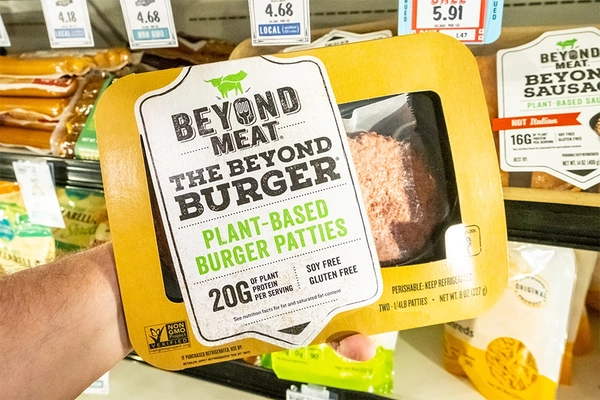
Beyond (formerly Beyond Meat) has until August 31, 2026, to save its listing on Nasdaq, after it traded below the minimum US$1 per share price for 30 consecutive business days. We look at how this early plant-based meat pioneer plans to bounce back from long-term sales decline and regain compliance with the US’ second-largest stock exchange.
The California-based company received a letter from the Nasdaq Listing Qualifications Department on March 4, 2026, warning that it would be delisted if it failed to trade above US$1 per share for at least ten consecutive business days before the deadline.

Beyond said in a statement that it may take action to regain compliance with Nasdaq rules. One option it could use is a reverse stock split, which combines existing shares into fewer shares to raise the price per share. The company noted that its shareholders approved changes to its corporate charter in November 2025 that would allow the board to implement a reverse stock split.
If Beyond does not regain compliance by the August deadline, it may be granted another 180 days to fix the issue. To qualify for this extension, the company would need to move its listing to the Nasdaq Capital Market and continue meeting that market’s listing requirements.
If it does not qualify for the extension or still fails to regain compliance, its stock could be removed from Nasdaq and traded on smaller over-the-counter markets, which typically have lower liquidity and less investor interest.
How did Beyond get here?
The Beyond Burger manufacturer’s stock has collapsed largely because its origin growth story (the rapid adoption of plant-based meat alternatives) has not materialized as quickly as investors expected.
The company’s share price has fallen from ~US$235 at its 2019 peak to ~US$1 in 2026 (a decline of ~97%). At the same time, Beyond has continued to post heavy losses, including a US$110.7 million net loss in Q3 2025, while carrying roughly US$1.3 billion in debt. An update on the release of its Q4 and full-year 2025 earnings has not yet been provided.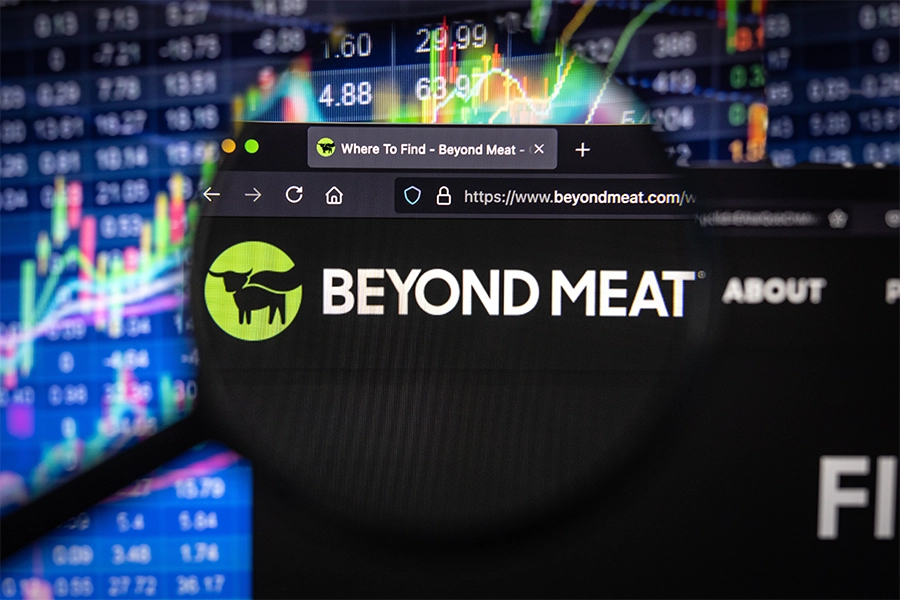 Beyond Meat faces Nasdaq delisting threat as stock hits record lows – can a reverse stock split save it?
The biggest factor in Beyond’s decline has been weaker-than-expected consumer demand. Growth in the plant-based meat category slowed sharply after the initial 2019–2021 hype. According to SPINS — a major data provider tracking grocery and retail sales — US retail sales fell 7.5% in 2025, with unit sales down 10%.
Some consumers find plant-based meat alternatives too expensive, overly processed, or less tasty than animal meat, which reduces repeat purchases. Consumers are also pushing for plant-based foods to be clean label and minimally processed, with shorter ingredient lists.
Meanwhile, major rivals like Impossible Foods entered the market. Large players, such as Nestlé (Garden Gourmet and Sweet Earth), launched or acquired their own plant-based brands, making the market more competitive and squeezing Beyond’s growth.
Beyond revealed last year that it would halt its operations in China and cut 64 jobs as part of a cost-reduction strategy. The company also reduced its workforce in North America and the EU by approximately 44 employees, accounting for 6% of its global headcount.
Beyond’s product diversification bet
Last year, Beyond Meat changed its name to Beyond, signaling a shift away from its meat-alternatives perception, as it repositioned as a plant-based protein innovator operating across multiple F&B categories in an attempt to revive its valuation.
Earlier this year, the company announced its first foray into a new, higher-growth market, with the launch of Beyond Immense — a functional, on-the-go beverage containing plant protein, fiber, antioxidants, and electrolytes.
Beyond Immense targets the rising demand for high-protein, functional beverages, as part of the company’s efforts to re-engage consumers and investors. According to Grand View Research, the US functional beverage market is expected to reach ~US$78 billion in revenue by 2030, at an 8.3% CAGR.
Innova Market Insights identified “Powerhouse Protein” as its top industry trend for 2026, finding that nearly 60% of global F&B consumers report actively increasing their protein intake. Beyond Immerse targets this growing demand with two options: 10 g protein/60 calories or 20 g protein/100 calories.
The low-calorie, high-protein formulation is likely to appeal to GLP-1 consumers, who require smaller, nutrient-dense products to support muscle maintenance.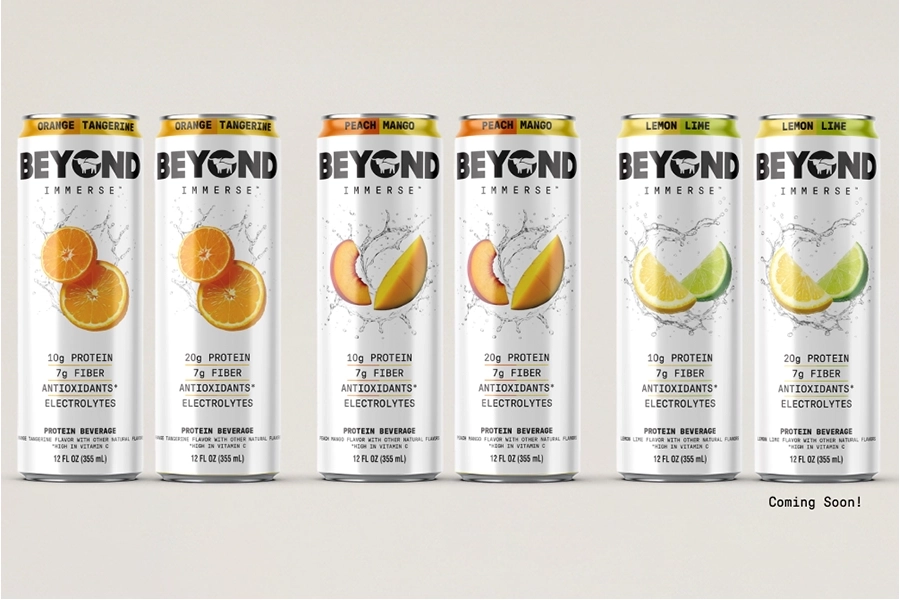 Beyond expands beyond burgers with the launch of a high-protein, functional beverage to revive growth.
Beyond’s functional beverage taps into several other leading trends identified by Innova — notably “Gut Health Hub,” “Beverage with Purpose,” and “Authentic Plant-based” — offering 7 g of fiber, antioxidant Vitamin C for immune support, and plant-based ingredients like pea protein and tapioca fiber.
“With Beyond Immerse, we are bringing our pioneering expertise in unlocking the power of plants to a functional beverage line,” says Ethan Brown, Beyond’s founder and CEO. “Our intent is simple: immerse the consumer in the remarkable nutrition of plants — from protein to fiber, with the addition of antioxidants and electrolytes — all in a single refreshing and satisfying 12 fl oz drink.”
Unlike dairy-based RTD shakes or protein waters, Beyond Immerse sits at the intersection of fiber-forward, plant-based, and low-calorie functional beverages. The line debuted in three flavors (Peach Mango, Lemon Lime, and Orange Tangerine), while the company showcased four other flavors at Expo West 2026 last week (Cherry Berry, Strawberry Lemonade, Piña Colada, and Cucumber Grapefruit).
Plant-based brands: Challenges and opportunities
Plant-based meat brands face a myriad of challenges, including taste and texture challenges and regulatory obstacles. Consumers increasingly demand high-protein, nutritionally optimized products that align with evolving health trends, such as GLP-1 use — but they must also be affordable.
Recent analysis by the Good Food Institute found that some plant-based alternatives are now cheaper than their meat equivalents in Europe. However, this cost advantage is driven primarily by growth in private-label products, sold under the retailer’s own brand, not by name-brands like Beyond.
As private-label brands rise, Beyond must innovate to stay competitive and maintain its leadership in the growing but increasingly stable plant-based market. Innova research indicates that NPD activity in the plant-based sector has settled, with a 4% CAGR in global F&B launches with plant-based claims from October 2020 to September 2025.
Beyond can also draw on its inherent value as a manufacturer of non-animal-protein products. Animal welfare is an increasingly important consideration for some consumers, with Innova finding that 30% of global shoppers say they look for animal welfare claims when making F&B purchases.
The Good Food Institute revealed this year that alternative proteins could massively bolster the EU economy, but only if regulators and investors treat them as a strategic priority. The EU recently moved to ban some meat-related names for alternative F&B products, though some descriptive terms like “burger” will still be allowed.