


AI and gene editing accelerate climate-resilient corn development for food ingredients


Key takeaways
- Rainbow Crops and Vylor are developing gene-edited corn traits to improve raw material consistency and climate resilience.
- The technology could help ingredient manufacturers secure more reliable corn inputs for starches, sweeteners, and proteins.
- The collaboration uses AI-driven trait discovery and multiplex gene editing to accelerate improved corn hybrid development.
Rainbow Crops is collaborating with seed and genetics firm Vylor to accelerate the development of novel gene-edited corn traits using AI, multiplex genome editing, and precision breeding. The move aims to develop more resilient corn hybrids with improved tolerance to climate stresses as volatility continues to impact agricultural productivity and raw material supply.
Many agricultural traits, such as drought resilience and yield stability, are influenced by multiple genes. Rainbow Crops says its Trait Foundry platform combines AI with multiplex genome editing to explore multiple genetic changes, supporting the development of more resilient and higher-quality corn varieties.
For ingredient companies, the partnership could eventually help sustain corn varieties that provide more consistent and reliable raw materials for applications such as starches, sweeteners, and proteins.
Food Ingredients First speaks with Giacomo Bastianelli, CEO and co-founder of Rainbow Crops, to understand how combining AI with genome editing can help manufacturers develop improved corn genetics for supporting more consistent and functional food ingredients.
The Ghent, Belgium-based company is an agtech spin-off from VIB (Flanders Institute for Biotechnology) and Ghent University’s Center for Plant Systems Biology and develops climate-resilient crop varieties. Vylor, meanwhile, is set to become an independent advanced seed and genetics company following its planned spin-off from agriculture giant Corteva on October 1, 2026.
Building a more reliable corn supply
Climate volatility is already changing what “reliable supply” means, Bastianelli tells us. Heat, drought, and unpredictable rainfall show up downstream as “inconsistency in the raw material long before they show up as a headline.”
Moreover, reliability in F&B ingredients starts “further upstream than most people think,” he argues.
 AI-driven insights could help develop corn traits that balance ingredient quality with agronomic performance, says Giacomo Bastianelli.“Corn is only as consistent as the plant it comes from, and traits like yield stability, drought resilience, and input efficiency all affect how predictable that supply is from season to season. Rainbow Crops’ Trait Foundry was built to improve exactly those agronomic traits.”
The AI-powered platform is used to develop corn hybrids that are more resilient to climate stresses.
“Resilience and performance aren’t treated as a trade-off in this process — the platform’s Design, Build, Test cycle screens for both together, so a trait only progresses if it holds up on both fronts,” explains Bastianelli.
“A more resilient, more consistent crop gives manufacturers a steadier raw material to build on, which matters as much for applications such as starches and sweeteners as it does for the farmer growing the corn.”
Rainbow Crops says its AI platform will support Vylor’s expertise in gene editing. The companies expect the collaboration to deliver complex agronomic traits that use inputs “more efficiently and, ultimately, increase yield to support farmer profitability.”
From crop genetics to ingredient functionality
The corn hybrids developed through the collaboration could potentially enable ingredients with enhanced functionality, Bastianelli shares.
“Traits such as starch composition, protein or oil profile, digestibility, and other grain-quality characteristics can, in principle, be addressed with the same platform, and these could ultimately translate into ingredients with different nutritional or functional properties.”
Additionally, quality traits often interact with agronomic performance, he continues. For instance, improving composition may affect yield, plant fitness, or stress resilience.
“In those cases, you do not want to optimize one trait in isolation, but the combination of traits together. That is a particularly good fit for Trait Foundry, because the platform is designed to explore multiple genetic changes and multiple phenotypes simultaneously.”
AI unlocks complex crop traits
Scientists are exploring gene-editing techniques across crops like rice and raspberry varieties, as the industry seeks ways to improve climate resilience while maintaining quality.
Using AI, Rainbow Crops is able to identify which genes and genetic combinations in corn are most likely to improve a given characteristic. These predictions can then be refined using phenotypic data generated during screening, Bastianelli explains.
“For food applications, that could mean optimizing characteristics such as starch, protein, or oil composition while simultaneously accounting for agronomic traits such as yield, plant fitness, and stress resilience. Once you start optimizing several traits together, the number of possible genetic combinations becomes very large.”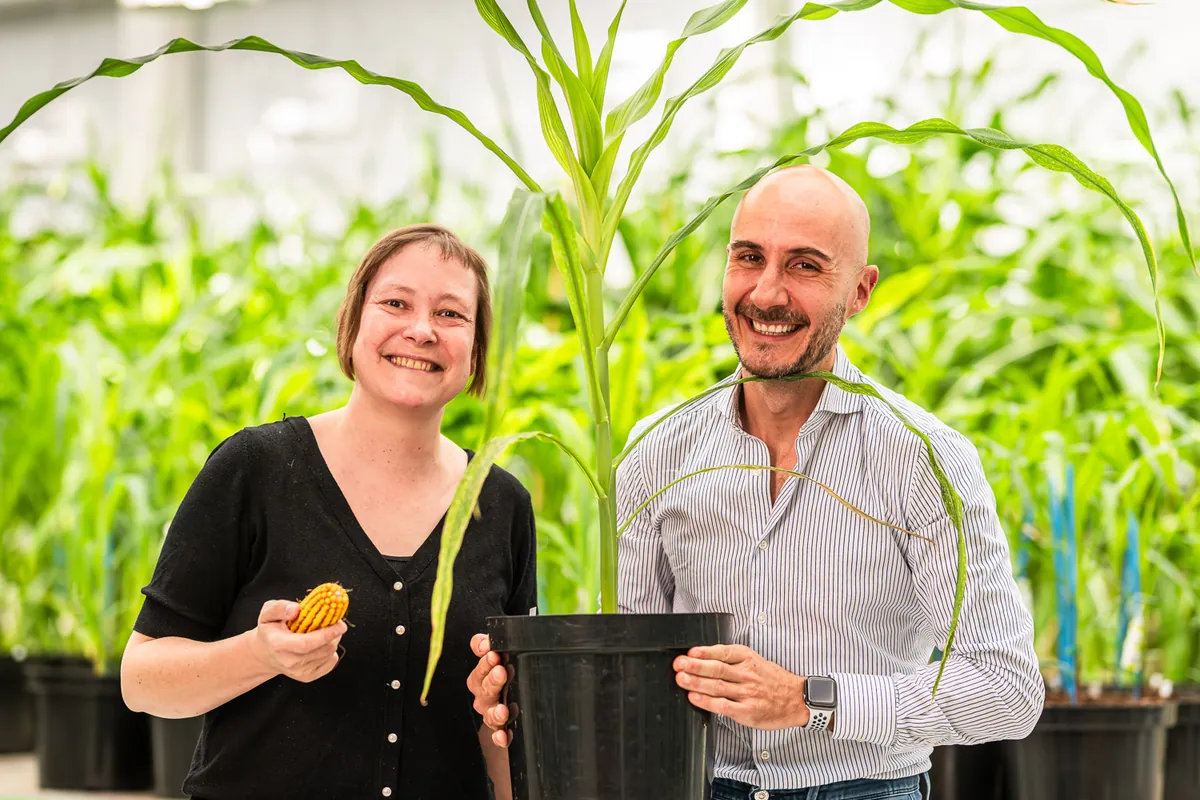
This is where AI becomes particularly valuable.
“It can help identify targets and combinations that may improve the desired grain characteristics while preserving, or potentially improving, the agronomic performance that farmers also need.”
Gene editing gains momentum in Europe
Beyond technological advances, regulatory developments will also influence how gene-edited crops are developed and adopted in Europe. In June 2026, the EU completed adoption of its new genomic techniques regulation, which creates a simplified regulatory pathway for gene-edited plants deemed equivalent to conventionally bred varieties. The rules are expected to apply from mid-2028.
For Rainbow Crops, the focus remains on advancing the technology itself and demonstrating how AI-driven crop development can address agricultural challenges.
“We’ve just announced a collaboration with Vylor to accelerate new corn traits, following our proof of concept in corn and the US$11.25 million oversubscribed seed round in June this year,” Bastianelli notes.
The company also received a US$7 million grant from the Gates Foundation in March 2026 to apply the Trait Foundry platform to maize, sorghum, and rice.
Looking ahead, Rainbow Crops aims to expand its platform beyond current projects and continue developing AI-enabled approaches for crop improvement.
Bastianelli says the company sees “real optimism” in applying AI to crop development with the potential to deliver meaningful real-world impact over the next decade.



Upcoming webinars

Oat-Standing Ingredients - Showcasing Irish Grain Through Innovation
Tirlán Ingredients

2027 Food Safety Risks for Quality & Compliance Leaders
FoodChain ID

Formulating for function: Developing benefit-led beverages with natural colours, botanicals, and flavours
Givaudan Sense Colour