

- Industry news
Industry news
- Category news
Category news
- Reports
- Key trends
- Multimedia
- Journal
- Events
- Suppliers
- Home
- Industry news
Industry news
- Category news
Category news
- Reports
- Key trends
- Multimedia
- Events
- Suppliers
Natural sweetener company Sweegen has expanded its better-for-you taste options with the launch of Tastecode. The natural flavors offer “very targeted solutions for which sugar was always used in the past,” explains Casey McCormick, head of global innovation. He also shares his perspective on what’s driving the sweetener space in North America and Europe and previews an exciting development for the company’s brazzein ingredient expected at IFT 2025.
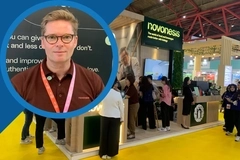
This is Missy Green at IFT 2024.
I'm here with Casey McCormick.
He's the head of global innovation at Swein.
Welcome, Casey.
Thank you.
So Swegen is presenting Taste code here at the show.
Could you tell us a little bit about what that is?
Absolutely.
So Sweet G has been in the natural sweetener space for coming up on a decade.
And over the past few years we've come to learn that there's a lot more that goes into cracking the equation of great taste beyond just having a superior sweetener system.
So what we did was leverage our expertise and biotechnology for nature-based ingredients to extend that platform into making natural flavor solutions that can complement our sugar reduction technologies.
Most importantly, can be very specific on solving the taste equation for manufacturers, and what that means is that we are offering very novel solutions in the flavors with modification property space, and these solutions are very targeted.
They're very simple designs to take care of basic taste problems that sugar has been always used to solve for in the past.
If your product was Astringent, add a little more sugar to it.
Your product has a bitterness from caffeine.
Add a little more sugar to it, and we know that some manufacturers are hesitant to maybe use additive non-nutritive sweeteners, so we wanted to offer them a line of technology that would solve their taste problem and delight their consumers but still meet their labeling needs.
OK, so these are actually flavors.
That can be used.
Correct.
Everything in taste code would be labeled as a natural flavor.
And while we do offer some sweet modifiers in the line, the line is much broader to address the entire spectrum of taste challenges that we know manufacturers are trying to solve for consumers.
So, there's also this new collaboration between Sweden and Sensogen.
You know, Sensogen is known for flavors.
Is this related to.
Taste.
It's not exclusive to Taste Code, but it is a partnership we're very excited about.
So, so tell us about that collaboration.
Yeah, our sister company Sensogen, they are, they are also in the natural natural solutions category, specifically with bio-based flavors, so they can sell you a great red fruit or citrus flavor, unlike Sweeten, who again only offers flavors with modifying properties.
Now when manufacturers tend to work with their vendors, the sweetener and the FMP vendor can often be different than the vendor who is providing the characterizing flavor.
And because those two companies are not coordinating, they tend to overdevelop their solutions to try and send the right message to overcompensate in terms of the FMP to balance out the flavor or the flavor is too heavy because the FMP is overdesigned.
This collaboration allows us to develop a very simple, elegant design for our customers in collaboration such that not only are we delighting them in terms of the taste experience.
But we're also passing along a very cost effective total solution for them as , so they're able to get the total solution at a very actionable price.
We know that today with high inflation that no manufacturer, no brand has an appetite to pass price on to the consumer.
The consumer continues to demand high value for dollar, and they're very price sensitive right now, but it doesn't mean that they're not aspirational and want better for you, better tastings.
So is this just from the fact that it's it's more cost effective because you guys are working together so then you're able to use the minimum amount that's really needed?
That's a big part of it again.
Our designs in the FMP world and, you know, we're only leveraging the one or two active ingredients in our flavors that that a product design would require.
We're not overdesigning it.
One addendum I would add to what you said though is because we are vertically integrated from the discovery to the manufacture of the novel materials that go into our flavors just like with our sweeteners, it also gives us a pricing advantage as because we are our own manufacturer of materials.
We are not purchasing these things from the market.
OK.
So another question for you.
What is, in your opinion, driving, what's the stronger driving force behind the use of stevia and beverages?
Do you think that's more a consumer interest and demand, or there's more happening from the government perspective?
It depends a bit where in the world you're asking the question.
I think in the United States it is primarily driven by public outcry looking at the obesity crisis that I will point out continues to get worse.
And the need for the food and beverage companies to be a part of solving that versus outsourcing the solution to the pharmaceutical companies.
There's a hesitancy among consumers to expand further into synthetics.
The people who are going to consume synthetic sweeteners have already chosen to do so to reach that next round of consumers.
You need to be in the natural sweetener space.
I think that when you talk.
About parts of the world such as Europe, that's where the governments play a much larger role.
Specifically, we see in Europe actively passed and in progress a number of different sugar taxes in different countries on different categories, specifically because those countries' governments are trying to get ahead of what is an emerging obesity crisis within the European Union.
And I saw that brosing is still being combined with flavors this year.
Is there any horizon for it to becoming a fully fledged sweetener?
Yes, this is our preview for IFT 2025.
So yes, we do still continue to sell our Sweettensify flavors, which those are natural flavors appears on the label as natural flavor but they are the active ingredient in there is brasine so those are actively growing in the marketplace today.
Sweet has prioritized though getting regulatory approval for brasine as an additive sweetener.
So we are currently finishing up some of the additional diligence required to build the dossier to submit to the FDA.
That will happen here in 24, beginning of 25.
That will also come with a self grass affirmation and it will also come with a simultaneous submission to EFSA, the European Food Safety Authority.
Sowegen is pursuing this very aggressively because again our material is not just novel but Incredibly high purity.
It requires us to do a very high level of diligence which we expect to be completed by the end of the year with regards to the actual approvals from those bodies, as mentioned, we will have a self grasp affirmation we expect by the end of this year.
So that's when I really encourage customers to really begin.
Partnering with Sweden understanding how this technology can integrate into the products and brands, we typically see 6 to 12 months from the FDA in terms of a no objections letter.
EFSA timelines tend to be longer than that, and I wouldn't want to speculate beyond likely over a year.
Does Bros have a natural synergy with Stevia?
It has a tremendous synergy with Stevia and would love an opportunity to come and see some customers and demonstrate that exactly for them.
OK, I'm looking forward to the next IFT for more information.
Thanks so much, Casey.
Thank you.