
- Industry news
Industry news
- Category news
Category news
- Reports
- Key trends
- Multimedia
- Journal
- Events
- Suppliers
- Home
- Industry news
Industry news
- Category news
Category news
- Reports
- Key trends
- Multimedia
- Events
- Suppliers
Fi Europe 2025: Faravelli advances texture and stability through customized functional systems
09 Dec 2025 | Faravelli
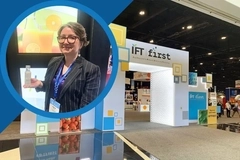
At Fi Europe 2025, Giulia Bulai, project manager & technical sales for Faravelli Functional Systems, discusses the latest functional systems designed to enhance texture and stability in plant-based, reduced-fat, and gelatin-free formulations. She explains how customized stabilizer and emulsifier solutions, supported by strengthened R&D and application expertise, help manufacturers overcome reformulation challenges and efficiently scale from development to industrial production.
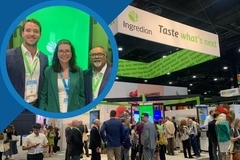
Finney Greens first, reporter from FI Europe 2025 in Paris, we're here at the Ferabelli stand with Julia Boulet, who is functional systems project manager and technical sales.
Welcome to you.
Welcome to you as.
Thank you.
So can you start by telling us what new FAA functional systems you're highlighting at this year's event, which applications are designed to improve the most?
So this year we decided to bring our gummies.
And we are promoting one of our ingredients we distribute is a monkfrit decoction.
Which is like a sweetening solution number without any number, so it's a clean label solution, and we combine it with our text runs as we also develop and sell our hydrochloid solution blends and in this case we brought one of our pectin which works at pH neutral, let's say so.
For example, you can combine it with non-fruity flavors like caramel, cola, or coffee, and there is a special pectin that works , let's say not a which normally the pectin would.
So yes, this is our innovation we bring this year.
That's interesting.
Can you tell us how is demand changing for customized stabilizer and emulsifier blends, especially in plant-based, reduced fat or gelatin-free formulations?
So I would say it depends on the market.
In Europe over the last few years, plant-based was a big thing.
And right now, at least my feeling is that the demand is stable, more or less.
There are some companies innovating still in plant-based, but some others, for example, in the Italian market, the dairy is a big thing, and I would say also in Germany and in France, but customers are always asking for.
Label solution or sugar free or fat reduce and so on and always moving towards a clean label, so trying to avoid some numbers in in the process in the product so many brands are struggling with texture and stability during reformulation.
Can you tell us more about the Of problems they bring to you and how thorough helps to solve these issues.
So I would say there are many problems that the customer can encounter.
For example, in drinks can be sedimentation or like missing a mouth fill, especially if you do something like sugar free.
You miss some mouth fill.
And in other creams or plant-based, I think can be synesis, so water separation.
For example, face stability like getting face separation over time and in general this is all things you normally solve with stabilizers and hydrocolloids, so we get many, many projects and depending on the customer's process and the The product and their machinery we develop like blends that can fit their system depending also on their requirements and we really study together with the customer solution and we do some first production with them.
We really support the customer in the lab.
Yeah, OK, so that leads me to my next question actually.
So how is the company strengthening its R&D and application support to help manufacturers move innovations from lab to full scale production more efficiently?
Yes, so the thing is we try to open like a dialogue with the customer from the technical side to the technical side.
So we really, we need to be there for the customer and we need to have like an open customer, maybe also sharing some recipes so that we can try them ourselves and try our blends into the into the recipe to fully support the customer.
And then it's quite often the case, we travel to the customer.
And we do trials together also first production maybe really to see their process and to understand where the problem can be.
So we try to create a trust relationship with the customers so that we can really support them openly.
Julia, thanks for your time today.
Thank you.