



Tufts University launches food-tech hub for scale-up and commercialization


Key takeaways
- Tufts University has launched a new innovation hub to help turn food-tech research into commercial products.
- The facility will support fermentation, cell culture, food formulation, scale-up, sensory testing, and biomaterials development.
- The hub aims to lower barriers for start-ups and researchers by providing shared equipment, expertise, and product development support.
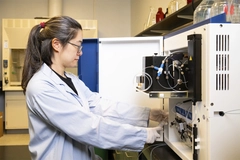 Lennie Cheung, a postdoctoral scholar in the Department of Biomedical Engineering at the Innovation Hub for Food and Materials.
Tufts University has launched a new shared research and development hub designed to help food-tech companies, researchers, and entrepreneurs turn early-stage ideas into commercial products.
The Innovation Hub for Food and Materials, based in Medford, Massachusetts, will give users access to equipment and expertise for food prototyping, bioprocessing, formulation, scale-up, sensory testing, and consumer research. Interim space is already available, while the fully equipped 17,000-square-foot facility is scheduled to open in fall 2026.
The facility is aimed at start-ups, established companies, academic researchers, nonprofits, and entrepreneurs working across emerging food technologies, novel ingredients, sustainable production, and biomaterials.
Tufts says the hub is intended to fill a gap between early research and commercialization, particularly for smaller companies that may lack access to expensive pilot-scale equipment and testing facilities.

“We’ve consistently heard from both researchers and industry that there is a need for shared infrastructure to move ideas forward,” says David Kaplan, professor of engineering at Tufts.
Food innovation from cell culture to consumer testing
The hub combines several stages of the product development process in one location.
Its BioLabs-operated incubator will include 46 laboratory benches, alongside offices, meeting areas, and shared working space. A food and materials technology core will offer capabilities including cell culture, fermentation, bioprocessing, food formulation, materials processing, and scale-up production.
A test kitchen and sensory analysis facilities will allow developers to move beyond laboratory testing and see how new foods perform in real-world settings with chefs and consumers.
The hub will also offer what Tufts calls a “technology sandbox,” where companies developing equipment, such as bioreactors, extrusion systems, and materials characterization tools, can test their technologies as part of a wider production process.
Another key resource is Tufts’ cell bank, which includes animal and insect cells as well as a plant cell collection covering more than 2,000 species. The hub will also collaborate with the Tufts University Center for Cellular Agriculture, which explores cultivated meat, alternative proteins, novel materials, plant-derived biomaterials, and hybrid plant-animal cell systems.
Lowering barriers for food-tech development
Tufts has invested US$4.6 million in shared research infrastructure and product development capabilities for the initiative. The core food and materials facility has also received support from a US$2.1 million grant from the Massachusetts Technology Collaborative.
The university says bringing infrastructure and expertise together could help companies test ideas without having to invest in their own laboratories or pilot facilities at an early stage.
The model could be particularly useful for emerging areas, such as cellular agriculture and fermentation, where companies often need access to specialized equipment before they have reached a scale that justifies building their own facilities.
The hub will also connect users with Tufts’ expertise in nutrition through the Friedman School of Nutrition Science and Policy and its Food & Nutrition Innovation Institute, helping developers consider nutrition, sustainability, and consumer needs alongside technical performance.
For Tufts, the aim is to create a more direct path from scientific research to products that can reach the market, while giving both young companies and larger industry players a shared space to test new food and materials technologies.



Upcoming webinars

Oat-Standing Ingredients - Showcasing Irish Grain Through Innovation
Tirlán Ingredients

2027 Food Safety Risks for Quality & Compliance Leaders
FoodChain ID

Formulating for function: Developing benefit-led beverages with natural colours, botanicals, and flavours
Givaudan Sense Colour