


Sweet protein blends drive next-gen sugar reduction at IFT FIRST 2026

Key takeaways
- Sweet proteins move center stage as precision fermentation and molecular farming unlock rare ingredients at scale.
- Stevia emerges as the go-to blending partner, pairing well with sweet proteins and monk fruit.
- Monk fruit takes two new paths: minimally processed decoctions and fermentation-derived mogrosides.
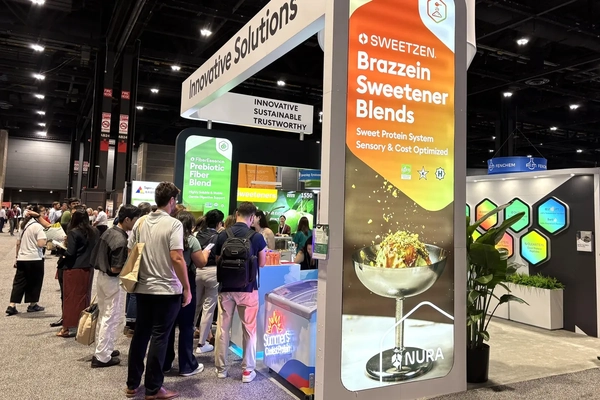
In the race to replicate sugar’s performance, innovation is happening at a minuscule level, both through precision fermentation and molecular agriculture. At IFT FIRST 2026, which took place in Chicago, US (Jul 12–15), sweetener suppliers presented small solutions that exert a powerful sensory effect.
Sweet proteins were a key component in new sweetener blends, such as honey truffle sweet protein, thaumatin, and brazzein.
Suppliers also explored new formats for monk fruit, with Layn Natural Ingredients presenting a gently extracted monk fruit decoction and Manus using precision fermentation to produce a monk fruit sweetener on US soil.

Scaling rare, sweet proteins
Precision fermentation is scaling up in the US, making many high-value ingredients more accessible. In the sweet space, MycoTechnology showcased its Zukora Honey Truffle Sweet Protein, released this year. The ingredient is reportedly 2,000 times sweeter than sugar and was initially isolated from a wild truffle that grows in Hungarian forests for just one or two weeks per year.
“There are several sweet proteins that have been on the market for years, like brazzein, monellin, or thaumatin,” says Jordi Ferre, CEO of MycoTechnology.
“The difference with ours is that we were the first to characterize this one. Our founder read about this sweet truffle through literature, and because we’re in the fungi business, he wanted to look into it. He made an expedition to the forests of Hungary with dogs; he found it and brought it back to the US.”
Back at the company’s R&D lab, MycoTechnology identified the sweet protein in the truffle, which comprises just 0.3% of the fungus. In March this year, the company received self-GRAS status for its novel sweetener.
“In a short period of time, we’ve been able to take this product to market. We have applications and are manufacturing it. We are already engaged with the big customers,” adds Ferre.
At the show, the company demoed a slushie with 50% less sugar using its Zukora protein and allulose to help with freezing. It also featured a sports bar with reduced sugar in combination with tapioca syrup.
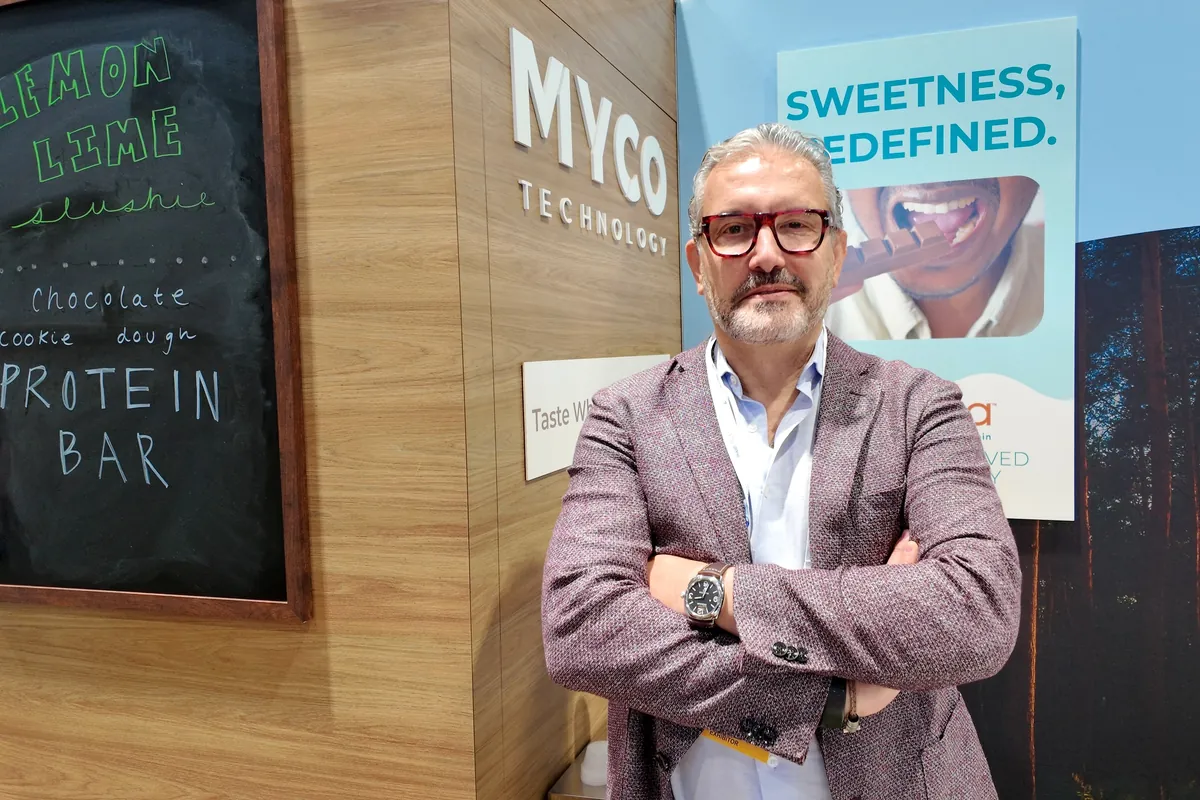 Jordi Ferre, CEO of MycoTechnologyProteins as sweeteners
When MycoTechnology brought its new ingredient to the US FDA, Ferre said that the company was given the option of calling it a honey truffle sweet “protein” or “sweetener,” but because of consumer perceptions, “protein” was the most consumer-friendly.
“Unfortunately, the average consumer may interpret the word ‘sweetener’ in a different way than it should be. Even sugar is a ‘sweetener,’ but consumers may connect the word with artificial sweeteners that have been in the market for a long time,” says Ferre.
Calling it a sweet protein may also win over consumers in the GLP-1 era, who are generally eating healthier and are mindful of increased protein needs. Although Ferre points out that at the extremely low inclusion levels, sweet proteins cannot contribute to a meaningful amount of protein.
Michele Scott, director of insights at Innova Market Insights, who gave a talk on GLP-1 in food innovation at IFT FIRST 2026, comments on consumer attitudes toward sweeteners:
“Artificial sweeteners aren’t a deal breaker [for GLP-1 users], but clean labels may be preferred, mirroring trends apparent in the general population. Among GLP-1 users, 40% are eating less sugar, while only 31% are actively reducing artificial ingredients.”
Recombinant technologies
Another sweet protein on the market to watch is thaumatin. Spain-based Nambawan, promoted its Thaûma sweet protein as the branded name for thaumatin II. The protein naturally occurs in the West African katemfe fruit at low levels, and it is 13,600 times sweeter than sugar, although its sweetness does not increase linearly. Nambawan produces its ingredient through recombinant technology and plant molecular farming.
“Thaumatin genes are introduced into crops like barley and sorghum in such a way that the protein accumulates in the seeds,” explains founder and CEO Yuri Gleba. “The seeds are then harvested, and the ingredient is purified from the biomass.”
Despite genetic modification of the host seeds, the final product can be labeled non-GMO. It also has four US FDA GRAS approvals and is approved by the Joint FAO/WHO Expert Committee on Food Additives.
When asked why the company uses molecular farming over precision fermentation, Gleba responded that Nambawan has over 25 years of experience in plant molecular farming across proteins in plants. “Precision fermentation is a competing platform, but up to now, there has not been commercial success for thaumatin made by precision fermentation.”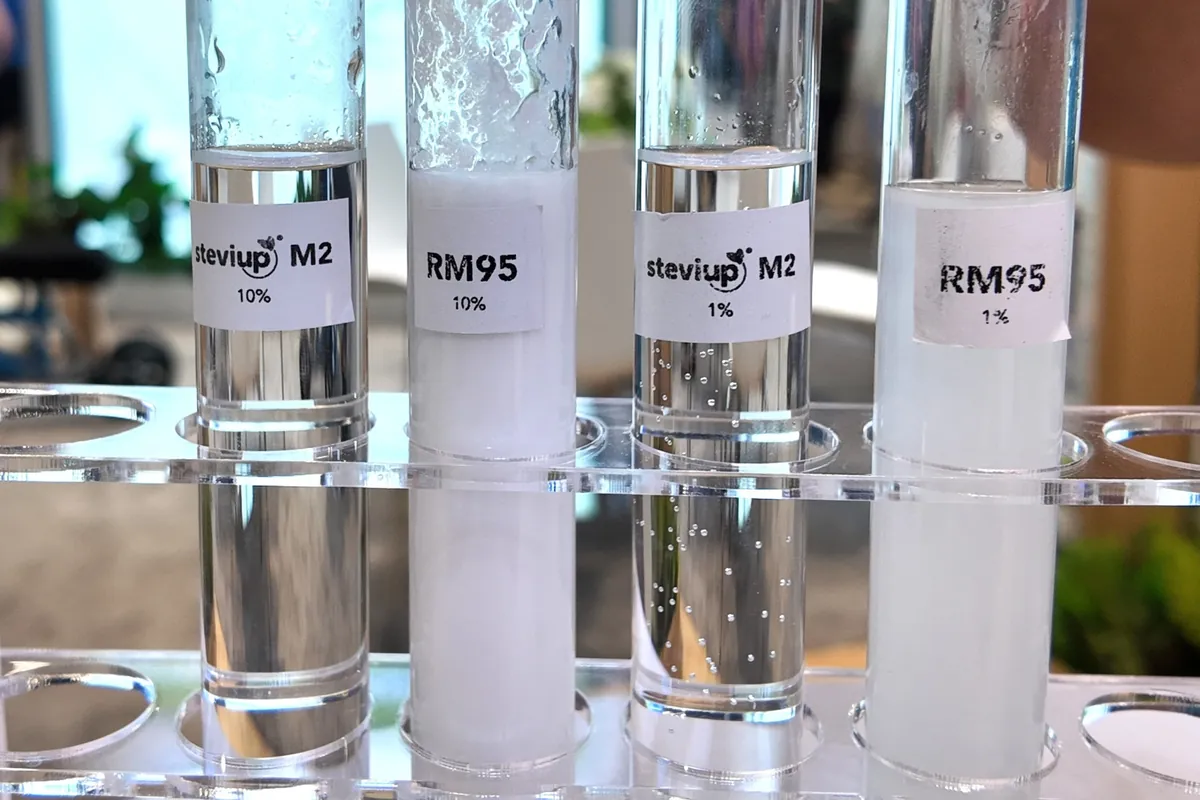 Layn Natural Ingredients’ new Reb M2 ingredient is fully soluble in water, removing barriers to the steviol glycoside being used in clear beverages.
Like other sweet proteins on the market, thaumatin II relies on other sweeteners to deliver the best results. The company refers to Thaûma as “the universal co-sweetener,” which can “offset stevia’s bitterness” and “tame monk fruit’s fruitiness.”
The company provided samples of instant iced tea sweetened with a combination of thaumatin II, Reb A, and Reb M at the trade show.
Stevia synergy
As new sweeteners make their way to the market, stevia was repeatedly positioned as an ideal synergistic solution.
On the show floor, Ingredion showcased its new Pure Circle Clean Taste Solutions, which utilized brazzein in combination with stevia in a no-sugar-added citrus fig mocktail.
Health-focused ingredients supplier Nura also exhibited at the event, promoting a new range of blended sweeteners called SweetZen. The supplier offers both a stevia-brazzein blend (320X sweetness potency) and a monk fruit-brazzein blend (195X sweetness potency). The company says that the use of brazzein can reduce bitterness and enhance the sweetness quality of F&B while lowering the cost-in-use.
Meanwhile, Layn presented two innovations in the sweetener area. In the stevia space, the company built upon Reb M’s clean taste and created Reb M2, which is fully soluble in water.
“Customers like the taste of Reb M on the market today, but because it’s not fully soluble, the applications are very limited,” says Elaine Yu, president of Layn USA.
This next generation of Reb M is created through enzymatic bioconversion and resolves the longstanding issues that have made conventional Reb M difficult to formulate in clear drink applications.
It also makes it more versatile when it comes to blending stevia with other sweetening ingredients like its new monk fruit decoction.
Monk fruit makeover
Layn’s monk fruit decoction takes a different approach to the way the sweetener has traditionally been developed.
Rather than isolating and concentrating mogrosides into an extract around 250 times sweeter than sugar, the decoction retains more of the original fruit format. At around four to five times the sweetness of sugar, it can be labeled as monk fruit decoction, monk fruit juice, or juice powder.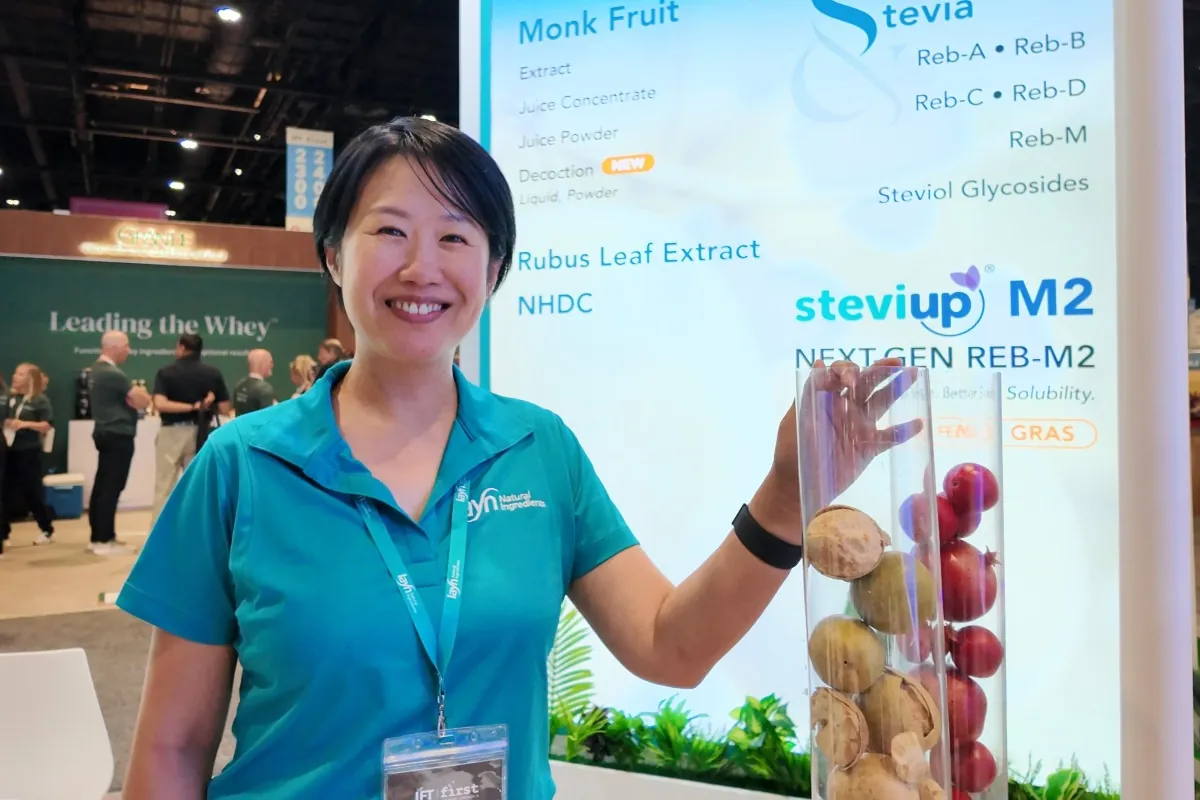 Elaine Yu, president of Layn USA
“This is a very minimal process, just through water extraction,” says Yu.
The new monk fruit format is not considered a novel food in Europe or the UK, granting it regulatory status in those markets.
Alongside this regulatory strategy, Layn is also working to improve the monk fruit crop itself. It maintains a genetic bank of more than 600 varieties and carefully selects plants for sweetness, yield, taste, and resilience before propagating seedlings.
“In this way, the raw materials we are growing are very consistent. They all have strong genetics from the same mother plant,” Yu explains.
From fruit to fermentation
Extraction from agriculture has made up Layn’s core business for the past 30 years, which Yu emphasizes is “not without its constraints.”
“The first hurdle is how to scale up. That’s difficult to do from farming,” she says. “The other problem is the weather. It’s in the hands of nature. There’s always unpredictability related to the extraction business. Enzyme technology and fermentation can eliminate those variations.”
Yu predicts that, in addition to its existing extract business, Layn will move into more enzyme and fermentation-based technology to both easily scale and provide more ingredients made in the US to meet customer needs for diversified supply chains.
One biotech company in the US is currently taking this very approach. Manus is producing mogrosides — the compounds responsible for monk fruit’s intense sweetness — through precision fermentation. The new ingredient is currently approved by FEMA, but Manus is still awaiting clearance from the FDA.
The approach could break the dependence of monk fruit supply chains from China’s Guangxi province, which has a microclimate exceptionally favorable to the crop. Manus acquired and repurposed the former NutraSweet manufacturing site in Augusta, Georgia, US, providing existing fermentation infrastructure for commercial-scale production.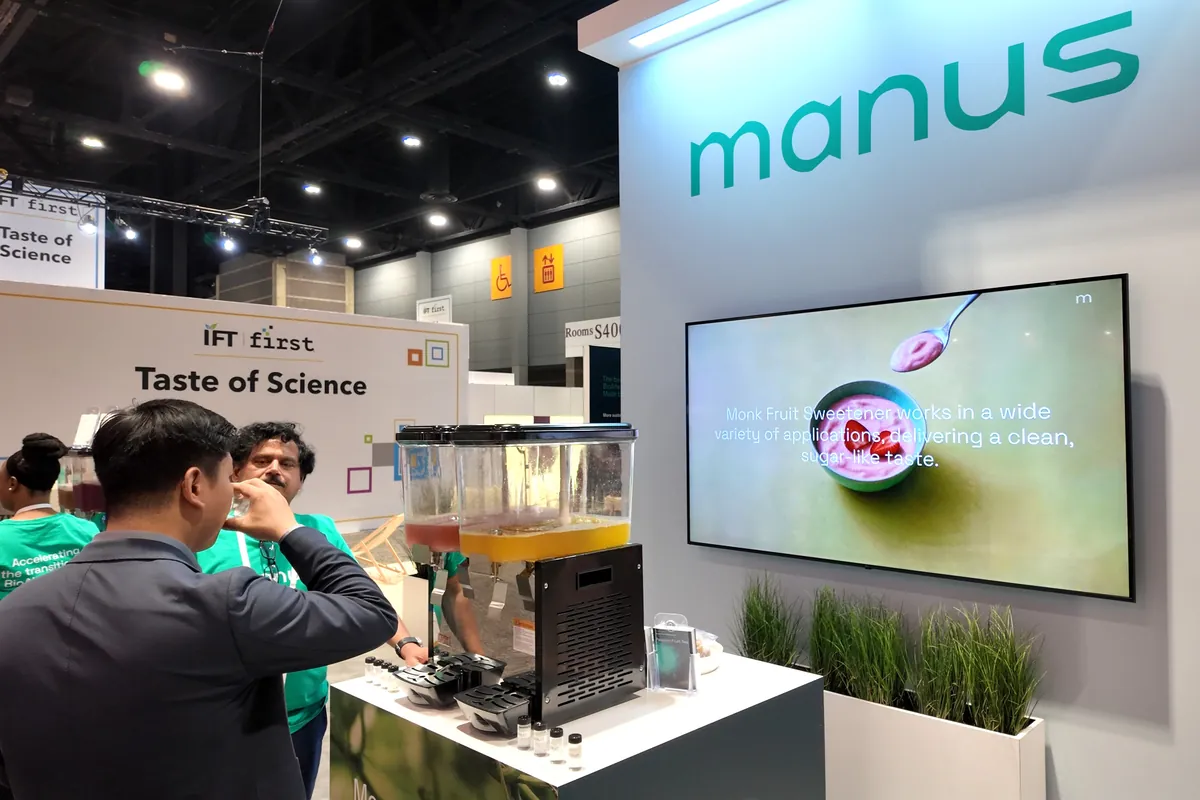 Manus presented its monk fruit sweetener produced in the US.
Function beyond sweetness
Other sugar reduction trends on the show floor included Bioenergy Life Sciences’ SweetR, a blend of D-ribose and monk fruit, in a brownie. Ribose is around 60% as sweet as sugar, while the monk fruit component can be adjusted to raise the overall sweetness.
D-ribose contributes to the unique property of browning, allowing it to replace the functionality of sugar in bakery. It also supports claims related to “can increase natural energy and reduce muscle cramping and soreness.”
In other sweet strategies, Edlong showcased its sweet enhancement technology with its sweet spot flavor in a maple syrup chocolate latte, while Lycored used its tomato-derived Santé ingredient in a barbecue sauce with 20% less sugar and 30% less sodium.