

Dairy proteins from plants: Scientists unlock seed biotechnology for cow-free casein

Key takeaways
- Scientists have engineered Arabidopsis seeds to produce and store bovine ß-casein in previously unknown protein-rich structures linked to oil bodies.
- The plant-made protein showed strong emulsification, stabilization, and cheese-melting potential, while enabling simpler extraction.
- Researchers have transferred the technology to safflower and are preparing field trials, regulatory work, and industrial testing for commercial scale-up.
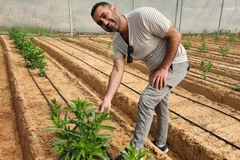 Lead author Almog Ozeri with the safflower plants transformed with the dairy proteins (Image credit: Mai Shamir).
Scientists in Israel have uncovered what they call an “unexpected” way for plant seeds to produce and store β-casein — a major milk protein that contributes to the nutritional value, texture, and functionality of dairy products. The discovery could help overcome a major technical barrier to producing dairy proteins without cows and pave the way for more sustainable dairy ingredients and alternative food production.
In the study, engineered seeds from genetically modified Arabidopsis plants formed previously unknown protein-rich structures resembling natural casein micelles, suggesting plants may have their own system for storing complex animal proteins.
The best-performing plants produced β-casein at levels of approximately 1.26% of total soluble seed protein, which the scientists say is “substantially higher than many previous reports of casein production in plants, demonstrating the potential of the new strategy.”

Food Ingredients First speaks with Oded Shoseyov, professor at the Robert H. Smith Faculty of Agriculture, Food and Environment at the Hebrew University of Jerusalem, who led the study, about how the findings could potentially improve alternative dairy functionality and what they mean for the future of plant-produced dairy proteins.
Plant-produced casein mimics dairy performance
The study, published in Frontiers in Plant Science, involved using Arabidopsis as the model plant to test whether seeds could produce and store bovine β-casein. The researchers inserted genetic instructions enabling the seeds to produce bovine β-casein and fused the casein to part of oleosin, a plant protein associated with seed oil bodies.
They then tested signals designed to direct the protein to different compartments within the seed cells. While they expected β-casein to accumulate in specialized storage vacuoles, results showed that it formed “previously unrecognized” protein-rich structures closely associated with small oil bodies.
“Our plant-based β-casein performs similarly to native β-casein and, in several respects, even outperforms it,” Shoseyov tells us.
“This is particularly evident in some of the functionalities most valued by the food industry, including emulsification, matrix stabilization, and one of the most challenging functionalities of dairy alternatives — cheese melting.”
The melting of animal-based cheese is due to casein in dairy proteins, which creates a stable emulsion in milk, its derivatives, and alternatives, underscores the study. It also contributes to the characteristic texture and mouthfeel of dairy products and contributes to the stretching properties of cheese, which alternative cheese manufacturers often struggle to achieve.
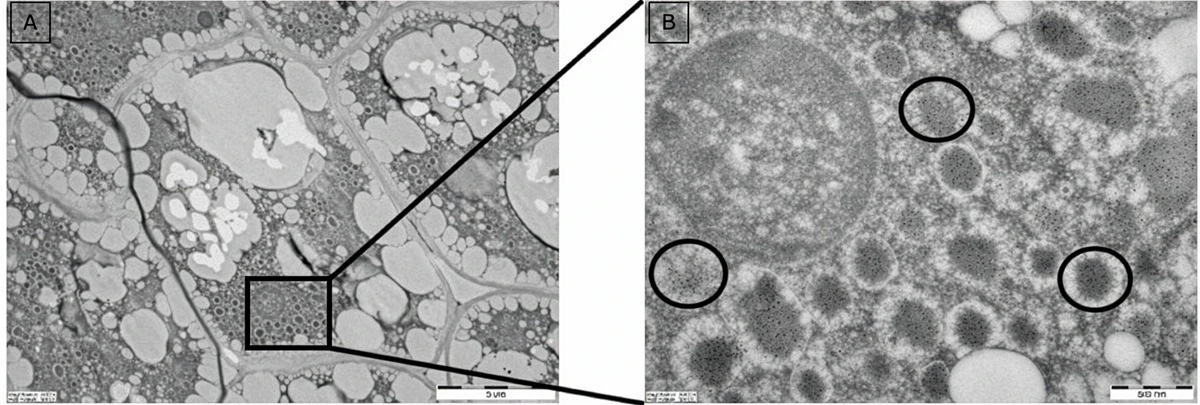 Transmission electron microscopy showed that the milk protein formed unexpected clusters (as distinct dark circles) near tiny oil bodies instead of entering its intended storage area (Image credit: Dr. Yael Friedman).
Seed “milking” cuts dairy protein costs
The study addresses a significant challenge in plant molecular farming, which uses crops as “miniature protein factories,” explains the researchers. However, producing dairy proteins in plants has proved technically difficult because the proteins must be expressed at useful levels, stored without damaging the plant, and later recovered efficiently.
The team addressed this issue by engineering Arabidopsis seeds to produce bovine β-casein fused to oleosin. The protein-oil aggregates discovered during the study may offer manufacturers an alternative route for storing complex recombinant proteins.
The method targeting β-casein to the oil bodies using a C-terminal oleosin tag simplifies the extraction of plant-derived dairy ingredients, explains Shoseyov.
“We can simply ‘milk’ the seeds to generate a cream fraction we named Miruku Cream, separated by straightforward decantation and maybe used directly in food products. We also have the option of releasing the β-casein from the oil bodies through a simple pH adjustment.”
“This approach is expected to significantly reduce the production cost of plant-derived dairy ingredients, making the combination of β-casein and fat more cost-effective than the corresponding cow’s-milk-derived ingredients.”
Safflower advances animal-free casein scale-up
Safflower represents the next scale-up step. The researchers have transferred the dairy proteins into safflower, advancing the technology beyond Arabidopsis model plants.
“Safflower is an ideal oil-seed plant, due to its ability to grow in hot climates and arid land, thus making it an ideal crop for global warming and growing demand for nutritional proteins,” note the researchers.
Shoseyov points to the technical hurdles while scaling production to safflower crops.
“Transformation of elite safflower lines is challenging. Nevertheless, we have developed an efficient transformation and regeneration method that allows us to screen numerous lines and select the best-performing candidates,” he says.
“However, this remains a time-consuming process.”
The scientists also emphasize the need for animal-free dairy products, highlighting the dairy industry’s mounting concerns over greenhouse gas emissions (GHG), land use, and water consumption associated with livestock farming. FAO data shows that milk production accounts for about 30% of livestock-sector emissions by commodity. Cattle raised for meat and milk together generate around 62% of livestock-sector emissions.
These concerns are incentivizing scientists to explore sustainable ways to produce authentic dairy proteins without animal dependency, note the researchers.
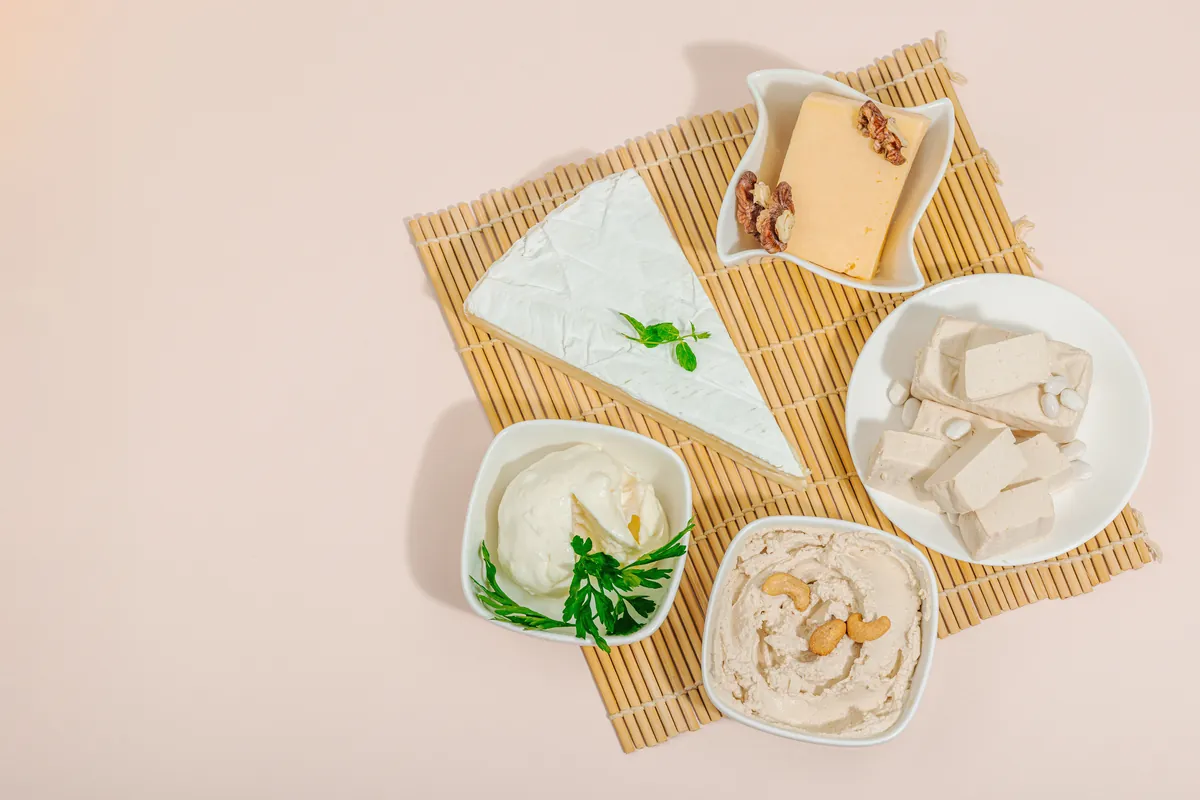 Plant-made β-casein may improve the melting and texture of dairy alternatives — key challenging functionalities in such products.
Regulatory pathway
Shoseyov emphasizes that the team is working closely with the major regulatory authorities and industry partners to address both labeling requirements and consumer acceptance of its bovine-identical dairy proteins.
“Ingredients derived from genetically engineered crops have been widely used for decades around the world and are produced in major agricultural countries, including the US, Australia, Brazil, and Canada,” he says.
“In addition, dairy proteins such as β-lactoglobulin produced through precision fermentation are already commercially available. We expect to follow a similar regulatory and product-labeling pathway.”
Plant-grown casein opens hybrid dairy potential
The scientists anticipate the plant-based β-casein and Miruku Cream’s integration with conventional dairy ingredients in the future, Shoseyov tells us. This will help develop “hybrid products that reduce production costs and improve life-cycle assessment targets.”
“They may also be used as standalone dairy alternatives with superior organoleptic properties compared with existing products.”
The next research steps toward commercializing plant-produced dairy proteins include “field trials and supply of Miruku Cream and plant-based beta-casein to our industrial partners,” Shoseyov concludes.
Beyond dairy alternatives, the authors say the findings could advance plant molecular farming for food, nutrition, and medicine applications. By understanding where and why recombinant proteins naturally accumulate, scientists may be able to design plants that produce higher yields while simplifying purification and reducing production costs.
 Study lead Oded Shoseyov, says hybrid dairy products could combine plant-grown casein with conventional dairy ingredients.