

Nestlé trials “Sniff, Look, Taste” labels across Australia to tackle food expiry date confusion


Key takeaways
- Nestlé launches an Australian pilot of its new “Sniff, Look, Taste” on-pack labels, encouraging consumers to check “Best Before” products before throwing them away.
- The initiative aims to tackle confusion over food date labels, a key contributor to Australia’s household food waste.
- Developed with OzHarvest, the trial reflects a broader push to reduce food waste through consumer education and behavior change.

Australians are throwing away millions of tons of edible food each year, with confusion over expiry labels emerging as one of the biggest drivers. Now food manufacturers are beginning to redesign packaging in an effort to change consumer behavior. Nestlé has become one of the first major brands in Australia to trial on-pack guidance encouraging shoppers to “Sniff, Look, Taste” before discarding products.
Developed in partnership with food rescue organization OzHarvest, the pilot will appear on selected Maggi 2 Minute Noodles multipacks sold in supermarkets across Australia.
The new logo encourages consumers to use their senses alongside a product’s “Best Before” date to determine whether food is still good to eat, while reinforcing that “Use By” dates should always be followed for food safety.

Date label confusion
Confusion over date labels on food and beverages remains one of the biggest barriers to reducing food waste at home.
The initiative comes as Australia (like most countries) continues to grapple with a growing food waste problem.
OzHarvest research finds that around 70% of Australian household food waste is still edible, while 58% of high-wasting households say they have thrown food away because they were unsure what “Use By” and “Best Before” labels actually mean.
The distinction between the two labels is a common source of confusion.
While a “Use By” date indicates when a product should no longer be eaten for safety reasons, a “Best Before” date relates to quality rather than safety. This means many foods can still be consumed after the date has passed if they have been stored correctly and show no signs of spoilage.
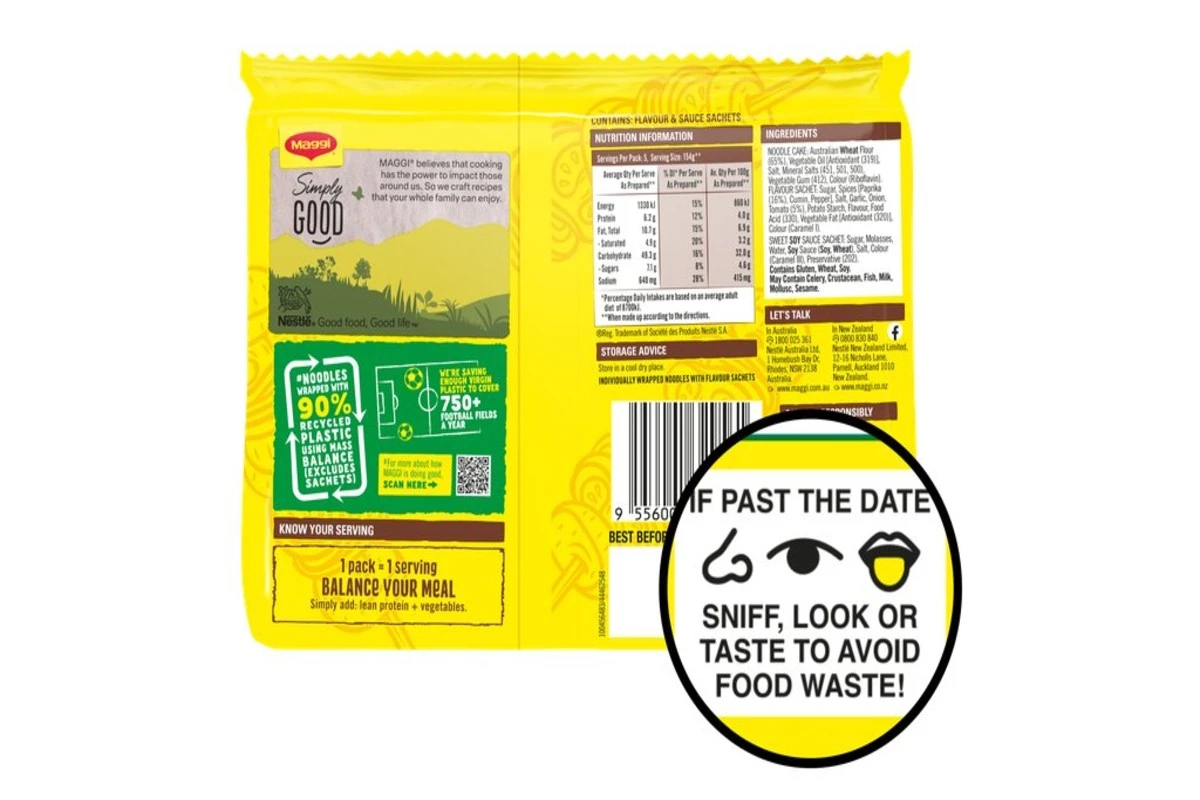 The pilot, developed by Nestlé with OzHarvest, is now rolling out on selected MAGGI 2 Minute Noodles packs in Australian supermarkets.
Changing consumer behavior
Nestlé Oceania regulatory, scientific, and nutrition manager Kirsten Grinter says the pilot was designed to give consumers greater confidence when deciding whether to keep or throw away food.
“The simple rule is that ‘Use By’ is about safety, so always follow it. ‘Best Before’ is about quality, so check it. That difference matters, because it can help people stay safe without throwing away food that may still be perfectly good.”
Food and nutrition scientist Dr. Emma Beckett stresses how many Australians are unnecessarily discarding perfectly edible food because they lack confidence in interpreting date labels.
“Good nutrition starts with having the knowledge and confidence to make the most of the food that we buy. That means knowing when food needs to be thrown out, and when it is worth taking a moment to check. For foods with a ‘Best Before’ date, a quick sniff, look, and taste, alongside reviewing the ‘Best Before’ date, can help people feel more confident about using food that is still good rather than letting uncertainty send it to the bin.”
The campaign reflects a broader shift in how food manufacturers are approaching sustainability. Rather than focusing solely on reducing waste during production or improving recycling, companies are increasingly looking at ways to influence consumer behavior after products leave supermarket shelves.
OzHarvest head of impact, Hally Lara, says that small changes in household habits could collectively have a significant impact on reducing Australia’s food waste.
“Many Australians want to waste less, but they don’t always feel confident making the right call, especially when it comes to date labels. Reducing household food waste is all about small changes that can make a huge difference.”
Australia’s food waste targets
Reducing household food waste has become an increasing focus for governments, charities, and the food industry globally, as Australia works toward national targets to halve food waste by 2030.
According to End Food Waste Australia, annual food waste could climb to 9.2 million metric tons by the end of the decade if current trends continue.
For Nestlé, the trial will also test whether simple prompts placed on everyday grocery items can help consumers make more informed decisions in their own kitchens.
The “Sniff, Look, Taste” logo is now appearing on selected Maggi Sweet Chilli and Sour Cream and Smokey Barbecue 2 Minute Noodles multipacks, with the pilot expected to inform future approaches to reducing household food waste.
Nestlé Australia and OzHarvest initially announced their partnership in May 2025. The pilot was also informed by local and global research, including RMIT University and End Food Waste Australia.


Upcoming webinars

Oat-Standing Ingredients - Showcasing Irish Grain Through Innovation
Tirlán Ingredients

2027 Food Safety Risks for Quality & Compliance Leaders
FoodChain ID

Formulating for function: Developing benefit-led beverages with natural colours, botanicals, and flavours
Givaudan Sense Colour