
Closed-loop microalgae system tackles cultivated meat’s cost hurdle

Key takeaways
- University of Queensland researchers find microalgae could recycle cultivated meat waste and cut growth media costs significantly.
- The closed-loop system reuses nutrients from spent media, reducing reliance on expensive amino acids and serum.
- Researchers are working with Magic Valley to explore how the approach could be scaled for commercial cultivated meat production.
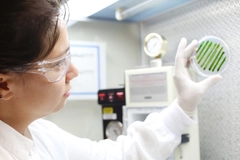 Dr. Melanie Oey inspects a petri dish of microalgae (All image credits: University of Queensland).
University of Queensland (UQ) researchers in Australia have developed a circular production system that uses waste from cultivated meat manufacturing to grow microalgae, which can then be processed and fed back to animal cells. The approach could cut one of the sector’s largest expenses — cell culture media — dramatically.
The research, published in Food Research International, targets the high cost of amino acids, serum, and other components used to feed animal cells during cultivated meat production.
Dr. Melanie Oey, from UQ’s Institute for Molecular Bioscience, says bringing these costs down is critical if cultivated meat is to move beyond pilot production and compete in mainstream food markets.
“From our calculations, we estimate we can reduce growth media costs somewhere between 60–90%,” says Oey.

“This greatly reduces the need for expensive growth factors and amino acids, which remain one of the largest hurdles to getting cultivated meat into supermarkets and onto dinner plates.”
Closing the production loop
The researchers grew Chlorella BDH-1 microalgae using spent media from cultivated meat production rather than discarding the nutrient-containing waste stream.
The study found that two rounds of recycling the spent media maximized the amount of microalgal biomass produced per unit of waste. The algae were then processed into a nutrient-rich lysate that could replace a proportion of the serum and amino acids normally added to animal cell culture media.
In testing, the researchers found that algal lysate supported muscle cell growth under reduced-serum and reduced-amino acid conditions. In some conditions, cell growth was more than twice that achieved with standard growth media..webp) Microalgae recycling could cut cultivated meat growth media costs by up to 90%.
Microalgae recycling could cut cultivated meat growth media costs by up to 90%.
Combining the lysate with microalgal co-cultivation also compensated for a 50% reduction in standard amino acids and serum while improving mammalian cell proliferation by 40%. The researchers conservatively estimated that this configuration could reduce media costs by around 66%.
The system also creates a reciprocal exchange between the two cell types. Microalgae can take up residual nutrients and carbon dioxide while producing oxygen that supports the mammalian cells.
Oey says this creates the potential for a “self-sustaining circular bioeconomy,” in which nutrients that would otherwise leave the production system as waste are recovered and reused.
The researchers also produced more microalgal biomass than was required for nutrient recycling during testing, opening the possibility of additional revenue streams from the excess material.
Economics under pressure
Cell culture media remain a central target for cultivated meat developers seeking to improve production economics. Food Ingredients First previously reported on US-based Clever Carnivore’s work to develop low-cost cell culture media alongside high-performance pork cell lines and production systems designed to improve scalability.
The pressure to demonstrate commercially viable economics has intensified as investment in cultivated meat has contracted. Earlier this year, former Meatable CEO Jeff Tripician told us that the cultivated meat sector faces a mismatch between the time needed to mature and scale its technology and investors’ expectations for returns. Meatable and Believer Meats both ceased operations in late 2025 amid a broader funding downturn.
The UQ team is now working with Australian cultivated meat producer Magic Valley, which supplied waste material for the research, to explore how the recycling system could operate in larger production facilities. The collaboration is supported by an Australian Economic Accelerator grant.
Magic Valley head of R&D Dr. Andrew Laslett says reducing media costs could help address one of the industry’s most persistent barriers to scale.
“By helping reduce media costs, one of the sector’s most significant barriers, this innovation could accelerate the pathway to commercial-scale cultivated meat production,” he says.
The research also comes as Australia and New Zealand establish themselves as emerging markets for cell-cultured foods. In June 2025, regulators permitted cell-cultured quail for sale under new production and labeling standards — a development that Vow told Food Ingredients First could provide a precedent for cultivated meat regulation in other markets.
For cultivated meat producers, the UQ findings could help cut fresh media costs while turning waste into a useful production input.


Upcoming webinars

2027 Food Safety Risks for Quality & Compliance Leaders
FoodChain ID

Formulating for function: Developing benefit-led beverages with natural colours, botanicals, and flavours
Givaudan Sense Colour
Let's reveal the grain potential: Innovate
Meurens Natural