




America’s appetite for food reform extends beyond MAHA’s supporter base

Key takeaways
- Support for additive regulation and UPF labeling extends beyond MAHA supporters.
- Seed oil replacement and SNAP restrictions expose divisions in food policy attitudes.
- Suppliers are advancing reformulation while protecting taste, safety, and shelf life.

US public support for tighter food additive regulation and ultra-processed food (UPF) labeling extends well beyond supporters of the Make America Healthy Again (MAHA) movement, according to newly released survey findings from the University of Pennsylvania’s Annenberg Public Policy Center (APPC).
The findings suggest a gap exists between the relatively low public support for the MAHA movement and the considerably higher backing for its food-related policies. While only 26% of US adults said they identify as MAHA supporters, support for its six most popular food-related proposals averages 73%.
Label ultra-processed foods — 80%
Remove highly processed foods from school lunches — 79%
Remove petroleum-based/artificial food dyes — 76%
Increase regulation of dyes and chemical additives — 75%
Ban glyphosate on crops grown in the US — 67%

Increase regulation of added sugars — 63%
“The findings suggest that it’s important to distinguish support for MAHA from support for specific MAHA policies,” says Laura A. Gibson, an APPC research analyst. “Many people who say they don’t support the movement nonetheless share its concerns about additives, chemicals, and highly processed foods.”
For food and beverage manufacturers, the findings suggest that ingredient concerns extend beyond MAHA affiliation and, therefore, could sustain long-term pressure for product reformulation.
Independent research company SSRS conducted the nationwide surveys for the APPC. The first involved 1,639 adults interviewed April 14–28, 2026, and the second included 1,904 adults interviewed August 4–17, 2026.
The reported August findings focus on 1,475 respondents who also completed the April survey. Interviews were conducted online and by telephone, with results weighted to represent US adults.
What are the US public’s food regulation priorities?
In August, respondents selected their three most important health issues from 17 listed proposals. Regulating chemical additives in food ranked highest overall, with 54% placing it among their top three.
Regulating chemical additives in food — 54%
Banning glyphosate in crops — 32%
Removing highly processed foods from school lunches — 32%
Regulating added sugars in food — 28%
Labeling ultra-processed foods — 27%
Removing petroleum-based food dyes from all foods — 25%
Among these six leading food-related proposals, labeling ultra-processed foods was the only priority showing a statistically significant difference between MAHA supporters and non-supporters, ranking among the top three for 21% and 31%, respectively.
The August survey also asked respondents to identify their three least important policies. Easing raw milk sales ranked lowest across all groups, with 31% of MAHA supporters and 38% of non-supporters placing it in their bottom three. Ending water fluoridation was also a low priority, appearing among the bottom three for 24% of supporters and 31% of non-supporters.
Where do food policy attitudes diverge?
The April survey’s topline results reveal sharper divisions over some food policies. Replacing seed oils with animal fats, such as butter or tallow, was favored by 31% overall, rising to 52% among MAHA supporters versus 18% of non-supporters. Meanwhile, 42% neither favored nor opposed seed-oil replacement.
Support for regulating added sugars was broader, at 74% among supporters and 62% among non-supporters. However, restricting sugary drink purchases through the Supplemental Nutrition Assistance Program (SNAP) attracted a wider divide: 79% versus 40%, respectively.
By contrast, banning glyphosate on US-grown crops attracted nearly identical support from MAHA supporters and non-supporters, at 72% and 70%, underscoring how certain food-related concerns extend beyond affiliation with the movement.
How is the industry responding?
Previous Food Ingredients First interviews show ingredient suppliers are already helping manufacturers address demand for natural colors, fewer additives, and reduced sugar. Their experiences also highlight the technical challenge of changing formulations while maintaining safety, shelf life, taste, and affordability.
At IFT FIRST 2026 in Chicago, US, Döhler identified color conversion as a major customer priority. “The biggest thing right now is the switch from synthetic to natural colors,” Kristy Ellenson, marketing lead for Döhler North America, told us.
The company showcased San-Ei Blue, a gardenia-derived color developed for beverages, while working to extend its use into other applications. However, Ellenson highlighted particular difficulties with natural blues and greens, whose stability can vary with pH, processing conditions, and shelf life requirements.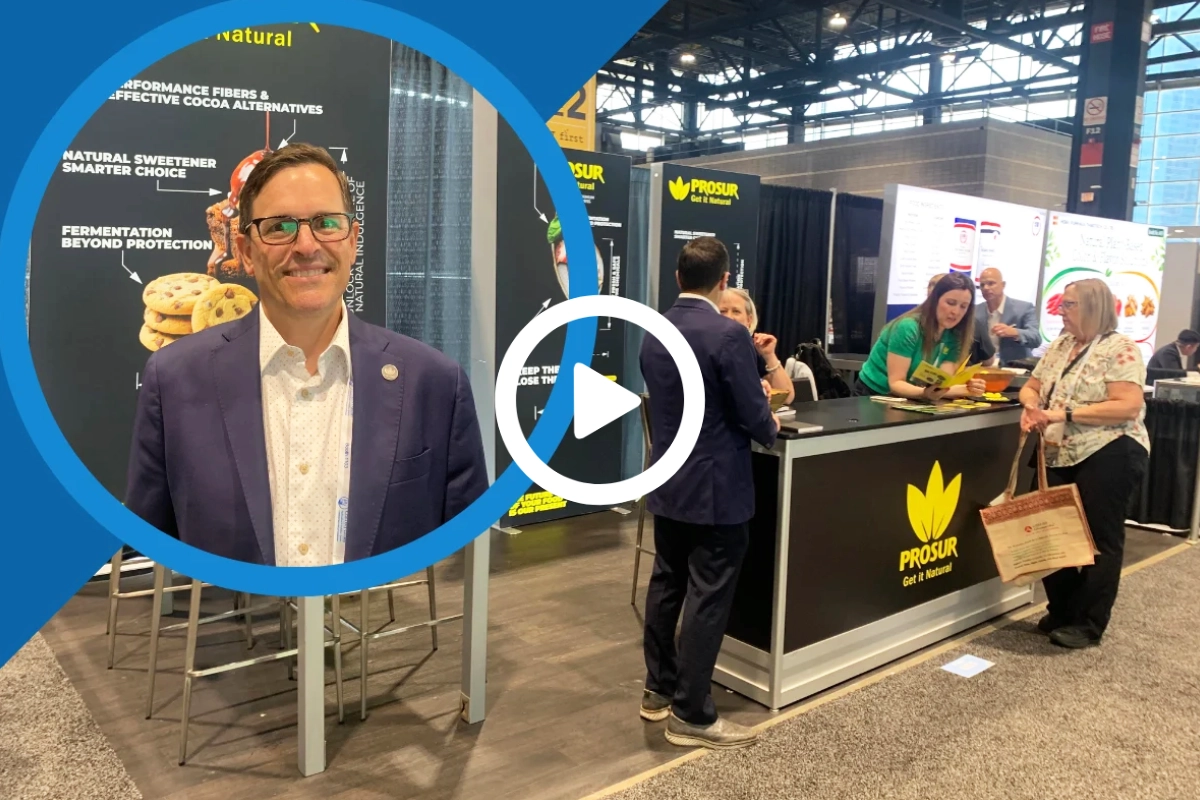 Prosur’s Brian Metzger, vice president for North America, explains how the Make America Healthy Again movement is accelerating reformulation across F&B manufacturing.
Preservation is another area of activity. Prosur develops functional systems using food-derived materials, including citrus fruits and rosemary. Brian Metzger, vice president for North America, told us: “We’ve seen a lot of demand in getting rid of various chemical additives.”
However, Metzger stressed that replacing nitrite in processed meat requires challenge testing and independent validation to demonstrate control of the pathogens it would normally help manage. Removing an ingredient, therefore, requires manufacturers to account for all the functions it performs.
Sugar reduction similarly involves rebuilding several aspects of a formulation. In Chicago, Samyang showcased crystalline kestose and its AI-powered 3S Solution, which recommends ingredient combinations and ratios according to sugar-reduction targets, product requirements, and cost. The recommendations provide a starting point for further application development with customers.
Ingredion demonstrated how these objectives can translate into finished-product concepts, including a no-added-sugar yogurt using a tapioca-based texturizer and a smoothie formulated with 50% less sugar.
“Food has to taste good, otherwise consumers will not come back,” Leaslie Carr, senior director of texture and healthful solutions and customer innovation at Ingredion, told us.
Health concerns compete with taste appeal
Innova Market Insights research highlights the challenge of balancing health perceptions with product appeal.
In its September analysis of US UPF trends, 42% of consumers opposed UPF consumption because they considered these foods unhealthy, while 44% cited taste as their main reason for consuming them.
Ingredient choices also shape perceptions. Innova found that 37% of consumers viewed natural ingredients as an indicator of a clean label, while synthetic ingredients and high additive content were among the characteristics associated with UPFs.
These findings add context to manufacturers’ efforts to simplify formulations while preserving the taste that continues to attract consumers.