



Ambition versus reality: EIT Food reveals major gaps in the protein transition

Key takeaways
- A new EIT Food study finds strong industry alignment around a circular, diversified protein system, but warns Europe is not on track to deliver it.
- Stakeholders expect an uneven protein transition due to gaps in financing, regulation, and consumer trust, despite clear agreement on direction.
- The report outlines four scenarios to 2050 and a roadmap highlighting five key levers, including regulation, investment, and circular processing.

A new foresight study from EIT Food finds strong alignment around a “Circular protein renaissance,” but warns that Europe’s protein transition risks drifting off track due to gaps in financing, regulation, and consumer trust. The key takeaway from the research highlights a disconnect between industry ambition and the trajectory currently taking shape in a more diversified protein system.
In a survey of 140 organizations and stakeholders across the food value chain, the EIT Food Protein Diversification Think Tank (PDTT) outlined four scenarios for Europe’s protein future alongside a roadmap to 2035 and 2050.
Results showed broad backing for the circular protein model, yet most respondents believe the sector is drifting toward a fragmented and uneven transition instead. In contrast, participants viewed an “Uneven protein transition” as the most probable path currently.

Mapping Europe’s protein scenarios
The report aims to provide strategic, evidence-based insights that guide Europe’s protein diversification transition and enable PDTT to contribute to building resilient, sustainable food systems.
It outlines four plausible futures for Europe’s protein system and highlights the key levers needed to accelerate a fair, climate-resilient transition. These range from a slow, uneven shift to a fully reimagined, circular, and technology-enabled food system.
Scenario 2: “Circular protein renaissance”
Scenario 2, the “Circular protein renaissance,” is identified as the most desirable outcome for Europe. It combines resilience, competitiveness, and fairness by diversifying protein sources across animal, plant, and biotech systems, while reducing reliance on any single category.
It also prioritizes greater use of agricultural by-products, faster but safe approvals for innovation, clearer labeling on climate and nutrition, and new income streams for farmers through protein crops and local processing hubs.
Overall, it points to a more efficient and accessible protein system across Europe, says EIT Food.
The analysis builds on earlier work by the PDTT, alongside AI-supported scenario modeling developed with VTT Technical Research Centre of Finland, to guide policy, investment, and industry decision-making.
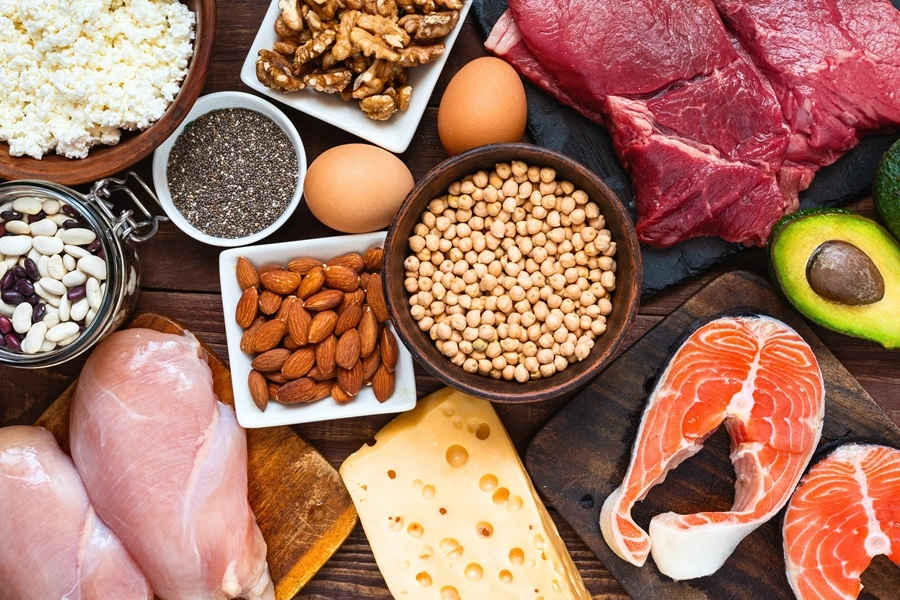 Scenario 2, the "Circular protein renaissance," is the most desirable outcome, promoting resilience and fairness through diversified protein sources across animal, plant, and biotech systems.
Other protein scenarios
On the other hand, scenario 1 envisages “patchy progress across regions” with some scaling innovations, while others are expected to stick to conventional protein sources. Scenario 3 (“Stalled transition”) sees centralized controls slowing approvals and consumer uptake. Scenario 4 (“Food system reimagined”) leans heavily on automation and bioreactors, requiring strong governance to safeguard equity and culture.
The report also sets out a transition roadmap with milestones for 2035 and 2050, identifying five high-impact levers for change. These are more agile regulations, including conditional approvals; blended public–private finance to support scale-up; energy-efficient biomanufacturing and circular processing hubs; initiatives to build consumer familiarity and trust; and open digital systems to improve traceability and safety.
Food system strain
This transition is unfolding against mounting pressure across Europe’s food system from climate volatility, geopolitical shocks, and farmer unrest.
This is intensifying the focus on protein self-reliance and pushing the EU toward simpler rules and a more system-level approach to the protein transition. With the European Commission’s new Vision for Agriculture & Food prioritizing research, adaptive regulation, and data-driven innovation, the conditions for action are in place.
EIT Food says that novel proteins are crucial to building a resilient and climate-robust food system, and flags how, by diversifying animal, plant, and biotech-based protein sources, and using circular side-stream valorization, land, water and emissions pressures can be reduced.
“Europe’s protein transition must balance innovation with inclusion. This foresight study shows how circularity, adaptive governance, and transparency can make sustainable diets effortless for consumers, while creating opportunities for farmers and SMEs,” says Lorena Savani, director of thematic leadership (Biotech & Protein) Impact.
Protein trends
While policy and industry roadmaps point to long-term protein system change, consumer demand is already shaping where growth and innovation are happening today.
This is reflected in Innova Market Insights’ top trend for 2026 “Powerhouse Protein,” which highlights the mainstreaming of protein as a core nutritional priority, with plant-based proteins increasingly central to product innovation.
The trend is being driven by growing demand for protein-rich foods linked to health, satiety, and everyday well-being, with plant proteins now appearing across a wider range of categories, beyond traditional meat alternatives.
The direction of Europe’s protein transition is increasingly defined. The question is whether policy, industry, and investment can move fast enough to match it.