
Egg replacements proliferate amid supply shocks and animal welfare shifts


Key takeaways
- Egg supply volatility is becoming structural, driven by avian flu, cage-free regulations, and rising input costs, pushing manufacturers to reduce reliance on eggs.
- Egg replacements are evolving beyond ethical substitutes, with plant-based and fermentation-enabled solutions increasingly capable of matching key egg functionalities.
- For food manufacturers, egg alternatives are now strategic ingredients, offering supply security, cost stability, and logistical advantages.
 Meala FoodTech’s Groundbaker solution showcased at Fi Europe 2025.
Supply shocks, price volatility, and animal welfare reform — egg producers face challenges from all directions. Bakery and baked goods manufacturers and other egg-dependent markets like ready meals and pasta are eager to reduce single-ingredient risk while improving their ESG credentials. This growing demand has given rise to sophisticated egg-free alternatives, which are increasingly viewed as strategic ingredient choices — not just substitutes.
Globally, egg prices have risen significantly amid avian flu outbreaks and structural cost increases from cage-free farming shifts. For example, Germany is expected to phase out routine caged farming for laying hens by the end of this year, while the UK recently committed to phasing out colony cages for laying hens by 2030.

In the US, egg prices reached record highs in 2025, with the national average hitting US$6.23 per dozen in March, according to the US Bureau of Labor Statistics. In the EU, egg prices jumped in 2022–23 and have continued rising.
With additional pressures, including structurally higher feed prices, labor shortages and wage inflation, and greater energy, packaging, and logistics costs, egg replacements have become increasingly attractive to food brands and ingredient companies for risk management and cost stability — not just ethics and sustainability.
However, egg substitutes must compete on functionality as well as taste to entice consumers. Historically, alternatives have worked in narrow use cases, but formulators are increasingly able to combine plant proteins like soy, chickpea, and canola to mimic specific egg functions, such as emulsifying mayonnaise, foaming for cakes, or binding for nuggets.
Egg alternative innovation
A 2024 study published in Comprehensive Reviews in Food Science and Food Safety emphasized that achieving the right protein behaviors in egg replacements is central to their success. What’s more, the research found that the functionalities of plant‐based egg analogs and plant‐based egg‐mimicking products have significantly improved.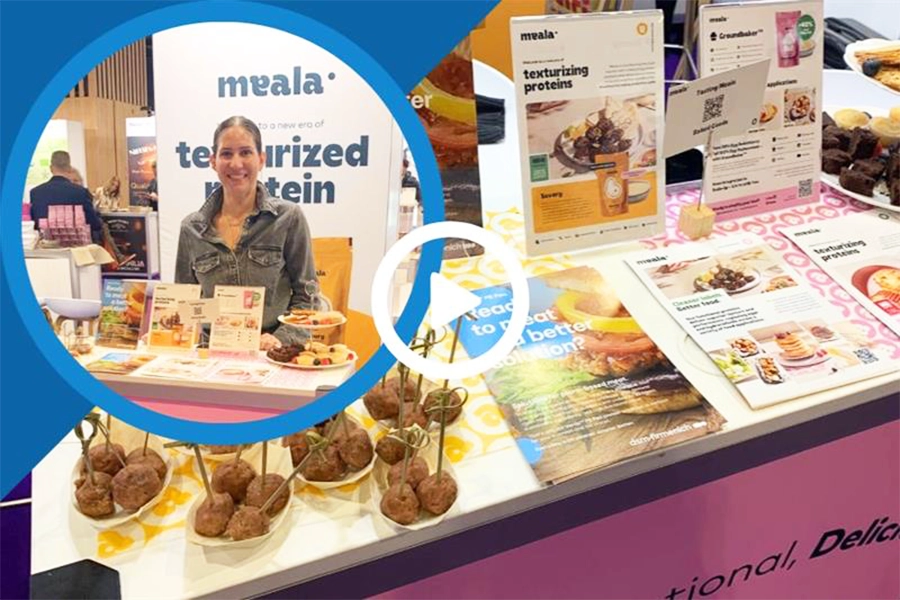 Meala Foodtech CEO Hadar Razmovich explains how Groundbaker addresses the functional challenges of eggs in bakery.
Fast forward to Fi Europe 2025 in Paris, France (Dec 2–4), and it was clear that egg alternatives continue to progress. Single-solution ingredients like Meala Foodtech’s Groundbaker and Ingood by Olga’s Lengood demonstrated competitive functionality and scalability. We spoke to both companies on the trade show floor.
Meala Foodtech CEO Hadar Razmovich shared how the firm’s Groundbaker ingredient addresses the key functional challenges of eggs in bakery, matching performance while enabling egg-free formulations.
“Baked goods use eggs because of their many functionalities, including texture and color. Until today, there wasn’t a single ingredient solution to match these functionalities, but Groundbaker finally delivers that solution,” she told Food Ingredients First.
“Groundbaker is commercially available, and we are producing it in large volumes. We constantly increase the product capacity and collaborate with large manufacturers like Lasenor. Groundbaker is very versatile — you can use it on pancakes, muffins, and a lot of other baked goods. But the product we are seeing the most interest in is sponge cakes, where everyone is looking to reduce and replace eggs.”
Across the show floor, Ingood by Olga presented its Lengood egg replacement. Claire Boniface, marketing and communication manager, explained how Lengood can ensure price stability and resilient supply chains in egg-free baked goods, sauces and dressings, and ready-to-eat foods.
“The egg market is under pressure, and the situation is not improving — that’s why we have developed Lengood. It’s an all-in-one ingredient that can fully replace all the functionalities of egg, such as gelation, forming, emulsifying, and texturizing,” Boniface told us.
“Egg replacements on the market are often based on a blend of plant-based ingredients and additives, which can be complicated for manufacturers. With our cost-effective solution, there is no compromise for manufacturers. Lengood can also improve the nutritional profile of products.” Claire Boniface at Ingood by Olga tells us how Lengood can ensure price stability and resilient supply chains in egg-free baked goods.
The egg replacement market
For now, egg replacements remain a small (less than 10% of total egg ingredient use globally) but fast-growing niche. However, growing vegan, vegetarian, and flexitarian consumer demands will continue to create opportunities for egg substitutes in categories like baked goods, ready meals, and pasta and noodles.
For global food manufacturers, the shelf life, storage, and standardization benefits of egg alternatives will remain attractive amid long-term egg supply volatility, as replacement powers, concentrates, and dry blends can simplify logistics compared to shell eggs and liquid egg formats.
The emergence of fermentation-enabled proteins is also appealing to manufacturers because they can be functionally similar to egg proteins, which is advantageous for premium applications where plant proteins struggle for certain foams, gels, or clean flavor.
At the same time, investment in egg production continues. In November, dsm-firmenich launched a machine learning-based precision service for laying hens, which the company says can help poultry producers improve overall animal health, productivity, and welfare.


Upcoming webinars

Oat-Standing Ingredients - Showcasing Irish Grain Through Innovation
Tirlán Ingredients

2027 Food Safety Risks for Quality & Compliance Leaders
FoodChain ID

Formulating for function: Developing benefit-led beverages with natural colours, botanicals, and flavours
Givaudan Sense Colour