


UK government pledges to reform cage farming and livestock slaughter


Key takeaways
- UK commits to phasing out colony cages for laying hens and farrowing crates for sows by 2030.
- The reform impacts more than seven million laying hens currently kept in highly confined spaces.
- Policy includes alternatives to CO2 stunning for pigs, promotion of slow-growing chicken breeds, and the first-ever humane slaughter requirements for farmed fish.
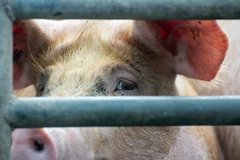
The UK government has announced plans to phase out colony cages for laying hens and farrowing crates for breeding sows by 2030, alongside comprehensive reforms to pig stunning methods and new welfare standards for farmed fish and poultry.
The Animal Welfare Strategy, launched by Environment Secretary Emma Reynolds today, commits to eliminating confinement systems in the UK’s £1.7 billion (US$2.15 billion) retail egg market, where caged production currently represents 18% of supply.
“This government is delivering the most ambitious animal welfare strategy in a generation,” says Reynolds. “Our strategy will raise welfare standards for animals in the home, on the farm, and in the wild.”
Colony cages and farrowing systems
While conventional battery cages were banned in 2012, this led to the rise of colony cages — larger systems holding up to 90 hens with perching spots, scratch mats, and nest boxes. However, each bird receives approximately the space of an A4 sheet of paper and never leaves the cage until slaughter. More than seven million laying hens remain in caged systems, according to Defra (Department for Environment, Food and Rural Affairs).
Pig farrowing, a system of cramped metal-barred crates that prevent sows from turning around or moving during the farrowing period, will also be banned. Around 200,000 sows annually spend close to a quarter of their adult lives in these systems.
However, 50% of the UK’s breeding herd of approximately 337,000 head already farrows outdoors, according to Agriculture and Horticulture Development Board data. The industry has voluntarily installed 5,000 flexible farrowing places, with 1,000 more in planning or construction stages, according to the National Pig Association.
Slaughter and breed reforms
The strategy also addresses welfare concerns with carbon dioxide stunning for pigs, which is currently standard practice in UK abattoirs but has drawn criticism from animal welfare scientists. The government says it will explore alternative stunning methods.
The reforms include the UK’s first humane slaughter requirements for farmed fish.For poultry, the policy promotes slow-growing meat chicken breeds to address welfare issues associated with fast-growing broilers, which can experience mobility problems and cardiovascular issues due to rapid growth rates.
The reforms also introduce the UK’s first humane slaughter requirements for farmed fish, marking a significant shift in aquaculture regulation. The sector has previously operated without specific welfare standards for slaughter practices.
Retailer alignment and market trends
Major UK retailers have already begun transitioning to higher-welfare systems. Waitrose stopped selling eggs from caged hens 25 years ago and committed to free-range pork by 2027. All Waitrose own-label chicken now meets the Better Chicken Commitment standards for slow-growing breeds.
“The Animal Welfare Strategy is an important step towards better lives for farmed animals,” says Charlotte Di Cello, chief commercial officer at Waitrose. “Shoppers want higher welfare standards, and it is good to know that some of the more inhumane methods of farming, such as fast-growing chickens, will be consigned to history in the UK.”
Consumer demand for ethical sourcing continues to drive market shifts. According to Innova Market Insights, there has been 4% global growth in ethical animal welfare claims in food and beverage launches from October 2020 to September 2025. The firm’s data shows 27% of consumers are willing to purchase meat or dairy from farms with higher animal welfare standards.
Anthony Field, head of Compassion in World Farming UK, says the commitment “will benefit over seven million hens and 150,000 pigs annually.”
“The Government’s commitment towards phasing out farrowing crates for mother pigs is in tune with both welfare science and public opinion,” says Field. “Supporting farmers to give animals more of the freedom they need and deserve is a hugely commendable and popular goal.”
The government will work with industry stakeholders to deliver the strategy by the end of 2030, providing a five-year implementation window. However, no specific funding package for farm transitions has been announced, raising questions about support for producers required to invest in new housing systems.
Delayed action in Europe
The UK announcement comes as European food companies intensify pressure on the EU Commission to deliver similar reforms. Food Ingredients First reported in December that more than 30 major food businesses, including Lidl, Sodexo, and Ferrero, submitted statements calling for EU-wide cage bans.
The commission is expected to propose legislation in 2026, after missing a 2023 deadline. In 2021, following the End the Cage Age European Citizens’ Initiative supported by 1.4 million citizens, the commission pledged to ban cages by 2023.
Animal welfare groups ramped up pressure on EU policymakers in February 2025 ahead of the expected policy review, and leading NGOs brought a court case against the commission in June 2024 for failing to deliver on its pledge.
Seven EU member states have already introduced national cage bans, creating market fragmentation that industry argues necessitates harmonized EU-wide standards.