



Crespel & Deiters R&D head: How industrial dry extrusion advances pulse protein production

Key takeaways
- Crespel & Deiters has scaled Happy Plant Protein’s dry extrusion technology to industrial production, creating textured proteins from European-grown pulses.
- The one-step process separates flour into protein and starch fractions while reducing processing complexity and resource use.
- The partnership supports Crespel & Deiters’ expansion into functional plant proteins for a range of food applications.
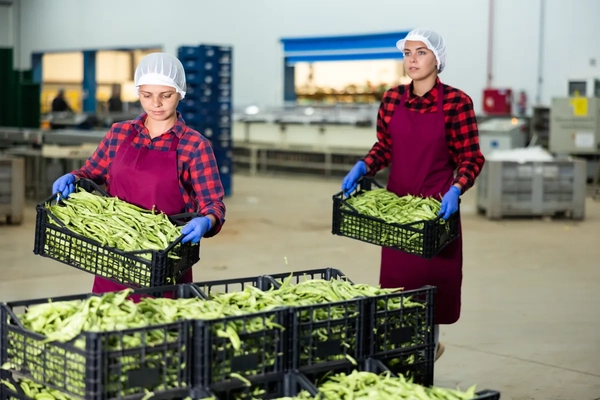
German ingredient specialist Crespel & Deiters is expanding its plant protein capabilities through a new partnership with Finnish food-tech company Happy Plant Protein, bringing a novel dry extrusion process into industrial production for the first time.
Operating from its extrusion facility in Helmond, the Netherlands, the company is now producing textured vegetable proteins from European-grown legumes, such as peas and fava beans, using a patented one-step process designed to improve efficiency while preserving ingredient functionality.
Happy Plant Protein’s patented dry extrusion technology offers an alternative to conventional air classification by separating flour into protein and starch fractions in a single processing step, while giving the protein the functional properties needed for food applications.
The process eliminates the need for protein isolates, chemicals, and water-intensive processing.

The partnership forms part of Crespel & Deiters’ broader strategy to diversify beyond its traditional wheat expertise and strengthen its portfolio of functional plant-based ingredients.
By combining its long-standing extrusion know-how with Happy Plant Protein’s technology, the company aims to provide food manufacturers with neutral-tasting, regionally sourced protein ingredients tailored for applications ranging from meat alternatives and hybrid products to ready meals and snacks.
As demand grows for clean label, locally sourced plant proteins, ingredient manufacturers are increasingly looking for technologies that can improve sustainability while delivering the performance food producers expect.
Against this backdrop, the partnership highlights how innovation in ingredient processing is helping shape the next generation of plant-based foods. We speak with Christopher Busch, head of R&D at Crespel & Deiters, about the technology behind the collaboration and what it means for the future of plant protein production.
This is the first industrial-scale deployment of Happy Plant Protein’s dry extrusion technology. What were the biggest challenges in scaling it up?
Busch: Anyone familiar with extrusion knows that scaling up is always a challenge. However, Happy Plant Protein conducted extensive preliminary trials, which convinced us that successful scale-up would be achievable. The technology had already proven itself at pilot scale, so we knew the time was right for a new approach to the separation and refinement of legume flours. Helmond has been our home for food extrusion since 1998, with modern production lines and a technical center with a lab-scale extruder. That combination allowed us to take the process from pilot scale to full production on familiar ground.
The technology combines fractionation and functionalization in a single step. How does that translate into measurable advantages for food manufacturers?
Busch: The standard industrial process for separation and refinement is air classification, followed by further processing such as extrusion. Our technology combines these two process steps into one, which means no protein isolates, no chemical processing aids, and no water-intensive steps. And because the raw material components are fully preserved, more of the input crop ends up as a usable ingredient. This means significant advantages for our customers in terms of cost efficiency and carbon footprint.
The company highlights neutral-tasting textured proteins without the typical “beany” off-notes. What is technically different about this process that enables that result?
Busch: The way proteins and other fractions are separated has a major impact on taste. We use processing conditions that minimize the extraction of bitter or “green” tasting compounds and reduce the formation of off-flavors. This results in highly functional ingredients that are cleaner in flavor before texturization even starts. This process is unique due to the interplay between raw material and our specialized extrusion technology.
Crespel & Deiters describes itself as evolving from a wheat specialist to a broader “refiner of raw materials.” How significant is this shift strategically?
Busch: Crespel & Deiters grew historically out of wheat processing. Wheat starch was the foundation on which everything was built. Proteins came later, with extrusion production at our site in Helmond, the Netherlands, a relatively new but decisive step. In recent years, we have proactively developed our portfolio and, today, we process a broad range of raw materials: pea protein, faba bean, rice, corn, and wheat.
What sets us apart is not the raw material portfolio itself, but the depth of functional refinement. That means we deliberately modify structures in order to achieve precise, neutral-sensory properties in the desired application: texture, water-binding capacity, and bite firmness. In general, we see a steadily growing demand in the future for all renewable plant-based raw materials, provided they offer functional improvements and can serve as equivalent or better substitutes for animal proteins.
As demand for plant proteins increases, how confident are you in the long-term availability and economics of regional pulse supply compared with imported protein sources?
Busch: Pulses such as fava beans and peas are well-suited to European climates and play an important role in sustainable crop rotations. They improve soil health, contribute to nitrogen fixation, and reduce the need for synthetic fertilizers. This makes them attractive to farmers beyond pure market price considerations, which, in turn, supports stable, long-term cultivation.
Where do you see textured proteins produced through this dry extrusion process fitting within that competitive landscape?
Busch: The two serve different purposes. Concentrates and isolates deliver high-protein purity but require intensive processing, often wet, chemical, or multi-stage, which strips out other components, and can leave off-notes to mask. Our texturates come from a dry, single-step process that preserves the raw material and delivers a ready-to-use textured protein with neutral taste, and defined functionality. For manufacturers who want European-grown, clean label texturates for meat alternatives, hybrids, ready meals, and snacks, without the sensory and processing baggage of isolates, that is a distinct proposition.
What level of customer interest have you seen since introducing the technology, and which application areas are generating the strongest commercial opportunities?
Busch: The texturates are perfect for meat alternatives, hybrid products, ready meals and snacks — all categories seeing growing demand for proteins from European-grown crops.
Since introducing the technology, we’ve seen strong interest throughout the value chain — not only from finished product manufacturers, but also ingredient suppliers and co-manufacturers looking to build new solutions around European-grown pulse proteins.
Do you see the collaboration with Happy Plant Protein as a single technology partnership, or part of a broader strategy to build an ecosystem of novel processing technologies?
Busch: The collaboration with Happy Plant Protein fits into something larger. Our refinement strategy is explicitly about bringing in technologies that complement our existing capabilities in fractionation, extrusion, modification, and protein hydrolysis — and extending our portfolio beyond traditional starch and protein ingredients. This partnership is a clear example of that approach, and we continue to look for technologies that add to what we can do.