



Barry Callebaut eyes recovery with Mondelēz deal and factory overhaul as profits fall

Key takeaways
- Barry Callebaut signed a 15-year Mondelēz cocoa farming agreement, starting in Brazil.
- Investments in Indonesia and Canada accompany proposed US and UK factory closures.
- Full-year earnings declined, although fourth-quarter volumes grew 5.7% year over year.
Barry Callebaut has signed a 15-year cocoa farming agreement with Mondelēz International, starting in Brazil, while approving manufacturing investments in Indonesia and Canada and proposing two plant closures.
The announcements accompany FY2025/26 results showing that the chocolate and cocoa supplier still has ground to recover.
Annual volumes fell 0.7% to 2.11 million metric tons, from 2.13 million a year earlier. Recurring operating profit declined to CHF594 million (US$723.49 million) from CHF703.4 million (US$856.74 million), down 15.6% in reported terms, or 14.1% at constant currency.
“We are entering the year more focused, more disciplined, and better equipped to deliver on our commitments,” says CEO Hein Schumacher.
Building a broader cocoa supply
The Future Farming Initiative agreement targets higher yields, geographic diversification, and a pricing model intended to make cocoa supply more predictable.
Barry Callebaut launched the initiative in 2024, initially including a partnership to develop 5,000 hectares in Bahia, Brazil. Its ambition was to test a scalable farming model and transfer lessons to growers in its existing sourcing countries.
The agreement comes as manufacturers look beyond short-term price movements when planning their cocoa requirements.
In our recent report on cocoa reformulation and supply resilience, Symrise highlighted exposure to crop disease, weather disruption, and concentrated sourcing, while Kerry warned of continuing pressure on cocoa powder.
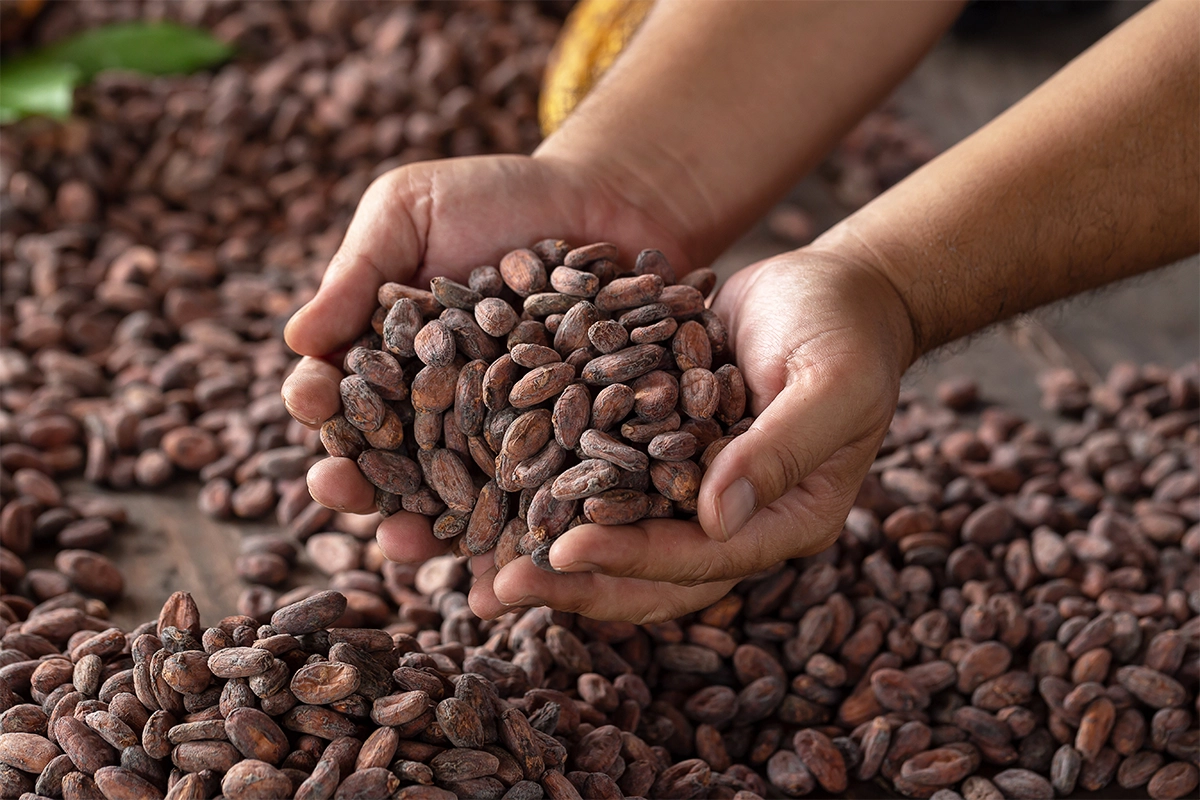 Barry Callebaut is reshaping its cocoa supply chain and manufacturing footprint as it targets a recovery in profitability.“Therefore, we see manufacturers treating cocoa optimization as a long-term resilience strategy rather than a short-term response,” Anna Kosubski, category manager Sweet for EMEA at Symrise, told us.
For Mondelēz, the partnership comes as its chocolate, biscuit, and baked-snack businesses remain central to its growth plans. Its latest quarterly results showed improving snack volumes and lower production costs supporting margins.
Factory investments and proposed closures
The Barry Callebaut board has approved a greenfield site in Karawang, Indonesia, and additional cacao coatings capacity in Brantford, Canada. It meanwhile proposes closing the Hendersonville facility in the US and the Chester beverages plant in the UK during the second quarter of 2027.
The changes sit within a broader effort to reshape the business around specialty solutions and premium products. In its annual report, Barry Callebaut sets out plans to grow these activities while protecting its volume base, with a portfolio spanning cocoa, chocolate, coatings, and non-cocoa solutions.
Its current Hershey agreement expires at the end of 2027, with the future relationship under discussion. Barry Callebaut expects the transition to reduce group sales volumes by approximately 1% in FY2026/27, with a neutral effect on profitability. Hershey accounted for approximately 4% of group volume in FY2025/26.
Hershey is also navigating pressure on chocolate demand. As we reported earlier this week, its North America confectionery sales increased in the third quarter, but higher prices accompanied lower volumes, while salty snacks delivered stronger growth.
Premium products and recovery
Barry Callebaut’s recent Flavourcode launch illustrates its approach to product differentiation. At its Innovation Summit in Belgium, attended by Food Ingredients First, the company presented controlled cocoa fermentation as a way to develop distinctive, repeatable flavor profiles for applications including biscuits, confectionery, and ice cream.
“That creates chocolates with much more depth and intensity, and we can reproduce it consistently and at scale,” Dries Roekaerts, president of Customer Experience at Barry Callebaut, told us at the event.
Full-year results and outlook
For the full fiscal year 2025/26, recurring net profit fell 13% at constant currency compared with FY2024/25, to CHF215.5 million (US$262.48 million). Free cash flow totaled CHF2.01 billion (US$2.45 billion) during FY2025/26.
Full-year revenue declined 17.6% from FY2024/25 to CHF12.2 billion (US$14.86 billion) as cocoa-linked selling prices fell. However, sales volumes in the fourth quarter of FY2025/26 increased 5.7% compared with the same quarter a year earlier.
Looking ahead to FY2026/27, Barry Callebaut forecasts volume growth of 1–3% and recurring operating profit growth of 3–5% at constant currency, both compared with FY2025/26.