



Biospringer by Lesaffre: Cracking plant protein sensory challenges with yeast-based fermentation

Key takeaways
- Plant-based foods face sensory challenges like bitterness, off-notes, and poor mouthfeel, hindering repeat purchases.
- Biospringer by Lesaffre’s yeast-based ingredients help elevate taste and texture in plant-based foods while meeting clean label demands.
- Fermentation-derived solutions are transforming plant-based food innovation by improving overall sensory performance and product consistency.
 The plant-based category is no longer about product availability, as sensory performance is the real barrier to repeat purchase.
The plant-based food category continues to gain traction, but faces sensory roadblocks, namely a lack of depth in taste, undesirable off-notes, and mouthfeel challenges, which can undermine repeat purchases. Biospringer by Lesaffre is responding to these challenges with its yeast-derived fermentation ingredients. These ingredients go beyond flavor masking to build the overall taste and texture of plant-based products, while helping manufacturers align with consumer expectations for clean labels and natural ingredients.
Cracking the plant-based taste code is increasingly critical for manufacturers. Nearly 44% of global consumers say they want improved flavor in plant-based products, according to Innova Market Insights. In the US, consumer adoption of plant-based meat alternatives weakened last year, with a study finding nearly 46% of consumers were not making repeat purchases due to “taste dissatisfaction.”

Yeast‑based ingredients and fermentation‑derived solutions are among the approaches F&B manufacturers are embracing to mask off‑notes, such as bitterness or beany flavors, in plant proteins and enhance umami and savory depth to elevate flavor complexity.
Food Ingredients First speaks with Jatin Sharma, global head of Strategic Marketing at Biospringer, to understand how yeast-derived fermentation solutions are tackling some of the key bottlenecks in the plant-based food sector. He shares insights into how manufacturers can leverage fermentation to meet both consumer taste preferences and the growing demand for clean label products.
What are the key flavor and texture challenges in plant-based foods, and how can yeast-derived solutions help address these sensory issues?
Sharma: The plant-based category is entering a phase where sensory performance defines success. While early adoption was driven by sustainability and curiosity, repeat purchase now depends on whether products deliver a convincing eating experience.
 Jatin Sharma: Traditional texturizers can shape structure, but fermentation adds something more powerful, shaping sensory perception.Three structural challenges remain. First is the taste gap. Many plant-based products lack the depth, evolution, and “cooked” character associated with traditional foods. Second is texture and mouthfeel, as the removal of animal fat often leads to products that feel thin, dry, or lack persistence. Finally, intrinsic off-notes, such as bitterness, astringency, and beany notes from plant proteins, continue to limit formulation potential.
Yeast-derived ingredients, produced via fermentation, offer a fundamentally different approach compared to additive-based corrections. Rather than masking issues at the surface, they act on the flavor and taste-building blocks of food — amino acids, nucleotides, and peptides — contributing to umami, roundness, and taste continuity.
This allows formulators to move from “damage control” to sensory reconstruction — rebuilding depth, enhancing perception of richness, and improving overall balance. Importantly, this approach aligns with clean label expectations, as fermentation is both a natural and well-understood process for consumers.
What are some examples of yeast-based ingredients being used to improve the taste and mouthfeel of plant-based proteins?
Sharma: In application, the biggest challenge emerges when protein levels increase. The higher the protein inclusion, the more pronounced the sensory issues — particularly bitterness, dryness, and lingering off-notes. To address this, formulators are increasingly adopting a layered design strategy. Step one is neutralizing off-notes, involving yeast-derived masking systems that reduce bitterness and metallic notes, creating a cleaner baseline.
Step two is rebuilding flavor. Once the base is balanced, fermentation-derived flavor systems are introduced to restore depth and complexity, moving the profile closer to familiar culinary references. The third step is reinforcing mouthfeel. Mouthfeel enhancers derived from yeast fermentation help improve coating, roundness, and persistence, which are often missing in plant-based matrices.
This approach is already being applied across protein beverages, plant-based meat analogs, and hybrid products, where achieving both nutritional density and sensory acceptance is critical. The key shift is that yeast-based ingredients are no longer used as “fixes,” but as core formulation tools that enable higher-performance products from the start.
How does Biospringer’s yeast extract portfolio support food manufacturers in creating plant-based products that meet both sensory expectations and nutritional requirements?
Sharma: From a manufacturer’s perspective, the challenge is not just sensory — it is multi-dimensional optimization. Products must deliver on taste, nutrition, clean label positioning, and cost efficiency simultaneously. This is where Biospringer’s portfolio is structured as a modular solution set, rather than a collection of standalone ingredients.
 The F&B industry is entering a phase where food is no longer just formulated, but designed at a molecular and sensory level.Springer Signature, Maxarome, Multirome, Springer Reveal, and Gistex are used to design targeted flavor profiles, enabling precise positioning — from savory depth to specific culinary notes, such as chicken, beef, or roasted profiles. Springer Cocoon range addresses a different dimension — mouthfeel and fat perception — which is particularly critical in reduced-fat or plant-based formulations.
Springer Mask range enables formulation flexibility by removing sensory constraints, particularly in high-protein systems. Springer Proteissimo contributes to nutritional value, supporting high-protein positioning while maintaining formulation compatibility.
What differentiates this approach is not the individual components, but how they are used together to unlock formulation space — allowing manufacturers to push protein levels higher, reduce fat or salt, and still maintain consumer-relevant taste and texture. In that sense, the portfolio functions as a toolkit for product design, rather than a set of incremental improvements.
What role do fermentation-derived ingredients play in enhancing the overall eating experience of plant-based foods, and how do they compare to other texture-modifying technologies?
Sharma: Fermentation-derived ingredients operate differently from traditional texture-modifying systems. Conventional technologies, such as hydrocolloids or starches, are effective at delivering structure, viscosity, or stability, but they are largely neutral from a flavor perspective. They solve for “form,” but not for sensory experience. Fermentation, by contrast, enables a more integrated impact — it contributes to flavor generation and enhancement, helps build taste through umami and kokumi effects, and supports mouthfeel through interaction with the overall matrix.
This is particularly important in plant-based systems, where consumer perception is driven by the combination of taste and texture, not one in isolation. For example, enhancing mouthfeel is not just about thickness — it is about how long the flavor lasts, how it evolves, and how it interacts with the palate. Fermentation-derived compounds play a role across all these dimensions.
As a result, they are increasingly seen as complementary to, rather than interchangeable with, traditional texturizers — bringing an added layer of sensory performance.
How does Biospringer manage the balance between creating innovative ingredients for plant-based foods, while ensuring they comply with health and safety regulations?
Sharma: Innovation in food ingredients must operate within a framework of regulatory clarity and consumer trust. At Biospringer, regulatory considerations are integrated early in the development process to ensure that solutions are globally deployable. This includes alignment with labeling standards across key markets and clear positioning within clean label frameworks, supported by fermentation as a recognized and accepted process. It also involves robust documentation and traceability, ensuring transparency throughout the value chain.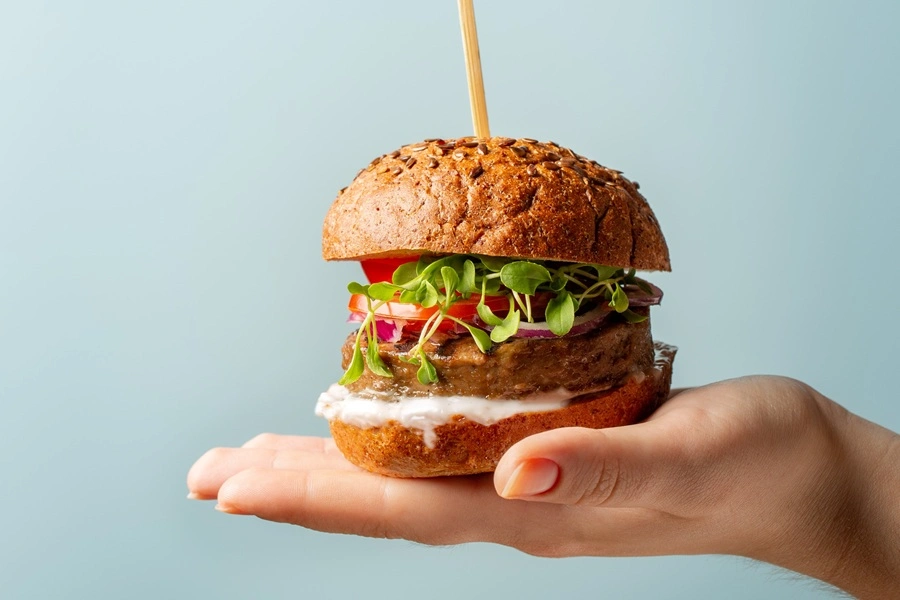 Biospringer views the future of plant-based products as not just mimicking meat, but creating products consumers actively prefer.
An important aspect is also application-level compliance. Different categories — whether beverages, meat alternatives, or dairy alternatives — have different regulatory expectations, and supporting customers in navigating these is critical. As fermentation technologies evolve, maintaining this balance between innovation and compliance becomes even more important. The objective is not just to develop new functionalities, but to ensure they are practically usable in commercial products across regions.
How do you see the evolution of fermentation technology further enhancing the sensory profiles of plant-based products, particularly in terms of taste and texture?
Sharma: Fermentation is moving from a supporting role to a central innovation platform in the food industry. Looking ahead, three developments will shape its impact — precision in flavor and taste creation as advances in fermentation enable more targeted and reproducible flavor profiles, including complex cooked, aged, or region-specific notes.
Secondly, integration of functionalities will drive the industry toward multi-functional ingredient systems that combine taste, texture, and nutrition, reducing formulation complexity while improving performance.
Finally, the expansion of fermentation-derived compounds with new classes of ingredients, such as specific peptides or organic compounds, will further enhance sensory perception, stability, and nutritional value.
For consumers, this will translate into products that are no longer evaluated as “plant-based alternatives,” but simply as high-quality food choices. For the industry, it represents a shift toward designing food at a more fundamental level, using fermentation to unlock capabilities that were previously difficult to achieve.